
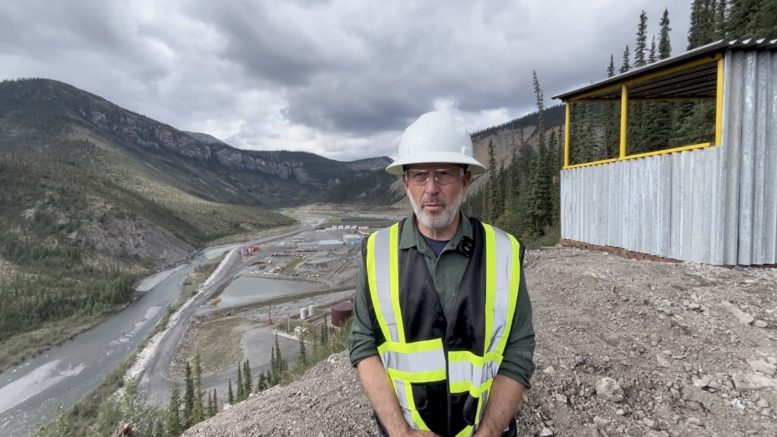
NEAR NAHANNI NATIONAL PARK, N.W.T. – The Prairie Creek site, nestled in a peaceful mountain valley in the Northwest Territories, is the project that won’t die after facing numerous dead-ends, studies and false starts over the past 40 years. But new owner Honey Badger Silver (TSXV: TUF) is working to ensure this time is different.
After acquiring the project for $12 million (US$8.64 million) in April from Denver-based private equity firm Resource Capital Funds (RCF), the Eric Sprott-backed junior miner is the latest in a string of owners that have tried to bring the silver-zinc-lead mine into production since construction was halted in 1982. Prairie Creek is about 550 km southwest of Yellowknife, near the remote Nahanni National Park Reserve.
“When you look at this mine, you go ‘there’s a lot of broken dreams here.’ A lot of people have spent a lot of time and effort and energy,” Honey Badger CEO Chad Williams told The Northern Miner during a site visit this week. “This time…the silver price has never been this high, there’s never been a focus on critical metals like there is today.”
Watch a video of the site visit
If Williams is right, Prairie Creek might not only help fill some of the economic hole opened by the territory’s closing diamond mines, but it could also help meet rising demand for critical metals required for the green energy transition.
Vintage, not obsolete
Even without knowing the historical details of the Prairie Creek project, its age is suggested by the vintage yellow school bus used to transport visitors from the air strip to the camp and the lightly rusted machinery inside the cavernous mill. But the mill has a capacity of 1,000 tonnes per day (tpd) and is permitted for up to 2,400 tpd.
“When we bought the mine, I had no idea that the mill was in such great shape,” Williams said.
“I thought we were inheriting something that we’d have to scrap and start from scratch. There were quality people that spent a lot of money doing things properly, and then smart people that cared deeply about this mine and preserved it.”
Fits and starts
The deposit at Prairie Creek was originally discovered in the 1920s and drilling and underground development occurred throughout the 1960s and 1970s. The main mine infrastructure was built in the early 1980s by Cadillac Explorations, financed by Nelson Bunker Hunt and Herbert William Hunt, best known as the billionaire silver bull “Hunt brothers.”
But when the silver price collapsed, the Hunts’ activities faced a U.S. government investigation and they pulled the plug on Prairie Creek in 1982, just three weeks before it was set to enter production.
After Cadillac, San Andreas Resources, later renamed Canadian Zinc and then NorZinc acquired Prairie Creek for $3.2 million in 1993. The NorZinc logo remains above two mine portals that lead to about 5 km of underground development.
As the project changed hands, its plodding progression was characterized by the long 19 years it took to acquire an environmental approval for Prairie Creek, which NorZinc secured in 2011.
Then RCF took NorZinc private in 2022 for $13.5 million.
Now, Eric Sprott holds a 7.8% stake in Honey Badger.
Company shares were down 4% to 83¢ apiece on Friday morning in Toronto, for a market capitalization of $131.9 million. The stock has traded in a 12-month range of 13¢ to $1.19.
Unusual development sequence
Four months after buying Prairie Creek, Honey Badger is keeping busy. It’s targeting an updated preliminary economic assessment (PEA) for Prairie Creek in the third quarter and a feasibility study after that, a surprising move for a project that has at least four economic studies going back more than a decade.
“We debated about doing the study at all because there’s a lot of infrastructure there and it was an [issue] of let’s just go into production and rely on previous economic studies,” Williams said. “But the board felt that we needed to freshen it up with 2026 numbers.”
The underground Prairie Creek mine could produce 2.55 million oz. silver, 122 million lb. zinc and 101 million lb. lead in annual output over a 20-year life, according to the 2021 PEA. Discounted at 8%, the post-tax net present value is pegged at about US$300 million, at initial costs of US$368 million. The after-tax internal rate of return is forecast at 18%, with a 4.8-year payback period.
It hosts 9.8 million measured and indicated tonnes grading 139 grams silver per tonne, 9.7% zinc, and 8.8% lead and 6.4 million inferred tonnes at 150 grams silver, 12.9% zinc and 6.7% lead. Metal prices in the PEA were set at US$20 per oz. silver, US$1.15 per lb. zinc and US$1.00 per lb lead.
While Fireweed Metals’ (TSXV: FWZ) Macpass project in neighbouring Yukon has a much larger zinc resource, Prairie Creek’s zinc grades are more than double Macpass’ 5.5% zinc.
Williams admits Honey Badger’s economic study progression is “very odd.”
“I’ve never seen this in my career,” he said. “We’re doing two tracks – restarting it, refurbishing it while we’re doing these independent economic studies. No matter if we’re producing and generating revenue, banks and long-term financial partners need a feasibility study.”
First production 2027
Honey Badger is targeting first production at Prairie Creek next summer to demonstrate that zinc and lead concentrate can be produced by the mill.
The company plans to drill about 3,000 metres underground in the near term, Williams said. The last time the project was drilled was in 2022, which was mostly surface drilling.
After the PEA, a future estimate will include a resource for germanium, a critical metal essential in fibre optics, semiconductors and defence applications. Historical assays at the project returned results of up to 316 parts per million germanium.
The quoted germanium price of about US$8,000 per kg is understated, Williams said.
“We have heard anecdotally from highly credible sources that the true market price for germanium today is multiples of that,” he said. “It will continue to get lots of attention from the Canadian and the U.S. government.”
There are no commercial germanium mines in Canada, though Teck Resources (TSX: TECK.A, TECK.B; NYSE: TECK) recovers the metal as a by-product of zinc processing at its Trail plant in British Columbia.
Road to success?
But for all its promise, Prairie Creek currently lacks all-season road access. Previous operators relied on a winter road to bring in supplies. Construction of the 170-km all-season route could begin next spring, assisted by $25 million from the National Trade Corridors Fund, with the potential support from regional First Nations, Williams said.
“Another thing that’s changed for us” is Indigenous support, he said.
Prairie Creek sits in the region of the Nahanni Butte Dene Band and the Liidlii Kue First Nation, with whom Honey Badger has impact benefit agreements. It also has a transportation corridor agreement with the Acho Dene Koe First Nation.
“They’re more supportive of this project than they’ve ever been,” Williams said. “We’re dealing with smart, business-oriented individuals who are amply qualified to provide services to us, including trucking and so on. It’s a meeting of many positive vectors that give us the best chance for this project to go into production ever.”




Be the first to comment on "Site visit: Can Honey Badger finally crack Prairie Creek?"