
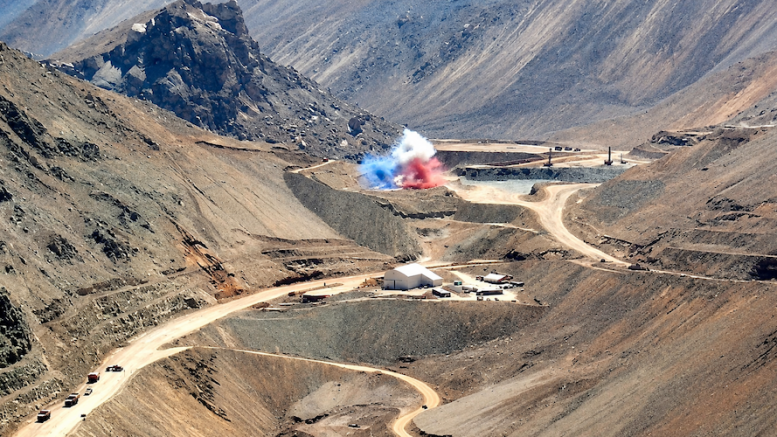
A snow avalanche that killed two subcontractor workers at Codelco’s El Teniente mine on Sunday has added to mounting supply concerns in Chile, as extreme weather, labour disputes and operational setbacks threaten output across the world’s largest copper producer.
The workers were inspecting the mine’s open-pit area, where operations had already stopped because of bad weather, the state-owned company said in a statement Sunday. Authorities are investigating the circumstances of the accident.
Located in the Andes Mountains about 75 km southeast of Santiago, El Teniente is the world’s largest underground copper mine.
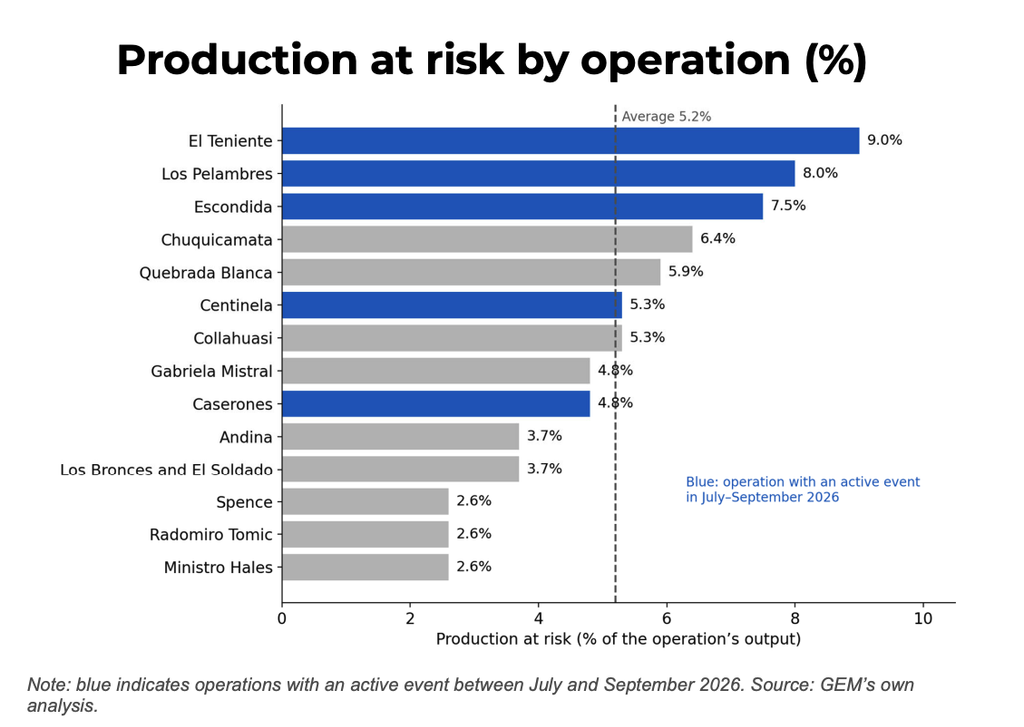
The incident follows a series of disruptions across Chile. A recent study by GEM Mining Consulting estimated that an average 5.2% of annual production at the operations it assessed was exposed to operational risks.
Growing production risks
GEM’s risk study, dated September, assessed 14 major copper operations across eight categories, including labour disputes, weather, water availability, geological conditions and safety.
El Teniente ranked as the most exposed at 9%, followed by Los Pelambres at 8% and Escondida at 7.5%. Nine operations had at least one risk classified as high.
The 5.2% figure is a simple average of the operation-level scores, rather than a production-weighted estimate for Chile. The index assigns standard assumed losses to low, medium and high risk ratings based on public information from 2025 and 2026.
Severe storms have already disrupted Los Pelambres and Caserones, contributing to lower production forecasts.
Further weather risks loom. El Niño continues to strengthen, with a greater than 83% chance of strong to very strong conditions lasting through January to March 2027, the U.S. Climate Prediction Center said in its October outlook. The agency cautioned that associated weather effects aren’t guaranteed.
Operational pressures
El Teniente has also faced problems beneath the surface. Codelco suspended development of its Andes Norte section because of deep seismic risks, adding to production setbacks at the company.
Labour unrest is adding another layer of uncertainty. Antofagasta’s (LSE: ANTO) Centinela copper mine and two striking unions were scheduled to resume negotiations Tuesday under voluntary mediation.
The strike began Oct. 7 and involves 709 employees, or 22% of Centinela’s direct workforce. The mine produced 240,400 tonnes of copper last year.
Antofagasta said when the strike began that its projected production remained unchanged, despite operational disruptions.
Meanwhile, supervisors at BHP’s (ASX, LSE, NYSE: BHP) Escondida, the world’s largest copper mine, have been in government-mediated negotiations aimed at averting a strike. A fatal accident temporarily halted operations in September.
Market expectations
Despite the growing list of disruptions, investment bank Panmure Liberum questioned how much of copper’s price strength can be explained by mine production losses.
Reported disruptions in 2025-26, including those at Indonesia’s Grasberg mine and Kamoa-Kakula in the Democratic Republic of Congo, amount to an estimated 350,000 to 400,000 tonnes of contained copper annually, according to the bank’s assessment cited by Reuters.
That represents 30% to 50% of published disruption allowances, the estimated losses analysts build into production forecasts to account for unplanned events.
Panmure Liberum consequently suggested that speculative and financial activity was probably the dominant driver of copper prices.
Be the first to comment on "Avalanche adds to Chile’s copper supply pressures"