
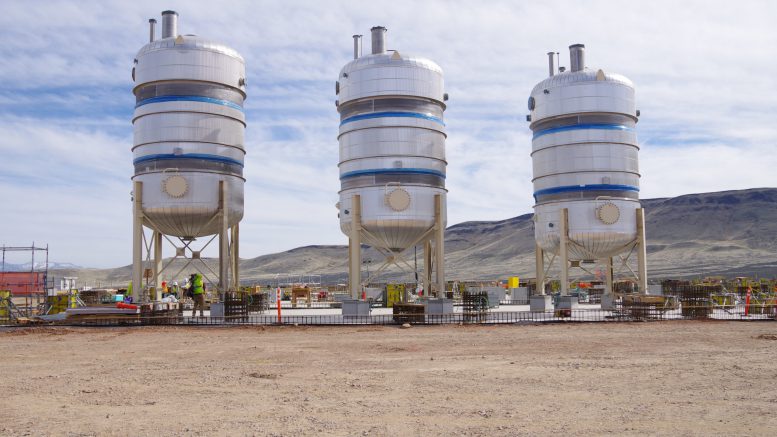
Albemarle’s (NYSE: ALB) Silver Peak mine in Nevada – the only active lithium resource in the United States – could soon have company.
As many as nine new lithium mines could start producing in the U.S. between now and the end of 2030, London-based market research and business intelligence firm CRU says. The group includes Lithium Americas’ (TSX, NYSE: LAC) Thacker Pass project in Nevada, which is poised to become one the Western Hemisphere’s largest lithium sources, and a Standard Lithium (TSXV: SLI; NYSE-A: SLI) project in Arkansas.
The upcoming building boom won’t quite manage to turn the U.S. into a global lithium powerhouse – but it’s a start. By 2030, CRU expects up to 95,000 tonnes of lithium carbonate equivalent (LCE) to be produced annually in the U.S., or less than 4% of primary global supply – assuming all existing projects pan out.
On an adjusted basis, which factors in the probability that some projects will be delayed, CRU’s forecast calls for U.S. output of 55,000 tonnes by 2030, or 2% of global supply. That’s up from projected output of 5,000 tonnes this year, or 0.3% of world production.
Global lithium supply is highly concentrated. The top three producing countries – Australia, China, and Chile – make up 77% of mined lithium output, according to a June report by investment research firm Alpine Macro. China alone accounts for nearly 70% of global refining capacity.
“Realistically, the United States is never going to take much market share away from somebody like China that dominates the lithium market and the whole battery value chain,” Cameron Hughes, a lithium market analyst at CRU, told The Northern Miner in an interview.
“The target for the U.S. is to become more self-reliant and build out their own battery supply chain. The lithium is there, and they will produce enough lithium to service their own demand.”
Price recovery
The U.S. lithium push come as prices for the commodity gradually recover from a two-year slump amid rising demand from the electric vehicle and energy storage sectors. Western governments, eager to loosen China’s control of electric-battery supply chains, have been offering grants and price support to bolster mine construction.
First out of the gate should be Thacker Pass, which sits near the Oregon border, roughly 835 km north-northwest of Las Vegas. Its initial stage, which is still scheduled for “mechanical completion” late next year, is designed to produce up to 40,000 tonnes of battery-quality lithium carbonate annually.
Thacker Pass is on track for “energization” in this year’s fourth quarter, CEO Jonathan Evans said Aug. 13. Detailed engineering design surpassed 95% completion as of June 30, while procurement exceeded 80%, including the shipment of major plant materials and equipment, Lithium Americas said.
The project has drawn strategic backing from General Motors (NYSE: GM), Orion Resource Partners and the U.S. government, underscoring the Trump administration’s drive to erode China’s dominance in critical metals.
US backing
Financing for the project’s first stage includes a $2.23-billion loan from the U.S. Department of Energy. Yorkville Advisors Global – a New Jersey-based investment firm that has financed several media ventures of U.S. President Donald Trump – is another backer, having agreed in August to buy at least $150 million of Lithium Americas debentures.
Thacker Pass’ first stage forecast is still budgeted to cost $1.3 billion to $1.6 billion this year, Lithium Americas said last month. Given the advanced level of detailed engineering achieved, Lithium Americas said it has started putting together a definitive capital estimate that should be completed by Sept. 30.
U.S. steel tariffs and the Iran war will add $80 million to $120 million to this year’s construction expense for Thacker Pass, Lithium Americas said in May.
Tariffs haven’t yet been included in the company’s total $2.93-billion capex estimate for Thacker Pass.
Thacker Pass “is the most promising project,” said CRU’s Hughes. “It’s high capex, which is an issue that is always going to be the case in North America. But it’s moving along and it’s definitely one that we expect to come online first.”
Hell’s Kitchen
In Southern California, privately held Controlled Thermal Resources (CTR) is developing the Hell’s Kitchen project, which will convert geothermal brine into steam to generate electrical energy.
Located about 200 km east of San Diego, Hell’s Kitchen is expected to produce 50 megawatts of power by 2028 and 25,000 tonnes of lithium annually by 2029. At full scale, it could produce up to 100,000 tonnes of lithium a year, CTR says. CTR already has lithium supply deals with General Motors and Stellantis.
Hell’s Kitchen was added to a fast-track permitting list by the Trump administration last year when it was designated as a FAST-41 Covered Project.
CTR agreed in March to merge with special purpose acquisition company Plum Acquisition in a deal that values Controlled Thermal Resources at about $4.7 billion. CTR will go public on Nasdaq upon closing, which is expected by year-end.
Legal proceedings
Ioneer’s (ASX: INR) proposed Rhyolite Ridge mine in Nevada is another key source of future supply, though its timing is much less clear.
Rhyolite Ridge hosts the continent’s only known lithium-boron reserve and is one of only two such deposits globally, according to the Australian company.
Ioneer says it will work on making a final investment decision in the next few months, after which construction would take about 36 months.
Legal proceedings have added to the uncertainty surrounding the project. Three non-governmental organizations are contesting a 2024 decision by the Bureau of Land Management (BLM) that authorized the company’s plan of operations for Rhyolite Ridge and completed the National Environmental Policy Act process.
Ioneer is actively participating in an appeal of a U.S. District Court’s decision upholding BLM’s approval of the project. Although the timing of the process is outside of Ioneer’s control, it expects a decision in mid-2027. The appeal isn’t expected to delay the start of construction, according to the company.
Korean support
In June, Ioneer secured support from two South Korean engineering and infrastructure groups for the project. One of the two, Korea Overseas Infrastructure & Urban Development, is considering making an equity investment in the project, Ioneer said July 8.
Ioneer has been working on Rhyolite Ridge since 2016, having initially brought in Sibanye-Stillwater (JSE: SSW; NYSE: SBSW) as a partner in 2019. The South African miner walked away in February 2025 from a proposed $490-million investment for a 50% stake in the project.
An October 2025 feasibility study for Rhyolite Ridge calculated an after-tax unlevered net present value of about $2.24 billion, an internal rate of return of 18% and a seven-year payback period.
Lithium carbonate equivalent (LCE) production at Rhyolite Ridge is now estimated to be 24,500 tonnes for the first 25 years of operations. Boric acid production would average 135,500 tonnes a year.
DLE prospects
Oil-rich states further east could also see lithium mines sprouting up.
Through their Smackover Lithium joint venture, Standard Lithium and Norway state oil company Equinor (NYSE: EQNR) are pursuing several projects in Arkansas and Texas.
High on the list is their South West Arkansas (SWA) project, which would be one of the first large commercial applications of direct lithium extraction (DLE) in the U.S.
SWA remains on track for a final investment decision and a start of construction this year, CEO David Park said Aug. 10. First commercial production of battery-quality lithium carbonate is targeted for 2029.
Two key objectives, securing customer offtakes and completing the project financing process, remain for Smackover. “Advanced” discussions are under way with several prospective customers, with a goal of concluding all remaining offtake agreements by the end of the third quarter, Standard Lithium said last month.
SWA, which is based on lithium-bearing brines in Arkansas’ Smackover Formation, has a reported reserve of about 447,000 tonnes LCE. The current plan calls for 22,500 tonnes per year of battery-quality lithium carbonate.
Oil majors
Up to 19 million tonnes of lithium could be present in the brines of the Smackover Formation, according to a December 2024 report from the U.S. Geological Service. That has attracted majors oil producers such as Exxon Mobil, Occidental Petroleum and Chevron to the area.
Privately-held T5 Smackover Partners, meanwhile, is developing an integrated geothermal energy and DLE “platform” in the region.
In June, it signed a five-year offtake deal with Glencore (LSE: GLEN) that will see the Swiss commodities giant market all lithium carbonate to be produced at T5’s East Texas operations, or about 5,000 tonnes a year. Deliveries are expected to begin once commercial production is underway – though T5 hasn’t disclosed when that will be.
“Outside of Nevada, the next most promising region is probably the southwest with Arkansas and Texas,” CRU’s Hughes said.
Carolina dreaming
Other non-traditional lithium hubs could also be about to emerge.
Albemarle is seeking permitting approval to resume open pit mining and expand the past-producing Kings Mountain mine in North Carolina, which sits on one of the country’s few known hard-rock lithium deposits.
Kings Mountain operated from 1937 until it was idled in the 1990s to focus on cheaper brine deposits in Chile.
The site is expected to feed sufficient material for 50,000 tonnes of lithium carbonate equivalent (LCE) of conversion capacity, Albemarle says on its website. It hasn’t published a resource for the property.
Be the first to comment on "SW US: New US lithium mines are coming "