
In the last two years, Northern Shield Resources (TSXV: NRN) has made two discoveries in the Labrador Trough, 100 km north of Schefferville, Quebec. The first, Huckleberry, was staked in June 2014. Northern Shield made the discovery there in late 2015, when assays from a gossanous outcrop returned intercepts grading 1.3% copper and 0.54 platinum-palladium per tonne. Its second discovery, Séquoi, lies 10 km east of Huckleberry and is being explored for Norilsk-style nickel-copper-platinum group metal (PGM) massive sulphides. Northern Shield’s president and CEO Ian Bliss spoke to The Northern Miner about the company’s plans for Huckleberry and Séquoi.
The Northern Miner: We last interviewed you in June, after Northern Shield signed an option agreement with South32 (LSE: S32) to earn a 70% interest in the Huckleberry project by spending $5 million on exploration over three years. How did that deal come about, and how long did it take to negotiate?
Ian Bliss: I had met them a year or two earlier regarding another project, but as soon as the doors opened at the Prospectors & Developers Association of Canada convention earlier this year their geologist came up to our booth and said, ‘Let’s talk about the discovery at Huckleberry.’ We were also in conversations at that time with other smaller companies. I wrongly assumed that big companies move slowly, but South32 proved otherwise. They went through the data and due diligence quickly, and within a few weeks had verbally agreed to the terms in principle. We didn’t sign the deal until June, because they had to wait until the snow melted to do their final due diligence.
TNM: South32 is based in Australia. How familiar is the company with Canada’s Labrador Trough?
IB: I do not believe they have “boots on the ground experience” with the Labrador Trough, but it’s broadly equivalent to the Fraser zone in Western Australia, which has had recent success with a nickel-copper discovery by an Aussie company called Sirius Resources, now called S2 [not to be confused with South32]. Their initial discovery was in 2014, and they drilled off a 15-million-tonne resource, and were bought out last year for US$1.5 billion. Canadians may not know the Fraser zone or Sirius, but it might help explain why South32 likes our Huckleberry project. The Fraser zone is a higher metamorphic grade, but it’s broadly similar to the Labrador Trough and other craton margins in Canada that have nickel deposits, like Raglan and the Thompson nickel belt.
TNM: Is Séquoi part of the option agreement with South32?
IB: No, it is not. Séquoi is 100% owned by Northern Shield, though South32 has a first right of refusal if we wanted to sell or option the project.
TNM: How would you describe the differences between Huckleberry and Séquoi? They are just 10 km apart.
IB: They’re two distinct properties, but it is possible they are part of the same magmatic system. The geology and geophysics is somewhat complex at Huckleberry. We have no outcrop at Séquoi, so we don’t know if the geology is complex … but the geophysics appears fairly straightforward: discrete, with strong coincident magnetic and electromagnetic (EM) anomalies. If these are nickel- and copper-bearing, this could be a world-class discovery, even a multiple of a Voisey’s Bay. It’s been awhile since Canada has seen a discovery like that in nickel, and maybe this is the shot in the arm the junior industry needs right now.
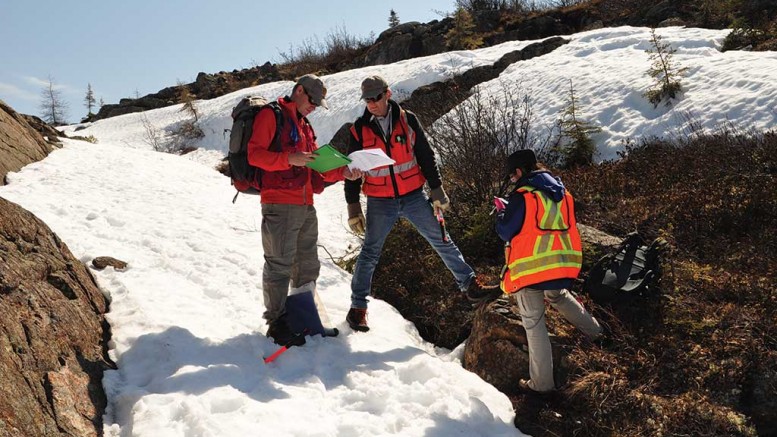
 South32 geologist Renato Bobis and Mirek Wozga exploring the Huckleberry project in the Labrador Trough, 100 km north of Schefferville, Quebec. Credit: Northern Shield Resources.
TNM: Tell us more about Séquoi and about your drill program.
IB: The name is actually a play on words. It means “What’s this?” in French, and refers to the unusual magnetic anomaly that underlies the property.
The plan is for a 1,000-metre drill program — about six holes, fairly shallow — to test several compelling geophysical targets we have there. Séquoi is a blind target. We have no outcrop whatsoever, but we think we could be dealing with a giant ore system. The geophysics — both magnetic and electromagnetic — and extensive nickel and copper anomalies in lake-bottom sediment samples are painting a compelling picture of what could be a large nickel-copper-PGM camp.
TNM: What information do you have that suggests Séquoi may host a world-class nickel-copper deposit?
IB: There is a vast and intense dispersion train of lake-bottom sediment samples that are highly anomalous in nickel-copper-PGMs. One of our geologists had reinterpreted ice movement in that area to be southward, not northward, as indicated on the maps. This would suggest the source is at the north end of the dispersion, not the south end.
Filtering data through various mathematical formulas kept pointing to the Séquoi area. We consulted the regional magnetic map and saw the large and unusual Séquoi magnetic anomaly sitting at the head of the nickel-copper dispersion. It was a eureka moment. We interpreted the magnetic anomaly to represent a large ultramafic intrusion and perhaps a feeder to the mafic-ultramafic sills of the Labrador.
Northern Shield completed an airborne versatile time domain electromagnetic survey of the property earlier this year, and the results could not have been much better. We saw strong and large EM conductors where our model suggested.
TNM: Can you talk a little more about the regional context of Séquoi and Huckleberry?
IB: The Labrador Trough includes 10,000 sq. km of mafic-ultramafic intrusive sills. To form a nickel or PGM deposit these elements must first be “scavenged” from a mafic-ultramafic magma. We see that many of the mafic sills in the Labrador Trough have had nickel and PGMs removed. Now we just have to find where it has been concentrated — perhaps at Huckleberry and Séquoi.
TNM: Can you tell us more about how you discovered the two projects?
IB: Both of them were brand-new discoveries. Huckleberry is an interesting story. Our background work in the Labrador Trough had highlighted that the southern area of the Labrador Trough was more highly prospective than other parts of the Labrador Trough. Our chief geologist, Christine Vaillancourt, was undertaking reconnaissance in the area in a helicopter and flew over what looked like a rust zone on the side of a ridge. She thought it was obvious someone must have sampled it already. But because of bad weather, the helicopter had to land, so she ended up taking a few samples.
We later found that no one had ever staked it before, and there were no references to it in any database or in the literature. It was a brand-new discovery in 2014.
The more we eventually learned about the geology at Huckleberry, the more we liked it. Without giving away our secrets, the mineralogy and textures of the rocks at Huckleberry caught our attention. Northern Shield has collected over 3,000 rock samples of the mafic and ultramafic sills in the Labrador Trough, including those from the surrounding area. Huckleberry is clearly different and prospective.
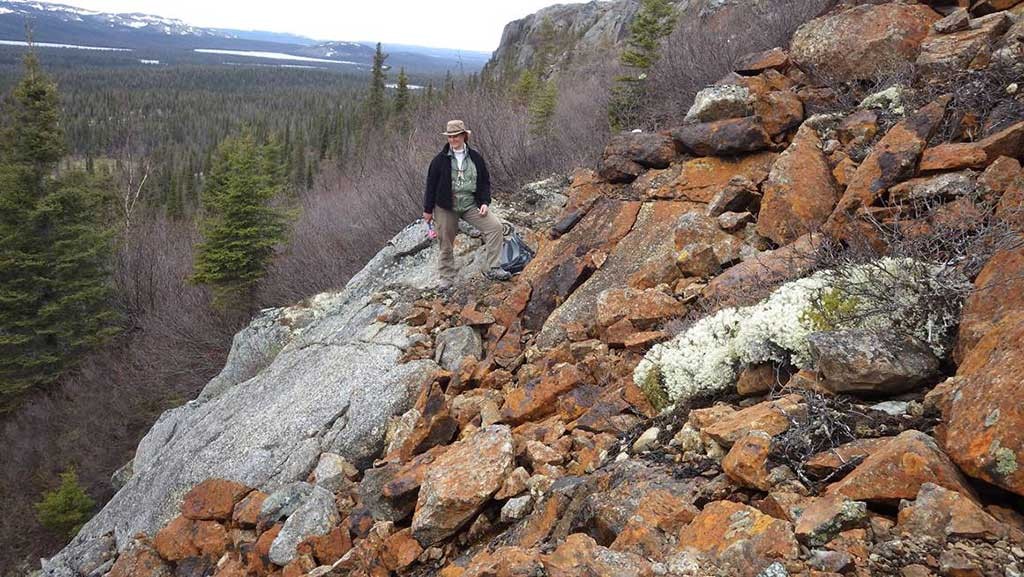
Northern Shield chief geologist Christine Vaillancourt at the Discovery Zone at the Huckleberry project. Credit: Northern Shield Resources.
TNM: What about Séquoi?
IB: We had been building up information on the Séquoi area for some time. We really liked the concept, but didn’t have money to stake the claims until earlier this year, so we had to keep it quiet for nine months.
We pieced all the information together last year when we were looking at various government datasets … namely lake-bottom sediment samples from the Quebec government and airborne magnetics.
With our understanding of the magmatic events of the Labrador Trough and our knowledge that something special was happening at Huckleberry, we began to build a model for Séquoi, based on the Norilsk-Talnakh deposit.
TNM: You don’t deny that Séquoi is a conceptual target since there is no outcrop, correct?
IB: That’s right. But combining the scientific data (EM, magnetics and lake-bottom sediment samples) with our knowledge of the region, the dial points to a nickel-copper-PGM magmatic system, and potentially a very large one at that.
Most of these large deposits have been found half a century ago, or often by luck, but this is one of the few times that combined geoscience and thinking outside the box provides a hint at what could be hiding at Séquoi.
TNM: In early November you released results from seven drill holes at Huckleberry totalling 2,053 metres and all but one of the drill holes intersected disseminated magmatic copper-nickel-PGM mineralization, with 29 samples assaying greater than 0.3% copper in association with nickel and PGMs. What did you think when you got those results?
IB: The results we just released for Huckleberry were not quite what the markets were looking for. Of course we would have liked to have seen slightly higher grades, but these are scout holes in a complex intrusion, and some of these holes were designed to build up knowledge in different parts of the intrusion.
We intersected the mineralized unit in the western zone in all but one hole, and we see encouraging features in the drill core.
TNM: Can you be more specific about what you think are the encouraging features?
IB: We see geochemical ratios and mineralization styles that tell us we’re getting close to the feeder to the mineralization. We’ll sit down with our partners at South32 early in the new year to discuss the next exploration phase, but we plan to be back drilling at Huckleberry next year to follow up on what we have seen and learned from the first phase of drilling. We may also complete some ground geophysics to help us, but we see enough already for a larger drill program next year.
A very large nickel-copper-PGE camp within this part of the Labrador Trough would be exciting. Hopefully the rocks prove Northern Shield right in their upcoming drill program at Sequoi!