
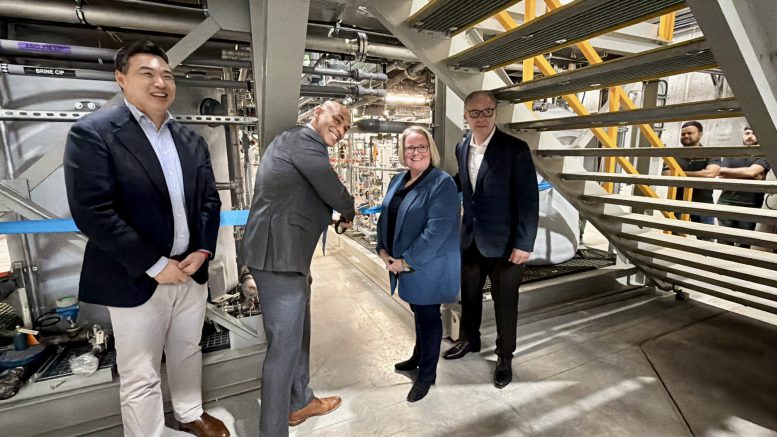
Privately held Mangrove Lithium on Thursday opened North America’s first commercial electrochemical lithium refinery, adding a missing piece to Canada’s battery supply chain.
The facility in Delta, about 30 km south of downtown Vancouver, can produce 1,000 tonnes per year of battery-grade lithium hydroxide. That’s enough for about 25,000 electric vehicles.
“What this facility and our next plant would allow us to do would be enabling a lithium mine to lithium chemical supply chain,” CEO Saad Dara told The Northern Miner. “The bigger prize is tying Canadian feedstock to Canadian battery chemicals, and eventually to battery material plants, cell makers and car assembly.”
Mangrove will perform refining, the step between mining and battery material plants that Canada still largely lacks. Lithium refining today remains tightly concentrated, with International Energy Agency data showing the top three countries controlling 96% of lithium refining in 2023. Chinese companies held more than two-thirds of global lithium processing capacity in 2022, according to the U.S. Energy Information Administration.
Mind the gap
The Delta plant does not complete the battery supply chain in Canada. It fills the refining gap and, together with Mangrove’s next plant, would help create a mine-to-lithium chemical chain, Dara said. Active materials making, battery manufacturing and electric vehicle (EV) assembly are still lacking in Canada.
“The battery supply chain has six main segments: mining, refining and processing, cathode manufacturing or active materials manufacturing, battery assembly, EV assembly and then battery recycling,” Dara said. “Critically, Canada today misses refining capacity, so most of our mineral resources get shipped out for processing elsewhere.”
The opening carries political weight as Ottawa and Victoria push to keep more battery value at home. “Today, we are not simply opening a facility,” Canada’s Minister of Veterans Affairs and local Delta MP, Jill McKnight, said at the ceremony. “We are signalling a clear new direction for Canada.”
In a video message recorded in Victoria, Premier David Eby called the plant “a critical step” toward a resilient battery supply chain in British Columbia. “The Delta refinery shows the future we’re building for this province,” Eby said.
Watch a video of the ribbon-cutting ceremony:
Cost-competitive
Mangrove can compete with low-cost refineries elsewhere by swapping chemical inputs and waste handling for electricity cost, Ryan Day, Mangrove’s senior director of operations, explained during a plant tour. The process uses fewer chemicals, produces less waste and can handle feed from brines, hard rock, clays, geothermal direct lithium extraction and battery recycling. The technology offers lower carbon intensity and reduced waste compared with conventional refining.
The chemistry is straightforward, according to Day. Conventional plants turn lithium sulfate into lithium hydroxide by adding sodium hydroxide, which leaves a sodium sulfate waste stream. Mangrove instead runs lithium sulfate brine through an electrolyzer, pulls the lithium across a membrane and turns the sulfate back into sulfuric acid for reuse at the front end. Day said that leaves no sodium sulfate waste and only small water losses.
That design lets Mangrove accept more than one kind of upstream source. Direct lithium extraction is not a rival process but a feed option, Day says: it can pull lithium from brines into a concentrate, but that material still has to be converted into battery-grade hydroxide or carbonate, which is where Mangrove fits.
Watch a video of Day explaining the lithium refining process in detail:
Investment
The Delta plant is a stepping stone to a much bigger refinery being planned in Eastern Canada.
Its opening comes three months after the Canada Growth Fund backed a financing package of up to $116 million (US$85 million) with tech incubators BMW i Ventures and Breakthrough Energy Ventures, and after Ottawa last month conditionally approved up to $21.9 million for engineering work on a 20,000-tonne-a-year Quebec refinery planned as Mangrove’s next plant, enough for about 500,000 EVs.
Mangrove has already signed a non-binding memorandum of understanding with Elevra Lithium (ASX: ELV) to source spodumene concentrate from the North American Lithium mine in Quebec.


Be the first to comment on "Mangrove opens Delta refinery to close lithium gap"