
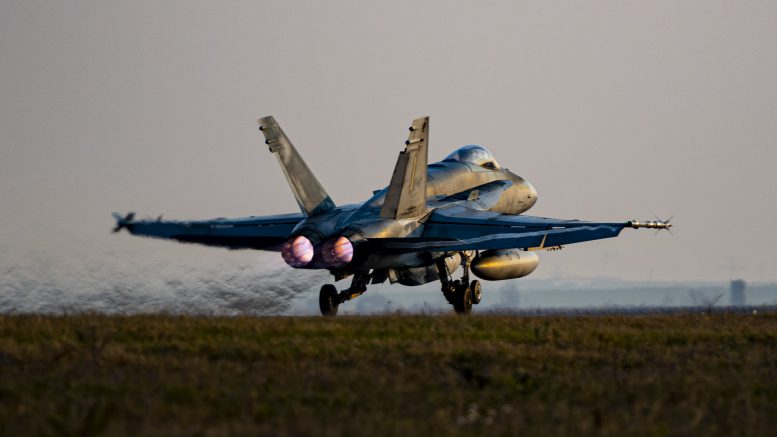
The war with Iran has pushed antimony further out of the shadows, highlighting the metal’s modern use in explosive formulations, flares and infrared sensors. The United States Geological Survey says 40% of U.S. antimony use last year went into antimonial lead and ammunition.
Canada already classifies antimony as critical but still lacks, miners say, a specific policy built to move the defence metal’s production from exploration to funding, permitting and processing.
“Canada, in my mind, is not doing enough,” Canagold Resources (TSX: CCM; US-OTC: CRCUF) CEO Catalin Kilofliski told The Northern Miner. “Canada does not have an antimony-focused strategy. It’s lumped within the general critical metals bucket.”
Canada’s antimony project pipeline remains thin, most tied to gold systems rather than stand-alone antimony mines and still lacks a clear domestic route from mine to metal. Canagold’s New Polaris gold-antimony project in northwest British Columbia is the most advanced with an update to last year’s feasibility underway. Others include Antimony Resources’ (CSE: ATMY) Bald Hill in southern New Brunswick and Critical One Energy’s (CSE: CRTL; US-OTC: MMTLF) Howells Lake project in northwestern Ontario – both still at a pre-resource stage. Endurance Gold’s (TSXV: EDG; US-OTC: ENDGF) Reliance project in southern British Columbia is a more advanced gold-antimony system with a first gold resource and antimony testwork underway.
New discoveries of antimony matter today given that China tightened export controls in 2024 and then banned metal exports to the United States, helping drive prices sharply higher and exposing North America’s weak supply chain. New Brunswick last month launched a competitive process for the old Lake George antimony mine, another sign governments want fresh domestic supply.
Where money flows
Ottawa in March reaffirmed more than $3.6 billion (US$2.6 billion) in critical-minerals programs and investments, including a $1.5-billion First and Last Mile Fund and a coming $2 billion Critical Minerals Sovereign Fund.
But those are broad critical-minerals tools, not an antimony strategy. That is the divide opening between Canada and the U.S., where Perpetua Resources (Nasdaq, TSX: PPTA) has already received more than US$80 million in Pentagon support for antimony work and where the government’s Export-Import Bank of the United States has advanced a proposed loan for the Stibnite gold-antimony project in Idaho.
James Atkinson, CEO of Antimony Resources, which is drilling the pre-resource Bald Hill project in southern New Brunswick, sees the same gap from earlier in the pipeline.
“In Canada there really is no antimony development as such,” he said, contrasting Canada’s thin project bench with U.S. backing for named projects. Even if Canadian mines advance, the harder problem comes later, because North America still lacks a clear processing route for new antimony concentrate, according to Atkinson.
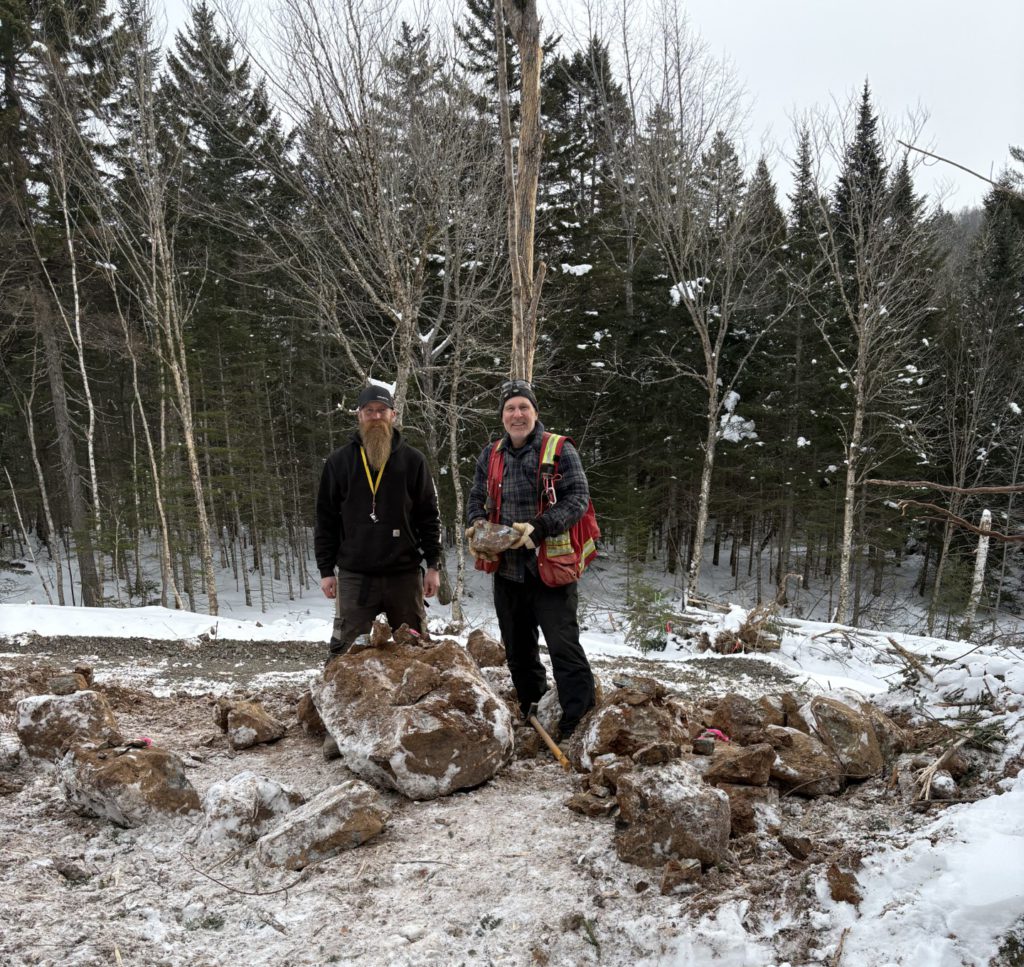
Examining rocks at the Bald Hill project in New Brunswick. Credit: Antimony Resources
Canagold has become a test case, according to Kilofliski. The company filed its environmental assessment application for the New Polaris on April 1, making it the country’s most advanced antimony development.
The mine plan contains 5,173 tonnes of antimony, though the current feasibility study gives it no antimony revenue, and Kilofliski said the company will drill 7,000 metres this summer to try to pull the metal into project economics.
Funding denied
Canagold has applied for Natural Resources Canada-related financial support and was turned down. It appears antimony is competing for capital against a long federal list of priority minerals instead of moving through its own lane, Kilofliski said.
Antimony stayed on the federal critical minerals list when Ottawa updated it in 2024, yet the metal still sits inside a 34-mineral framework that spreads money and policy attention across a much larger field, Kilofliski said.
Ottawa’s latest progress update says the country had 171 advanced critical mineral projects as of March 2025, but only five had been referred to the Major Projects Office for further review and none were antimony projects.
Political noise
British Columbia’s own fast-track language also looks thinner on inspection than it does in speeches, according to Kilofliski, who called much of that language “political noise.” The province’s Critical Minerals Office says it offers concierge support, but it also says it does not change any statutory requirement and has no funding programs.
While New Polaris itself has not hit permitting delays and the environmental assessment is moving on schedule, Kilofliski said, “the complaint is not that the process has stalled, it is that the policy branding still outruns the machinery behind it.”
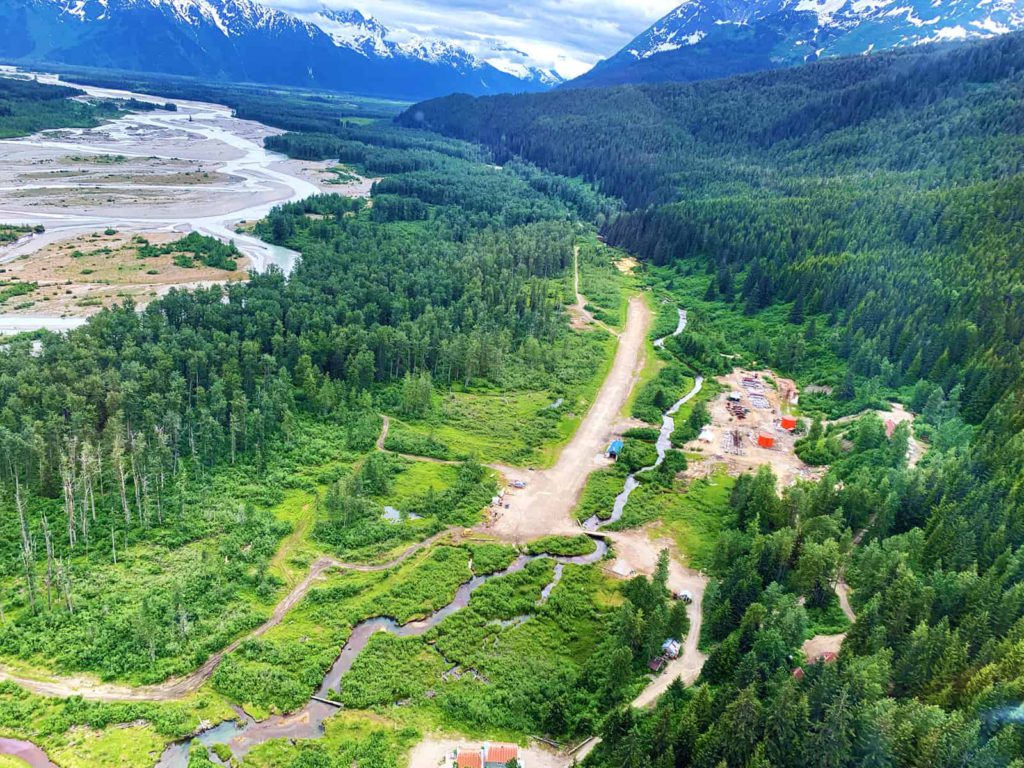
View of the New Polaris project. Credit: Canagold
Canagold’s feasibility study outlined a $425 million after-tax net present value at a US$2,500 gold price, a 30.9% internal rate of return and $250 million in initial capex. Subsequent test work produced an antimony-gold concentrate grading 59.1% antimony at 93.1% recovery.
“In other words, Canada already has a project far enough along to show what targeted policy could look like,” Kilofliski said.
Thin pipeline
Beyond New Polaris, the bench thins fast. Bald Hill is one of the few Canadian stories trying to stand up as a primary antimony project rather than a gold mine with antimony credits. Atkinson said Antimony Resources remains in pure exploration mode, with no resource, no preliminary economic assessment and no firm production timeline.
He pointed to Galway Metals’ (TSX: GWM) Clarence Stream gold project in New Brunswick as the only other eastern Canadian exploration project that even hints at antimony output and there the metal still sits behind gold.
Atkinson said the company has three drills turning, has completed about 10,000 metres and may keep drilling rather than rush into a first resource if newer zones continue to open up.
The harder gap comes after the mine gate. “There’s nowhere in North America where we can send it,” Atkinson said of a hypothetical future antimony concentrate.
Atlantic Canada has talked about a small regional refinery, but nothing has moved. That leaves Canadian developers with the same old problem: even if they can drill out a deposit, they still have no domestic chain to turn concentrate into metal.
Ontario upside
Critical One Energy (CSE: CRTL; US-OTC: MMTLF) sits even earlier on the curve, but founder and CEO Duane Parnham is trying to show Ontario is not off the antimony map.
The Howells Lake project is shaping up as a district-scale land package stretching roughly 30 km along strike, over ground where antimony was first recognized in 1978 and then saw little work after the mid-1980s.
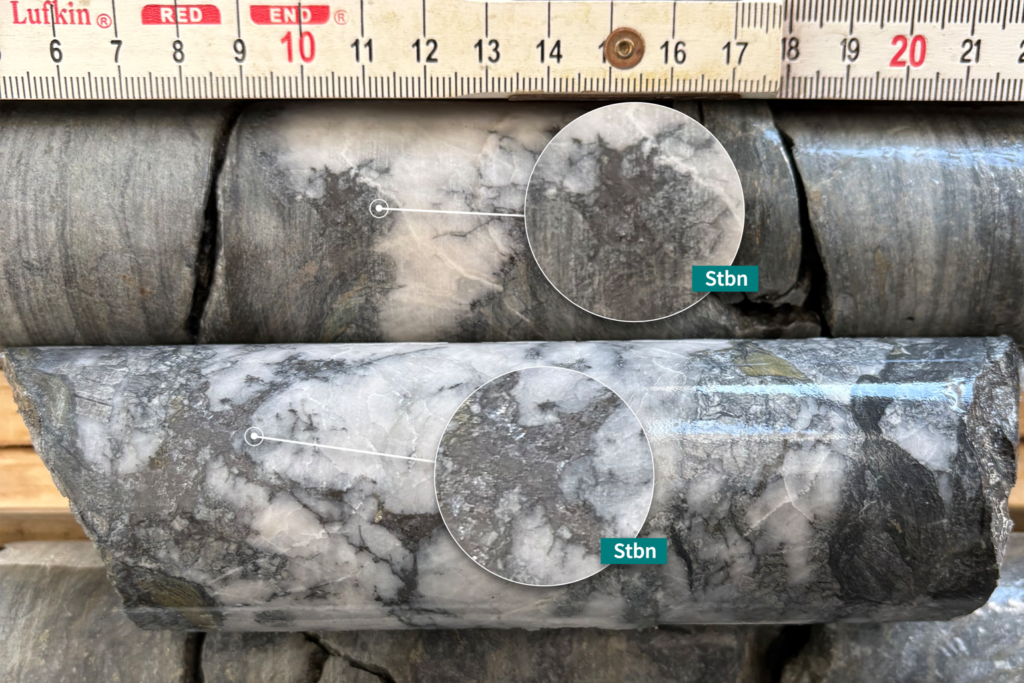
Semi-massive stibnite in quartz-carbonate veins within chlorite-altered feldspar porphyry from 75 to 78 metres downhole. Credit: Critical One Energy
Critical One has budgeted $9 million (US$6.5 million) for Howells Lake this year, Parnham said, and expects drilling to continue through the summer as it moves from the East zone to the West zone and then to a western anomaly. The company wants modern technical data first and a current technical report by year-end, before it rushes into a resource estimate.
Processing hiccup
Parnham said the project is remote and would likely need some form of on-site pre-concentration before trucking material south.
That is a long way from a Canadian antimony supply chain. It is why the weakness in Ottawa’s approach now shows so clearly, according to all three miners. Canada may yet prove it has the deposits. What it has not shown is that it can move fast enough to finance, permit and process them into a domestic supply chain.
“It’s a lot of political noise,” Kilofliski said. “It doesn’t yet translate into actual actions.”
Be the first to comment on "Canada’s antimony gap shows as Iran war sharpens focus on defence metals"