
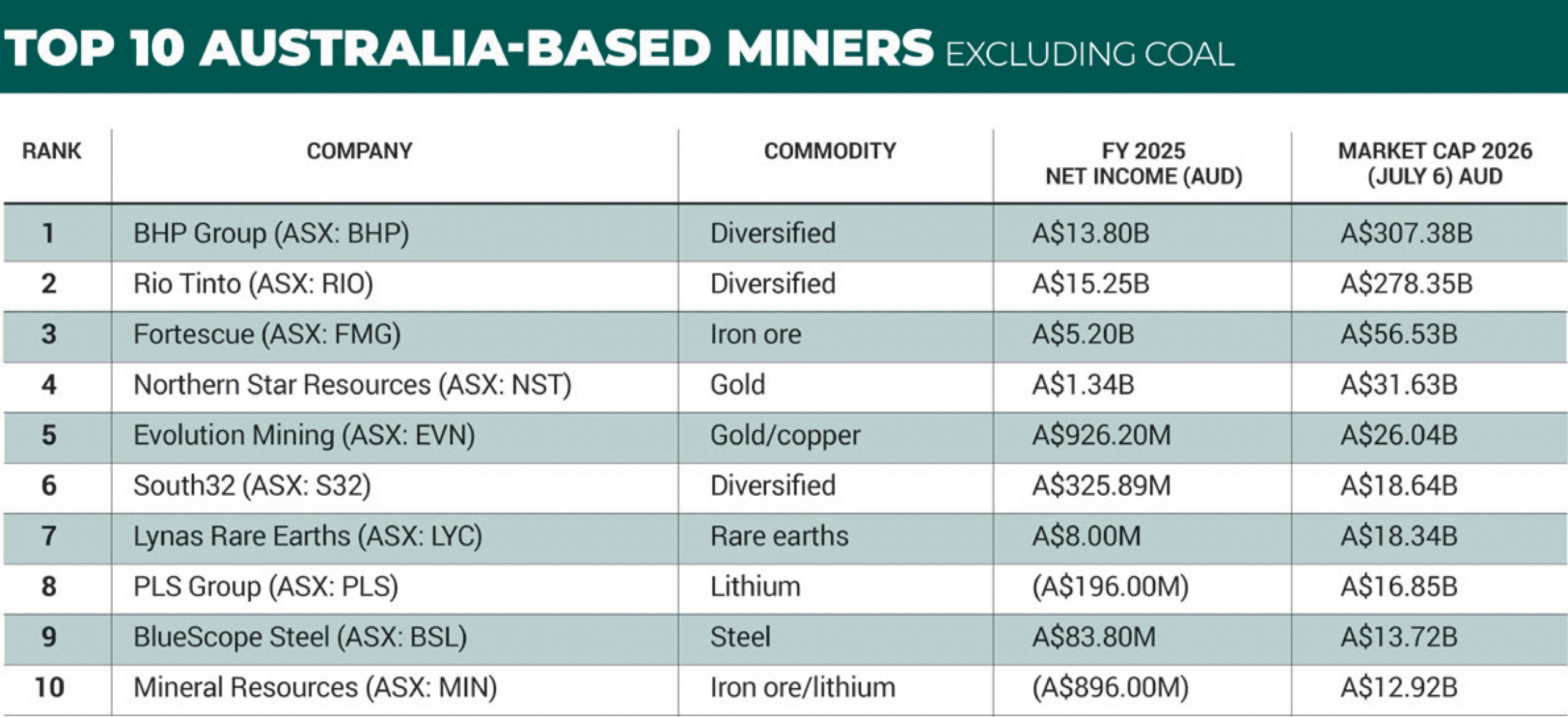
BHP Group (ASX, LSE, NYSE: BHP) leads Australia’s biggest listed mining and metals companies by market value, while Rio Tinto (ASX, LSE, NYSE: RIO) posted the strongest fiscal 2025 profit.
BHP was worth A$307.4 billion (US$213 billion) on July 3, ahead of Rio at A$278.4 billion. It earned A$13.8 billion in fiscal 2025. Its cornerstone Olympic Dam copper, gold and uranium complex lies about 560 km north of Adelaide, South Australia’s capital.
“We think that gives us a unique set of advantages to be very successful in the market, but copper clearly is a focus,” BHP CEO Brandon Craig said at a mining conference in May.
Diversified miners and iron ore producers still control most of the value and profit, but gold, copper and rare earths companies have climbed as investors seek metals tied to electrification, defence and constrained supply. Lithium producers remain highly valued despite losses, showing how far expectations have moved ahead of current earnings.
Diversified giants
Rio Tinto earned A$15.3 billion in fiscal 2025. Its iron ore business still funds expansion into copper and lithium through assets such as Oyu Tolgoi in Mongolia and the Arcadium Lithium portfolio.
That broader mix gives Rio more paths to growth as mature Pilbara iron ore mines face higher costs and declining grades. The company has paired its Australian iron ore base with copper, aluminium and lithium operations across the Americas, Africa and Asia.
Fortescue (ASX: FMG) placed third at a market capitalization of A$56.5 billion and earned A$5.2 billion. It remains far more exposed to iron ore than BHP or Rio, tying its cash flow closely to Chinese steel demand and benchmark prices.
The Perth-based miner has pushed into renewable power, green hydrogen and copper, but Pilbara iron ore shipments still drive its earnings. That concentration helped Fortescue generate strong cash flow during high-price cycles, while leaving it more vulnerable when Chinese demand weakens.
Gold strength
Northern Star Resources (ASX: NST) took fourth place with a market capitalization A$31.6 billion after earning A$1.34 billion last year. Its takeover of De Grey Mining added the Hemi project in Western Australia and strengthened its position among the world’s largest listed gold producers.
Hemi gives Northern Star another large growth project beyond its Kalgoorlie and Yandal operations. The deal expanded its resource base but added development risk and capital demands as the company works to lift output from its existing mines.
Evolution Mining (ASX: EVN) ranked fifth at a market cap of A$26 billion and posted A$926 million in net income. Its gold mines and Ernest Henry copper operation give it more exposure to copper than most Australian gold producers.
Northern Star and Evolution have benefited from record gold prices, but their valuations reflect different growth paths. Northern Star has pursued scale through acquisitions, while Evolution has relied more heavily on mine expansion and the cash flow from Ernest Henry.
South32 (ASX, LSE: S32) ranked sixth at A$18.6 billion, with fiscal 2025 profit of A$326 million. Its spread of aluminium, copper, zinc, silver and manganese assets lowers dependence on any single metal, though weaker prices and operating setbacks have weighed on returns.
Critical minerals
Lynas Rare Earths (ASX: LYC; US-OTC: LYSCF) placed seventh at A$18.3 billion despite earning only A$8 million. The gap between its profit and valuation reflects its strategic role as one of the few suppliers globally of separated rare earths outside China.
Lynas mines ore at Mt Weld in Western Australia and processes material in Australia and Malaysia. Its supply chain has gained relevance as Western governments seek alternatives to China for metals used in permanent magnets, electric vehicles, wind turbines and defence systems.
Pilbara Minerals (ASX: PLS) ranked eighth at a market cap of A$16.9 billion after posting a A$196-million loss. Its Pilgangoora lithium operation, about 1,200 km north of Perth, remains one of the world’s largest hard-rock lithium mines.
The company’s valuation rests less on current earnings than on the scale of Pilgangoora and expectations for a lithium market recovery. That leaves its shares highly exposed to spodumene prices after a supply surge pushed the sector from boom to retrenchment.
BlueScope Steel (ASX: BSL; US-OTC: BLSFY) took ninth place at A$13.7 billion, with net income of A$84 million.
Mineral Resources (ASX: MIN) rounded out the list at A$12.9 billion after losing A$896 million.
Its portfolio combines iron ore, lithium and mining services, but heavy spending and weak lithium prices have strained its balance sheet. Its place in the ranking, alongside Pilbara and Lynas, shows investors still assign high value to scarce mineral exposure even when near-term profits lag.
Be the first to comment on "Top 10: BHP leads heavyweights Down Under "