
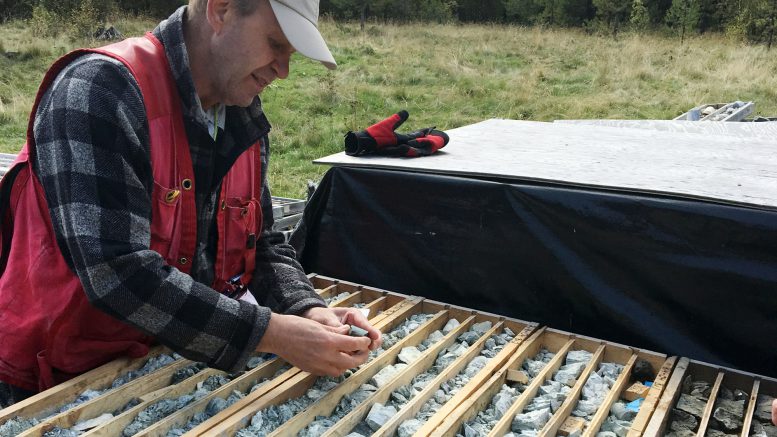
First-pass drilling at Inomin Mines’ (TSXV: MINE) Lynx block in central British Columbia cut 420 metres of near-surface nickel-magnesium mineralization, marking a second discovery area 10 km south of Beaver. Shares rose.
Hole L26-04 returned 0.21% total nickel and 22% magnesium over 420 metres from 3 metres downhole. L26-03 cut 392.5 metres grading 0.22% total nickel and 23.5% magnesium from 2.5 metres. The project lies 50 km north of Williams Lake and about 450 km north of Vancouver, near Trekor Metals’ (TSX, LSE: TKO; NYSE American: TGB) Gibraltar copper mine.
Asked whether the low nickel grades could support a mine, President and CEO John Gomez said the magnesium content could prove decisive.
“Obviously, we won’t know until there’s a feasibility study done on the project and market prices at the time,” Gomez told The Northern Miner by phone. “But the real kicker might be the magnesium. That is not low-grade. This is 20% to 25% magnesium.”
Inomin shares jumped more than a third on the discovery news to set a new 12-month high at 15¢ on Tuesday, after testing a low of 5¢ in the same period. The company has a market capitalization of $8 million (US$5.6 million).
Magnesium high
The discovery gives Japan’s Sumitomo Metal Mining (TSE: 5713) a second drilled area to assess under an option that could give it 80% of the project.
Sumitomo is funding exploration under an earn-in but hasn’t yet disclosed an ownership stake. It can earn 60% by spending $3 million by April 2027 and another 20% through a further $5-million investment. Inomin remains operator during the first phase.
All four holes reported Tuesday crossed between 330 and 420 metres of mineralization near the surface, Inomin said. The intervals are core lengths and true widths remain unknown. The holes were spaced at least 200 metres apart.
Target rich
Inomin drilled nine holes totalling 3,452.8 metres at Onuki, a 6-sq.-km magnetic target, and surveyed 158.4-line km with ground magnetics. Assays for five holes remain pending.
Onuki is one of seven magnetic targets across the 173 sq. km Lynx property. The targets generally extend for 1.5-3 km, but only Onuki has been drilled, Gomez said.
Inomin’s release said initial indications confirmed continuity between Lynx and Beaver, but Gomez said the 10-km gap hasn’t been tested.
“We don’t know yet,” he said. “We haven’t done any testing there. It’s really unknown what’s in between.”
Recovery test
The total-fusion assays measure nickel held in both sulphide and silicate minerals. Inomin hasn’t disclosed the sulphide-hosted share at Lynx, so the reported grades alone don’t show how much nickel flotation could recover.
In January, Inomin said Activation Laboratories had developed a partial-digestion assay to estimate sulphide nickel in samples grading more than 0.1% total nickel, but these rsults have not yet been released.
Earlier tests on a single eight-metre composite from Beaver recovered up to 58% of its nickel by flotation and extracted 99% of its magnesium using hydrochloric acid, according to Inomin.
Partner path
Sumitomo Metal Mining Canada funded the $2.3-million drilling program, as well as a$1.7-million program in 2025, bringing the two announced exploration budgets to $4 million. Inomin hasn’t said whether Sumitomo has formally exercised its 60% option.
Once the remaining Lynx assays arrive, the partners will consider step out and infill drilling at Beaver South, Gomez said. Enough drilling there could support a maiden resource in 2027.
“We’re just a small junior. We’re not going to be in production ourselves,” Gomez said. “We hope Sumitomo is the one that advances it all the way. They’re big enough. They’re capable of doing that.”
Be the first to comment on "Inomin cuts 420 metres at Lynx nickel discovery"