
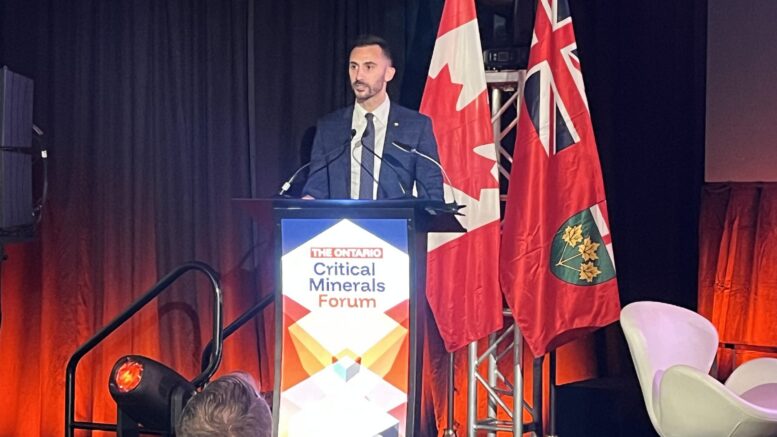
Ontario plans to overhaul mining approvals beyond its fast-track program for four major projects, proposing to eliminate or streamline half of the key permits and authorizations required to develop mines.
Energy and Mines Minister Stephen Lecce said Tuesday the government would introduce legislation next week to accelerate exploration and approvals for new and expanding mines, while introducing tougher enforcement measures and new rules aimed at preventing companies from indefinitely holding idle mining leases.
“One of the greatest concerns we heard is while One Project, One Process is a sound supercharging mechanism, how about for everyone else? For the 98% of projects not captured by the 1P1P,” Lecce told the Ontario Critical Minerals Forum in Toronto.
The proposed reforms come as Ottawa and provincial governments prioritize domestic mineral production to strengthen Canada’s economic security, reduce dependence on Chinese-controlled supply chains and respond to United States tariffs.
Cutting timelines
The government estimates the changes could save a combined 31,000 to 47,000 calendar days a year across mining permit applications.
The changes would cover new and expanding mines, as well as early and advanced exploration. Companies would be able to obtain a single exploration permit instead of several, while the validity of early exploration plans would be extended to three years from two.
“Our permits right now still take too long to get approved through government,” Lecce told reporters after his speech. “It’s a maze of bureaucracy, and it’s paralyzing investment.”
The reforms build on Ontario’s One Project, One Process framework, launched in October 2025 to halve government review times for major mining developments. Four projects have been designated so far: Frontier Lithium’s (TSXV: FL; US-OTC: LITOF) PAK lithium project, Kinross Gold’s (TSX: K; NYSE: KGC) Great Bear gold project, Canada Nickel’s (TSXV: CNC; US-OTC: CNIKF) Crawford nickel project and Mayfair Gold’s (TSXV: MFG; NYSE-A: MINE) Fenn-Gib gold project.
Mining lease changes
Lecce also announced a “Use It or Lose It” policy intended to prevent companies from indefinitely holding mining leases without advancing exploration or development. Only 15% of Ontario’s land with high mineral potential is currently available for new staking, he said.
“Some of these leases are being held for a good reason,” Lecce said, acknowledging that mining projects can take years to advance. “But others are sitting, waiting for the company that actually wants to build to come along, pay them, and get out of the way.”
Under the proposed changes, idle leases would not be renewed, allowing other companies to stake the land. Lecce said fewer than half of Ontario’s mining leases have exploration plans or permits. Lecce didn’t specify how idle leases would be defined or whether exemptions would apply to projects facing lengthy development timelines.
Enforcement changes
Lecce also outlined a graduated enforcement system that would give regulators more options for dealing with violations, including field orders, tickets and administrative monetary penalties.
The legislation would also consolidate oversight of mine tailings storage facilities under the Ministry of Energy and Mines to reduce overlap among provincial ministries, Lecce said.
Price support
Despite the government’s emphasis on countering China’s dominance of critical mineral supply chains, Lecce stopped short of committing Ontario to minimum-price guarantees that could help new mining projects secure financing.
Asked by The Northern Miner whether the province would guarantee critical mineral prices, Lecce pointed instead to Ottawa’s work with G7 partners on a critical minerals buyers’ club through the existing Critical Minerals Resilience and Production Alliance. The alliance aims to strengthen supply chains among allied countries and reduce exposure to market concentration and manipulation.
“We’re working closely with Minister Hodgson as he works to establish a global buying club to ensure that our minerals are able to be exported to allied supply chains, and that we’re able to create price stability,” Lecce said, referring to federal Energy and Natural Resources Minister Tim Hodgson.
Efficiency over funding
Asked whether the new legislation would include additional funding commitments, Lecce said the government’s priority was reducing regulatory delays rather than announcing a new financing program.
“The problem we hear from industry is not a lack of capital from government or otherwise,” he said. “It’s that it takes too long to open mines because the permits get stuck in the bureaucracy.”
Lecce cited provincial support for Generation Mining’s (TSX: GENM; US-OTC: GENMF) Marathon copper-palladium project. Further investments under Ontario’s existing $500-million Critical Minerals Processing Fund will be announced in the coming weeks and months, he added.
Ontario announced up to $11 million in conditional loan support for Marathon’s processing facility in September. Lecce didn’t identify which additional projects might receive support in 2027.
Separately, Lecce said Ontario plans to release a new minerals strategy in March 2027, ahead of the Prospectors & Developers Association of Canada convention in Toronto. The document will expand the province’s existing focus on critical minerals to include gold, industrial minerals and the broader mining sector, he said.
Be the first to comment on "Ontario seeks to speed up mining approvals"