
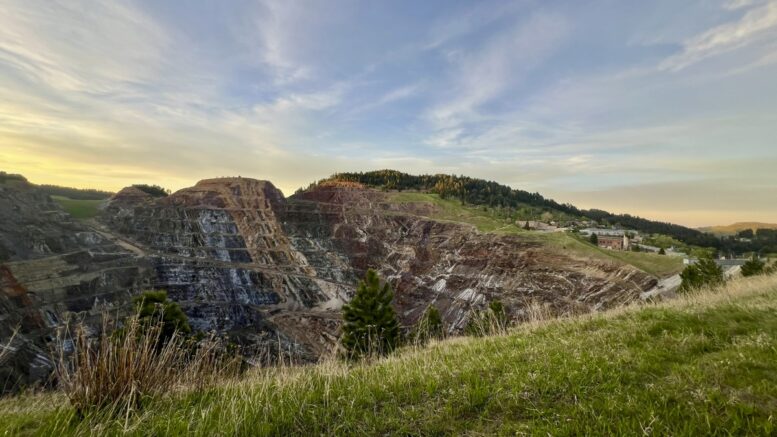
Dakota Gold (NYSE-A: DC) expects its Richmond Hill project in South Dakota to produce 12% more gold annually than projected last year, even as lower recoveries and a shorter mine life cut the metal that the company plans to sell by 40%. The stock dropped.
Initial capital rose 40% to $538 million (C$773 million) for an open-pit, heap-leach operation that would produce 171,000 oz. of gold annually and run for nine years instead of 17, Dakota said Monday in a prefeasibility study (PFS). Even so, the company raised its base-case after-tax net present value to $2 billion, compared with $1.6 billion in a 2025 assessment. It used a 5% discount rate in both cases.
The new study “further de-risks and re-confirms Richmond Hill as one of the few advanced development projects globally, with commercial production targeted for 2030,” BMO Capital Markets mining analyst Andrew Mikitchook said Tuesday in a note.
Dakota’s “new conservative mine plan significantly reduces technical risks at the mine through better informed drilling and metallurgical testing,” he added.
Shares of Dakota plunged 8% to $4.02 Tuesday morning in New York, valuing the company at about $539 million. They have traded between $3.96 and $7.25 over the past year.
Historic mine
Located about 320 km west of South Dakota’s capital, Pierre, Richmond Hill is part of a 180-sq.-km land package controlled by the company near the historic Homestake mine. It hosts a large oxide gold system amenable to conventional open-pit mining and heap leach processing.
Homestake produced about 40 million oz. of gold during more than 145 years of mining. It ceased operations in 2002.
Dakota Gold co-chair Robert Quartermain previously built Pretium Resources and developed the Brucejack mine in British Columbia before agreeing to be bought by Newcrest – now Newmont Mining (TSX: NGT; NYSE: NEM) – for about C$3.5 billion ($2.5 billion) in 2021. He formed Dakota Gold the following year to explore in South Dakota.
At a new, higher assumed gold price of $3,500 an oz., Dakota projects a 71% internal rate of return. Using $2,750 gold, the new valuation is $1.25 billion against last year’s $2.15 billion. Dakota’s new plan assumes a 72.4% gold recovery, down from 85.1%, and cuts lifetime payable production to 1.56 million oz. from 2.6 million ounces.
Reclassifying material previously considered suitable for heap leaching took about 1 million oz. of gold out of the plan, Mikitchook said. He cut his share price target to $10 from $11 while maintaining his outperform rating.
Larger crushers
Proven and probable reserves as of Nov. 23 totaled 119.6 million tonnes at 0.56 gram gold and 6.61 grams silver per tonne for 2.16 million oz. of gold and 25.4 million oz. of silver. Dakota, which used $2,600 gold to calculate reserves, estimates all-in sustaining costs at $1,289 an oz., including South Dakota’s severance tax.
Larger crushers and the cost of building the first section of a leach pad in a steep-sided valley account for much of the increase in initial capital, Vice-President of Project Development Mike Eiselein said Monday on an investor call.
Dakota is drilling higher-recovery breccia to try to add at least 10% to reserves for a feasibility study due in mid-2027. It aims to start production in 2029, subject to permits and a construction decision.
The feasibility study and permitting “are the next de-risking steps,” Scotiabank mining analyst Eric Winmill said Tuesday in a note.

Be the first to comment on "Dakota Gold nearly halves Richmond Hill mine life"