
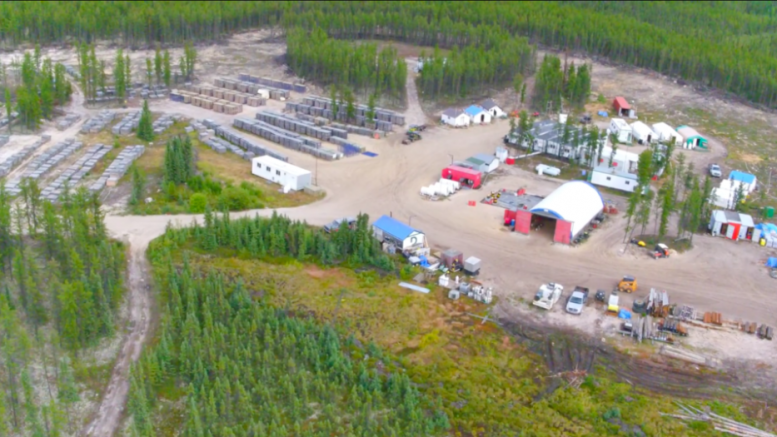
Denison Mines (TSX: DML; NYSE-A: DNN) began full construction at its Phoenix uranium project in northern Saskatchewan, by starting installation of the first perimeter freeze wall after finishing site preparation.
First production for the Athabasca Basin’s first commercial in-situ recovery mine is slated for mid-2028, Denison said Tuesday in a statement.
The $700 million (US$500 million) project, roughly 800 km north of Regina, could produce about 9 million lb. uranium oxide a year at peak.
“Achieving these positive early results demonstrates the readiness and commitment of Denison and our construction partners as we advance this unique nation-building project to become Canada’s first new large-scale uranium mine since Cigar Lake,” CEO David Cates said.
Denison is to add a large new source of Western uranium as more than 30 countries aim to triple nuclear capacity by 2050, according to International Atomic Energy Agency data. The mine would also test in-situ recovery at commercial scale in the Athabasca Basin, where the method has never operated commercially.
If it works as planned, Phoenix could widen the development options for other high-grade deposits in a district built around underground mining.
The company’s Toronto-listed stock fell 4.9% to $3.91 per share, after testing $2.58 and $4.08 over the past 12 months. Denison has a market capitalization of $3.54 billion.
Construction update
Crews have completed more than a fifth of civil work and nearly all ground preparation for the processing plant and wellfield, the network of injection and recovery wells, the company said. The plan is to add a second shift so crews can work nearly around the clock on weather-sensitive jobs. Concrete pours for the plant and main power transformer foundations are expected to start in next month.
The freeze wall is to isolate the first mining area and help contain the solution pumped through the deposit to dissolve uranium. Recovery wells will return the uranium-infusion to surface for processing into uranium oxide.
Denison has expanded temporary camp capacity to nearly 400 people as the workforce grows. A concrete batch plant has reached the site, a nearby quarry is producing aggregate and crews are preparing an airstrip and the site power network. SaskPower has completed a 138-kilovolt transmission line to Phoenix.
Engineering is about 90% complete, with 95% of the main design packages issued for construction. The Canadian Nuclear Safety Commission approved the federal environmental assessment and construction licence in February after Saskatchewan cleared the project last July.
Project case
Phoenix holds 56.7 million lb. in proven and probable reserves within 219,000 tonnes grading 11.7% U3O8 on a 100% basis. The mine plan covers about 10 years.
A 2023 feasibility study, updated this year for capital costs, estimates a post-tax net present value of $1.57 billion at an 8% discount rate and a 73% internal rate of return. It forecasts average all-in costs of US$18.41 per pound. Denison expects to spend $600 million after its investment decision, on top of about $100 million spent earlier.
Denison owns 90% of the broader Wheeler River directly and another 5% through its half-owned JCU subsidiary. Wheeler River also hosts Gryphon, a proposed underground mine that Denison expects could follow Phoenix and use infrastructure built for the first operation.
Phoenix must still prove in-situ recovery at commercial scale in the basin, hold its two-year building schedule and control costs.
Funding base
Denison held $418 million in cash and equivalents, 1.85 million lb. of U3O8 worth about $216 million and $33 million in uranium investments as of March 31. The roughly $670-million pool gives it substantial funding flexibility, though much of the total is uranium rather than cash.
The company has fixed prices for 950,000 lb. scheduled for delivery through June 2027 at an average US$92.05 per pound. Those sales are expected to bring in US$87.5 million through June 2027.
Be the first to comment on "Denison starts building Canada’s first ISR uranium mine"