

Artemis II is set to lift off tomorrow, spotlighting the geopolitical race for the metals behind modern spaceflight.
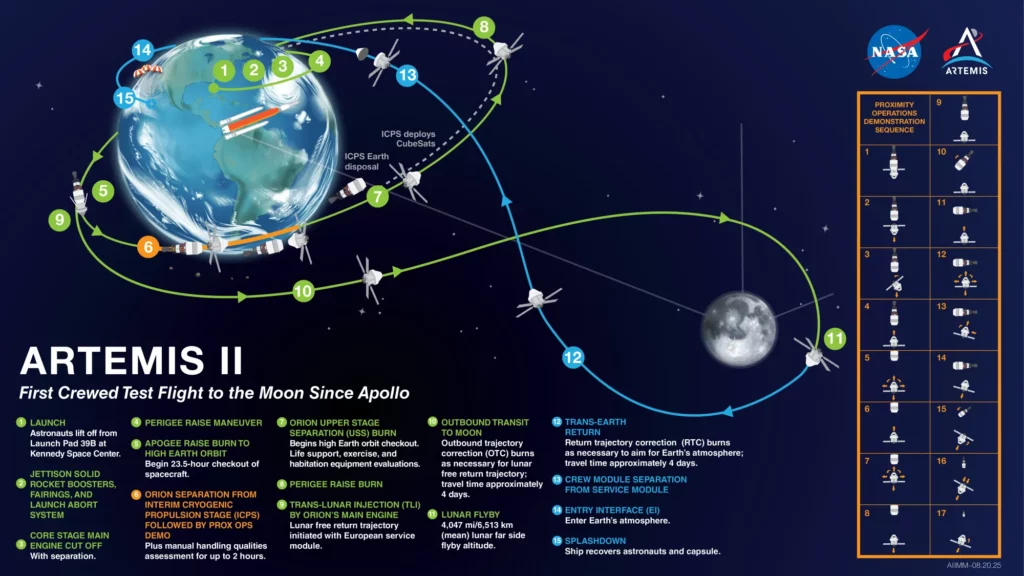
The flight around the Moon, without landing, will carry astronauts aboard the Orion spacecraft, marking the first human voyage beyond low-Earth orbit since 1972. The mission is built on a global industrial base led by contractors including Lockheed Martin (NYSE: LMT) and Boeing (NYSE: BA).
Even smaller suppliers such as London-based Smiths Group (LSE: SMIN), which makes parts critical to the world’s most powerful rocket, reflect a supply chain increasingly shaped by geopolitical competition.
“These components are highly engineered, solid, rigid tubes that are used to safely transport fuel and gas, as well as the safe transfer of hot air,” Smiths said in a release on Monday. “They are made from super alloy metals – high-performance alloys that have excellent mechanical strength and can maintain their integrity at incredibly high temperatures.”
Orion’s materials include aluminium-lithium alloys that reduce weight in the crew module, titanium provides structural strength, and nickel-based superalloys allow engines to operate under severe heat. Copper runs through electrical and thermal systems, while rare earth elements support avionics and guidance, and platinum group metals are used in onboard fuel cells. These materials are increasingly tied to strategic supply chains.
Minerals processing
The significance lies less in volume than in control of processing and supply. The space sector will not materially shift demand for bulk commodities, but its influence sits at the upper end of the value chain, where pricing, margins and strategic considerations diverge from those seen in larger-volume markets. The materials reflect a convergence of critical minerals, advanced metallurgy and processing capacity.
Western governments are pushing to build out domestic smelting and refining capacity, as much of the processing for critical minerals remains concentrated in China. The gap between mining and processing has become a strategic concern, with policymakers arguing that securing supply chains now depends as much on where metals are refined as where they are mined.
For mining companies, the opportunity is not simply to supply raw inputs, but to move further along the value chain into refined and engineered materials that meet demanding aerospace specifications.
Industry opportunities
Companies are positioning accordingly as the materials list extends well beyond copper and nickel. Aluminium, the backbone of most spacecraft structures, is produced at scale by companies such as Rio Tinto (LSE, ASX, NYSE: RIO) and Alcoa (NYSE: AA), with aluminium-lithium alloys used to reduce weight while maintaining strength.
Titanium feedstock from Rio Tinto’s Lac Tio mine in Quebec and projects operated by Tronox (NYSE: TROX) and Iluka Resources (ASX: ILU) underpins aerospace alloys used in structural and high-temperature applications.
Rare earth supply chains are led by MP Materials (NYSE: MP) at Mountain Pass in California and Lynas Rare Earths (ASX: LYC) at Mt Weld in Western Australia. Both are positioning to supply magnet materials used in avionics and guidance systems.
Developers including Defense Metals (TSXV: DEFN) at Wicheeda in British Columbia and Vital Metals (ASX: VML) at Nechalacho in the Northwest Territories are also targeting downstream processing as governments push to build domestic supply chains.
Canada Nickel
Nickel and cobalt used in superalloys and energy systems draw on operations run by Glencore (LSE: GLEN) and Vale (NYSE: VALE), including Voisey’s Bay in Labrador and Raglan in northern Quebec, which feed high-temperature alloys required for propulsion systems.
Canada Nickel (TSXV: CNC) is advancing its Crawford nickel-cobalt sulphide project near Timmins, Ont., one of the world’s largest nickel sulphide deposits, positioned to supply high-quality, low-carbon nickel used in heat-resistant alloys and advanced industrial applications, the company says.
Tungsten, used in radiation shielding and high-temperature environments, is sourced from projects such as Almonty Industries (TSX: AII; ASX: AII) at Sangdong in South Korea, reflecting concentrated supply in Asia.
Northcliff Resources (TSX: NCF) is advancing the Sisson tungsten-molybdenum project in central New Brunswick, one of the largest undeveloped tungsten deposits outside China, positioned to supply high-strength, heat-resistant metals used in defence and high-temperature applications.
Silver and gold also play niche but critical roles, with silver used in solar panels and electrical systems and gold valued for conductivity and radiation shielding. Producers such as Pan American Silver (TSX: PAAS; NYSE: PAAS) and Newmont (NYSE: NEM; TSX: NGT) supply metals that ultimately feed into high-technology applications. Gold is used in coatings and spacecraft electronics, where durability and conductivity are critical under vacuum and radiation.
Wider picture
The renewed focus on space exploration also carries a broader narrative, echoing the optimism of the 1960s when leaders such as John F. Kennedy framed lunar missions as engines of technological progress and economic growth. That backdrop contrasts with today’s geopolitical tensions, including conflicts in Iran and Ukraine that are weighing on global stability and supply chains.
For Canada’s own sense of pride, the country’s role in the program extends beyond raw materials to one of the astronauts. London, Ont. native Col. Jeremy Hansen, a former fighter pilot, will lift off as a mission specialist. Hansen, who will be the first Canadian to fly around the Moon, has taken part in several field geology training expeditions, including in Canada’s High Arctic.
MDA Space (TSX: MDA), of Brampton, Ont., is developing Canadarm3 in partnership with the Canadian Space Agency, a next-generation robotic system designed for use on the Lunar Gateway, a planned space station orbiting the Moon that is now tied to later-stage Artemis missions. The Canadarm3 system relies on lightweight alloys, advanced composites and electronics that draw on copper, rare earths and specialty metals, reinforcing Canada’s position in high-value supply chains.
Smiths in London sees similar opportunities for its components such as filtration sieves separating liquid and gas within fuel tanks; and high-speed cable assemblies supporting mission-critical communications. They must withstand the intense vibration and extreme temperature changes during spaceflight.
“Artemis II represents a significant moment,” Smiths CEO Roland Carter said in the release. “We have a long and proud history of supporting space missions.”
Be the first to comment on "Moonshot puts global metals scramble on display"