
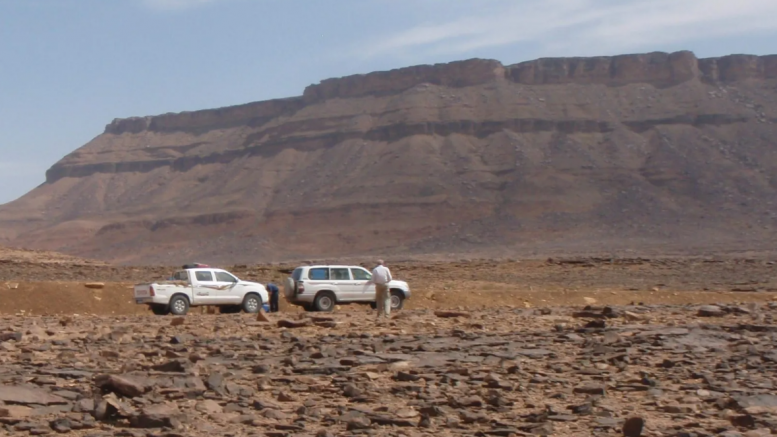
Aura Energy (ASX: AEE; AIM: AURA) is moving closer to building Mauritania’s first uranium mine after a bankable feasibility study outlined a $500-million (C$701.9 million) valuation for its Tiris project, despite a 52% increase in construction costs to $350 million.
The study gives Tiris a post-tax internal rate of return (IRR) of 28%, 11 percentage points lower than in a technical report from 2024, even though the uranium price assumption rose 12% to $90 per pound. Tiris is about 1,100 km northeast of the capital Nouakchott, located in the mineral-rich but high-risk Tiris Zemmour region.
“The army manages security [there] and has cleared artisanal miners from a 10-km strip along the Algerian frontier,” Sean Hagarty, security analyst and founder of the risk intelligence firm Region Alert told The Northern Miner on Tuesday.
“Aura’s security plan will have to be built with the army,” Hagarty said, adding that unsafe conditions in artisanal gold mining in the region have alerted communities to potential dangers.
“Those communities will judge a uranium project on water and radiation,” he said.
Tiris is a robust project that will open a new uranium province in Mauritania, according to Aura Executive Chair Philip Mitchell.
“It comes on line just as demand for uranium is accelerating,” he said in a release.
Burgeoning African uranium
The study bolsters the uranium potential of West Africa’s Sahel region, where Niger has long been a major producer and several large uranium projects are advancing or awaiting investment.
While Mauritania has largely avoided the insurgencies and instability affecting other countries in the Sahel, the region has presented investment challenges for miners in recent years. Sahel governments have feuded with Western miners as they sought to re-negotiate mining rules amid an atmosphere of resource nationalism.
“Mauritania renegotiates hard,” Hagarty said, citing $25 million that Kinross Gold (TSX: K; NYSE: KGC) paid the country’s government in 2020 to resolve tax and licence disputes related to its Tasiast mine. “But unlike Niger and Mali, it hasn’t taken mines away.”
Aura attributes the higher development and operating costs to more advanced engineering in the process plant and increased reagent consumption.
Tiris’ production profile of 46.1 million lb. over a 26-year life is essentially unchanged from the previous report, though proven and probable reserves grew 11% to 37.3 million lb. uranium oxide (U3O8) grading 227 parts per million U3O8. contained inside 74.6 million tonnes.
Project needs $400M
Aura still needs to secure most of the $400 million required to develop Tiris. The company is in discussions with the U.S. International Development Finance Corporation (DFC) for about $150–170 million of senior debt and has received a non-binding, fully funded proposal from an unnamed “major” U.S. investment fund.
The DFC in September gave conditional support for a $414.2 million U.S. government loan to build Global Atomic’s (TSX: GLO) Dasa uranium mine in Niger.
Aura is to start operating a pilot plant replicating the full flowsheet in November. It would process more than 80 tonnes of ore to confirm plant performance before the final investment decision in December. Mine construction would last about two years and first production could start at the end of 2028.
The “free-dig” open pit mine hosts relatively soft ore that requires no drilling or blasting and can be processed without crushing or grinding, Aura said.
Shares dropped 3% to a one-year low of A7¢ (C7¢) apiece on Tuesday in Sydney, for a market capitalization of A$69.1 million. The stock has traded as high as 25¢ in the past year.
Be the first to comment on "Mauritania’s first uranium mine comes into view despite funding, security issues"