
Lithium futures in China sank to a five-month low on Tuesday as expectations that a wave of restarted mines will tip the market back into oversupply next year overshadowed strong near-term demand from the electric vehicle and energy storage sectors.
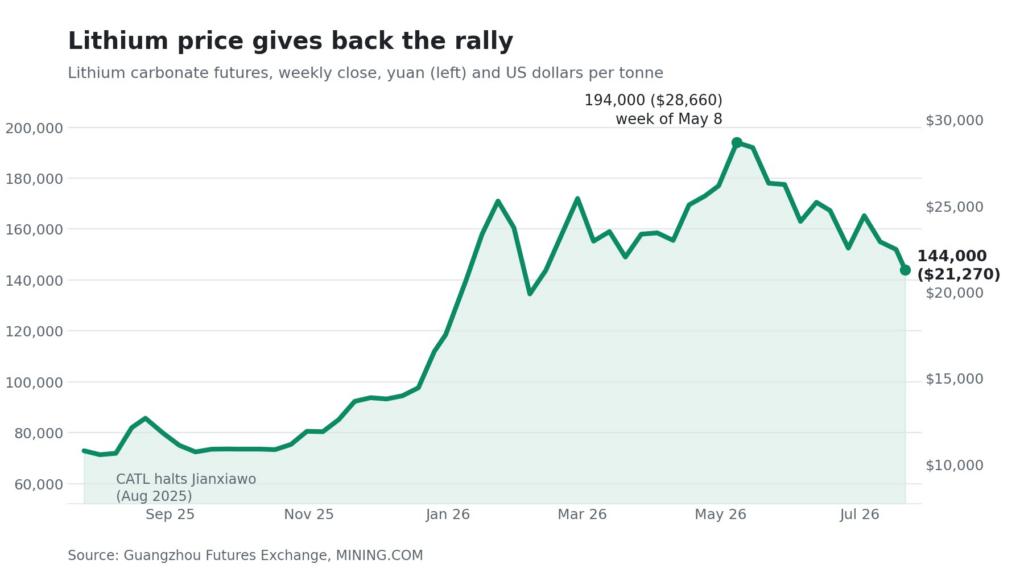
The most active lithium carbonate contract on the Guangzhou Futures Exchange fell to 136,800 yuan ($20,210) per tonne, its lowest since February 10, before clawing back part of the loss in afternoon trade to close at 144,000 yuan, still down 4.9% on the day. The contract edged down a further 0.7% to 143,000 yuan ($21,126) on Wednesday.
The selloff reflects a broader debate over whether a recovery in mine supply will once again outpace booming battery demand, a question likely to shape lithium prices through next year.
Lithium still up
The contract has now given back nearly 30% from the two-year high above 200,000 yuan reached in mid-May, although it still trades at more than double its level of a year ago, before the shutdown of electric vehicle battery giant CATL’s Jianxiawo mine set off a months-long rally. Even after Tuesday’s drop, lithium remains up about 22% in 2026.
Tuesday’s slide also lands just as Beijing works to make the Guangzhou exchange the reference point for global lithium pricing. The exchange opened its lithium carbonate contract to overseas traders this month and plans to launch a second futures contract, for lithium hydroxide, this year in a push for more pricing power over the battery metal.
Washington has also handed lithium bulls a fresh argument: earlier this month the Department of Defense moved to buy up to $300 million of lithium for the national defence stockpile.
Supply returning
That rally is unwinding as idled mine supply returns to the market. CATL restarted Jianxiawo in late June after securing a new safety permit, returning about 46,000 tonnes of annual capacity, some 3% of global output, to a market that had priced in its absence.
Australian producers are following. Mineral Resources (ASX: MIN) is restarting its Bald Hill operation and Core Lithium (ASX: CXO) is bringing its Finniss project back online. And the Mt Marion joint venture between MinRes, Ganfeng Lithium and POSCO has approved a A$490 million ($342.8 million) expansion, moves that analysts expect to swell supply through 2027 after two years when low prices had forced curtailments across the industry.
Not every 2027 signal points the same way. Zimbabwe, which supplied about 10% of the world’s mined lithium last year, on Friday rejected industry calls to delay the ban on lithium concentrate exports it will impose from January 1.
Demand still running hot
The retreat comes despite little sign of weakness on the demand side. China’s output of power and energy storage batteries reached 191.7 gigawatt hours in May, up more than 55% from a year earlier, and the boom in grid-scale energy storage has continued to absorb material alongside resilient electric vehicle sales.
When Ganfeng Lithium chairman Li Liangbin predicted in November that booming demand could carry lithium carbonate to 200,000 yuan per tonne, the forecast looked bold. The market briefly delivered exactly that in May, and has been retreating since.
Lithium equities have taken a harder beating than the metal as the rally unwound. Over the past month, Liontown Resources (ASX: LTR) lost 36% in Sydney, PLS Group (ASX: PLS) the former Pilbara Minerals, fell 26%, Mineral Resources 21%, Core Lithium 20% and IGO (ASX: IGO) 18%, while Ganfeng Lithium dropped 36% in Hong Kong.
Among U.S.-listed names, Lithium Americas (TSX, NYSE: LAC) gave up 28%, Albemarle (NYSE: ALB) 22%, Sigma Lithium (Nasdaq, TSXV: SGML) 21% and SQM (NYSE: SQM) 11%, with the Global X Lithium ETF down 15%. Sydney’s producers fell again on Wednesday, Liontown by a further 5.1%, although the U.S. names steadied in early trade.
Be the first to comment on "Lithium sinks to five-month low amid 2027 glut fears"