
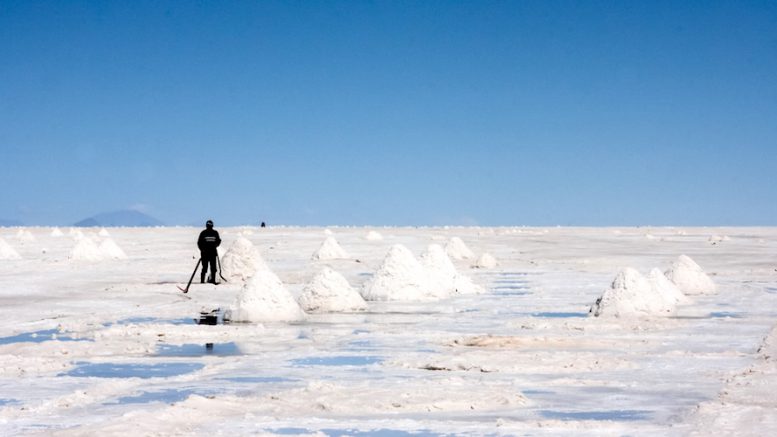
Argentina, Bolivia and Chile hold about 43% of the world’s identified lithium resources, but differences in brine chemistry and water availability complicate efforts to turn the Lithium Triangle’s geological wealth into new supply.
The three countries have 64 million tonnes of measured and indicated lithium resources, compared with about 150 million tonnes worldwide. Argentina accounts for 28 million tonnes, Bolivia for 23 million and Chile for 13 million, according to the U.S. Geological Survey.
The quality and quantity of lithium-bearing brines underpin the region’s development prospects, geologist José Cabello told MINING.COM. About 10 operations are already producing across Argentina and Chile, with several projects under development, he said.
But a large resource doesn’t establish how much lithium a project can recover, at what cost or with what environmental consequences. Brine concentration, impurities and groundwater behaviour vary between deposits.
Cabello examined 43 evaluated salt flats across the three countries for a review in the September issue of Andean Geology. The paper, available online since June, draws on scientific studies, company disclosures and government reports.
The tonnages describe contained lithium rather than lithium carbonate equivalent, a measure frequently used in project announcements. Resources also differ from reserves, the economically recoverable portion of a deposit under defined conditions.
Brine differences
The evaluated deposits sit within a broader landscape of about 130 salt flats, saline lakes and lagoons in the Central Andes.
Weathering releases lithium from surrounding volcanic rocks, and water carries it into closed basins. Evaporation concentrates the dissolved metal alongside potassium, boron and magnesium. Unlike hard-rock deposits, lithium-bearing brines occur in mobile groundwater systems, complicating exploration, sampling and recovery estimates.
Chile’s Salar de Atacama has benefited from a drier climate, fewer brine impurities and better export routes than some neighbouring deposits, Cabello wrote.
Argentina and Chile produced an estimated 79,000 tonnes of lithium in 2025, or about 27% of reported global mine output excluding the United States, according to the USGS.
Among the promising developments, Cabello highlighted Salares Altoandinos and Pedernales in Chile, and Hombre Muerto Oeste, Rincón, Sal de los Ángeles and Sal de Vida in Argentina.
Water trade-offs
Expansion requires an understanding of how pumping affects groundwater and the ecosystems it supports. Freshwater availability adds another constraint in a region with little rainfall.
Direct lithium extraction, or DLE, could help develop brines less suited to conventional evaporation ponds. Companies are investing in these technologies to shorten processing times and improve recovery economics.
DLE’s potential to reduce water consumption is crucial in these arid environments, Cabello told MINING.COM.
However, the benefits depend on the technology and local conditions. Some processing methods reduce net brine withdrawals but require more freshwater; others make the opposite trade-off, he wrote.
Cabello’s resource compilation excludes inferred resources, a less certain geological category. Assessing those estimates and investigating individual salt flats in greater detail could guide further exploration, he wrote.
Be the first to comment on "Water, chemistry challenge Lithium Triangle growth"