
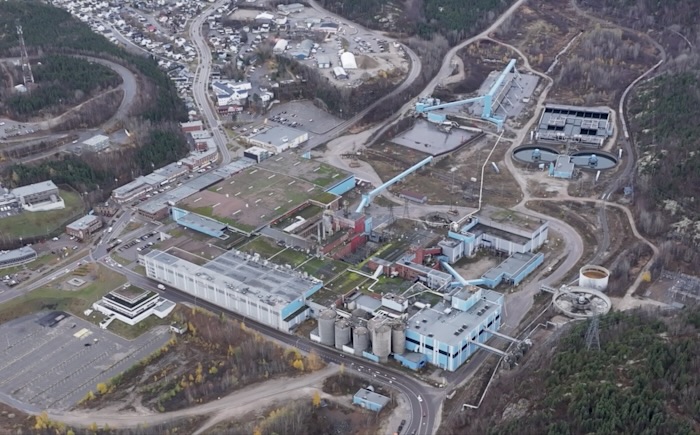
Canadian property developer BMI Group says the clutch of industrial buildings it’s amassed in Ontario and Quebec could help strengthen Canada’s role in the battery supply chain by linking mines with processing hubs and customers.
Dubbed the “Critical Minerals Corridor,” BMI’s asset portfolio includes five former industrial sites such as pulp and paper mills that have been repurposed into “deployment-ready” hubs with existing power and water and access to roads, ports or rail lines. More than C$200 million ($146 million) has been invested in acquisitions and modernization since 2014, said BMI CEO Paul Veldman, one of three brothers who work for the family-controlled company.
“We’re not a miner, we’re not a processor, we’re the infrastructure, the support,” Veldman told The Northern Miner in Toronto this month during the Prospectors and Developers Association of Canada annual conference. “Reinvigorating and reactivating idled infrastructure and idled assets, that’s our core business.”
BMI’s shared infrastructure concept comes as federal and provincial authorities in Canada pursue a longstanding goal of boosting metals processing activities on home soil as global demand for critical minerals booms, proponents say.
Early converts to the concept include Canadian miners Rock Tech Lithium (TSXV: RCK) and Northern Graphite (TSXV: NGC; US-OTC: NGPHF). Both companies are making plans to move into BMI-owned facilities – instead of building their own plants – to cut costs and shrink development times compared with greenfield projects.
’Rip and ship’
Canada holds significant mineral resources and produces hydroelectricity, but its domestic supply chains pale in comparison with those of foreign rivals such as China.
With large-scale Canadian miners such as Inco, Falconbridge and Rio Algom having been acquired by foreign buyers in recent decades, Canada now operates mostly as a mine-and-ship jurisdiction – a model that Ontario Energy and Mines Minister Stephen Lecce refers to as “ripping and shipping.”
Canada has only one active copper smelter, Glencore’s (LSE: GLEN) Horne facility in Rouyn-Noranda, Que., along with an associated refinery in Montreal.
While Canada has two lithium mines, Sinomine’s Tanco operation in Manitoba and Elevra Lithium’s (Nasdaq: ELVR; ASX: ELV) North American Lithium mine in Quebec, it has no plants to process the metal into lithium hydroxide or carbonate. A Rio Tinto (ASX, LSE: RIO) facility to make lithium hydroxide is under construction in Bécancour, Que., though the company said last week it would slow down work for the time being.
Ring of Fire
BMI’s Red Rock facility in northern Ontario – a former Norampac cardboard plant – sits about 10 km from Nipigon, a town that will serve as the road gateway to the resource-rich Ring of Fire region whose underground potential Ottawa and the province are looking to unlock. Nipigon is about 1,050 km northwest of Toronto.
Rock Tech Lithium’s planned lithium hydroxide facility will anchor the Red Rock site, which has 120 megawatts of installed power capacity and direct access to CPKC Rail’s transcontinental mainline.
“The Ring of Fire has been a known commodity for decades,” Veldman said. “We were zeroed in on the Ring of Fire and the understanding that there’s a vast amount of minerals of all kinds that are available in that region. That really brought us to think about the logistical aspect.”
Baie-Comeau
Northern CEO Hugues Jacquemin, whose company runs North America’s only commercially producing graphite mine, is a big believer in BMI’s corridor. Northern and BMI agreed last year to jointly evaluate building a battery-anode material facility at a former Resolute newsprint mill in Baie-Comeau being redeveloped as the Norderra multimodal hub.
BMI also bought a minority stake in Northern to cement the partnership, serving as the lead investor in the company’s $1.4 million private placement in October.
Setting up a battery material plant at the Baie-Comeau site – which shut its doors in 2020 – would probably take about 24 months following a final investment decision, Jacquemin said. Since a decision could come as soon as the end of 2026, this means that production could conceivably start by the end of 2028.
Deepwater port
Located on a deepwater port with access to global markets, Baie-Comeau would process graphite concentrates from Northern’s Lac-des-Iles mine in Quebec. If subsequently expanded, it could also process output from the company’s Bissett Creek project in Ontario and its Okanjande mine in Namibia, the CEO says.
“For us, Baie-Comeau is the perfect location. There’s a lot of space there, and all the infrastructure is in place. It’s really a no brainer,” Jacquemin said in an interview.
“The connection to the corridor, to and from Europe – that’s important for us, as is the ability to ship the material up there by train and the ability to use the Great Lakes and the waterways to service the North American seaboard, the East Coast of the U.S., because we have quite a few customers there,” he added. “And from a permitting standpoint, it’s much easier to permit a brownfield than a greenfield site.”
Close proximity
Canada’s geology also reinforces Baie-Comeau’s allure in the eyes of the Northern CEO.
Several graphite deposits in Quebec and Ontario are located within a few hundred kilometres of Baie-Comeau, which opens the door to partnership opportunities, Jacquemin says.
Although Baie-Comeau will initially produce 25,000 tonnes of graphite per year, enough to make batteries for 400,000 vehicles, there will be room to increase capacity to as much as 255,000 tonnes, Jacquemin says.
Baie-Comeau “will not only process our material, but we could expand the facility and work with the other miners in the area so that we make it a large, multimodal facility that can produce for everyone,” the CEO said.
The group includes mine developers Nouveau Monde Graphite (NYSE: NMG; TSX: NOU), Lomiko Metals (TSXV: LMR; US-OTC: LMRMF), Focus Graphite (TSXV: FMS; US-OTC: FCSMF), Metals Australia (ASX: MLS) and Graphano Energy (TSXV: GEL) – all of which have projects in Eastern Canada.
“We could easily work together, and we are in discussions. Of course it makes a lot of sense,” Jacquemin said. “It’s all about leveraging Canada’s unique position in graphite mineral and graphite processing technology.”



Be the first to comment on "‘Critical minerals corridor’ seen linking mines, markets"