
Chile’s lithium investment pipeline has more than doubled to $10.8 billion (C$15.5 billion), accounting for most of the growth in the country’s mining project portfolio as two major developments await environmental approval.
The Chilean Copper Commission (Cochilco) has identified $111.1 billion in planned mining investment between 2026 and 2035, the highest level in 13 years. The portfolio grew 6.3% from $104.5 billion in the previous survey, with lithium contributing $6.1 billion of the $6.6-billion increase.
Both lithium developments would introduce direct lithium extraction (DLE), a technology designed to boost recovery from brine. Albemarle’s proposal would complement its existing evaporation-based operation.
GEM Mining Consulting forecasts that Argentina could overtake Chile as South America’s largest lithium producer by 2035, according to Mining.com. That outcome depends heavily on delivery of the Pozuelos–Pastos Grandes project in Argentina, the consultancy’s analysis found.
Lithium projects
Two projects undergoing environmental review account for $6.1 billion, or more than half of the country’s planned lithium investment.
The larger is Albemarle’s (NYSE: ALB) $3.1-billion transition to DLE at the Salar de Atacama, which the company says could recover nearly twice as much lithium as its existing operation.
Novandino Litio, the public-private partnership between state-owned Codelco and SQM (NYSE: SQM), plans to spend $3 billion on Salar Futuro. The initiative aims to sustain operations at the Salar de Atacama between 2031 and 2060 by introducing new extraction technologies and reducing net brine withdrawals.
Both projects are under review by Chile’s Environmental Assessment Service. Their progress through permitting will help determine when the proposed investments can advance.
Cochilco’s acting executive vice-president, Claudia Rodríguez, presented the latest outlook at the World Copper Conference Asia in Shanghai, organized by UK consultancy CRU on Nov. 18–19.
The portfolio includes 72 projects over the coming decade, up from 59 in the previous survey. It contains “more initiatives with advanced technical and environmental definitions,” Rodríguez said in a statement, translated from Spanish.
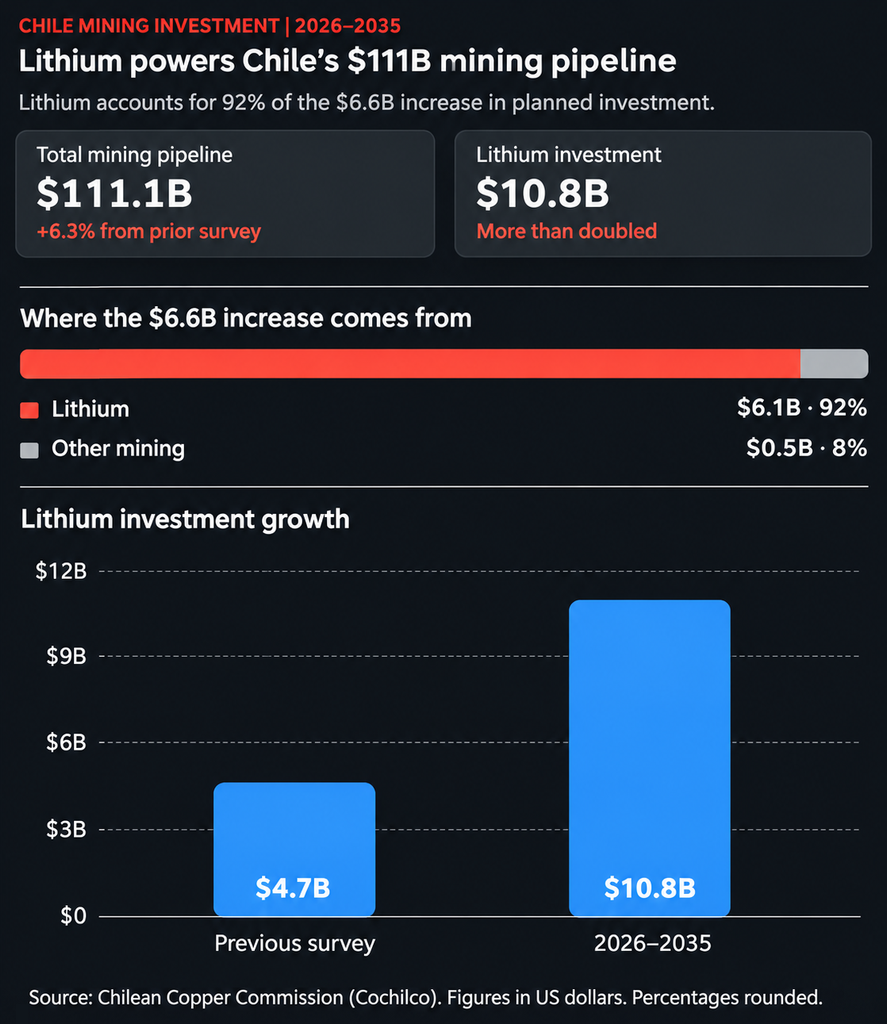
Copper nevertheless accounts for 84.5% of planned spending, or about US$93.9 billion.
Among the projects is BHP’s (ASX, LON, NYSE: BHP) US$1.3-billion extension of Escondida’s B1 leach pad, designed to sustain annual production of 210,000 tonnes of copper cathodes.
Capstone Copper (TSX: CS; ASX: CSC) is also planning US$500 million in improvements at Mantos Blancos, extending operations to 2041 and increasing sulphide processing capacity to 9.8 million tonnes annually.
Regional pressures
Antofagasta leads Chile’s regions with US$51.5 billion in planned mining investment, representing about 46% of the national total. Copper projects account for US$45 billion of that amount, or roughly 87%.
The regional pipeline also includes proposed upgrades at Escondida, Spence and Sierra Gorda.
The Capricorn Bioceanic Corridor is intended to link Brazil, Paraguay and Argentina with northern Chile’s Pacific ports, strengthening the region’s transport connections.
Antofagasta also depends on workers from elsewhere in Chile. A Nov. 16 report by the National Statistics Institute, based on the 2024 census, found a net inflow of 27 workers from other regions for every 100 employed residents.
For Novandino, the longer-term investment would accompany a shift in management. SQM manages the venture through 2030, with Codelco due to take over in 2031 under the partners’ agreement.


Be the first to comment on "Chile’s $111B mining boom hinges on lithium approvals"