
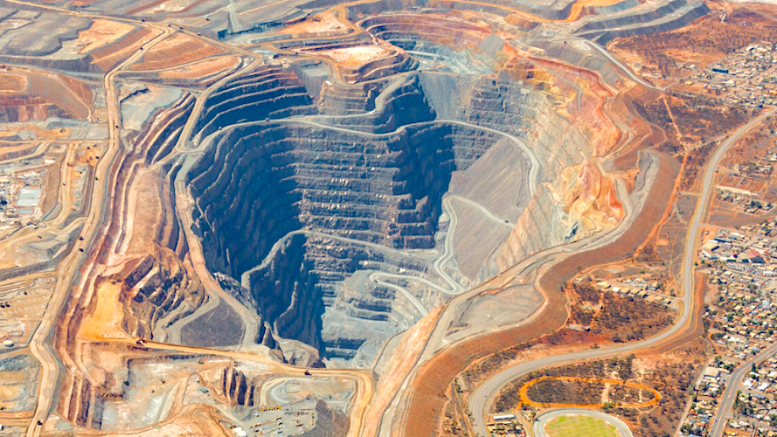
Australian gold output is set to rise as producers expand existing mines before a new set of projects starts later this decade, Melbourne-based mining consultants Surbiton Associates says.
The country produced 303 tonnes worth A$54 billion (C$53.2 billion) last year. Northern Star Resources’ (ASX: NST) Super Pit, about 600 km east of Perth, anchors the near-term gains, with commissioning underway on a plant that is to more than double annual processing capacity to 27 million tonnes from 13 million tonnes.
“Late 2026 and during 2027 will see several substantial expansions of existing operations,” Surbiton Associates director Sandra Close said in a release this week prepared for the Diggers & Dealers conference. “Of these Super Pit will be the largest by far, with its treatment capacity doubling.”
The build-out could push national production beyond the level it has held since 2017 and replace ounces lost as older mines close. Higher gold prices have made low-grade stockpiles and smaller deposits more profitable to process across Australia’s roughly 80 primary gold mines and 20 operations that recover gold as a by-product.
Early gains
Northern Star plans to feed the expanded Super Pit plant with large stockpiles of low-grade material that stronger gold prices have made economic. The company has started commissioning the new circuit.
Newmont (NYSE, ASX: NEM; TSX: NGT) has spent more than A$2.3 billion on a new shaft at its Tanami mine in the Northern Territory. The shaft is designed to hoist 3.8 million tonnes of ore a year, replacing a truck haulage system limited to 2.7 million tonnes. The major expects the project to cut costs and add about 150,000 oz. of annual production.
Capricorn Metals (ASX: CMM) is expanding its Karlawinda plant in Western Australia to 6.5 million tonnes a year from 4 million tonnes. The company expects the upgrade to lift production to 150,000 oz. a year.
Vault Minerals (ASX: VAU) plans to raise processing capacity at King of the Hills by 50%, to 7.5 million tonnes annually, increasing gold output by an estimated 35%. Commissioning is scheduled for mid-2027, although Vault’s planned merger with Genesis Minerals (ASX: GMD) could change the scope or timing.
Next wave
Ora Banda Mining (ASX: OBM) plans to build a 3-million-tonne-per-year plant at Davyhurst in Western Australia for A$375 million. The company aims to start production in the second half of 2028.
Capricorn Metals targets early 2028 commissioning at Mt Gibson, where it plans to build production to 260,000 oz. per year. The project holds 150.9 million indicated tonnes grading 1 gram gold per tonne for 4.7 million oz. and 38.1 million inferred tonnes at 0.8 gram for 969,000 ounces. Probable reserves total 119.3 million tonnes at 1 gram for 3.67 million ounces.
Minerals 260 (ASX: MI6) plans first production from Bullabulling in late 2028. The Western Australian project holds 140 million indicated tonnes grading 0.98 gram gold per tonne for 4.4 million oz. and 51 million inferred tonnes at 1 gram for 1.7 million ounces. Probable reserves total 90 million tonnes at 0.86 gram for 2.5 million oz., based on the earlier December 2025
Longer term
Northern Star’s Hemi project represents the largest later-stage addition in Surbiton’s forecast. The company plans to process 10 million tonnes of ore per year from 2030 and produce about 550,000 oz. annually.
Vista Gold (TSX, NYSE-A: VGZ) aims to bring Mt Todd in the Northern Territory into production by 2030. The company targets about 150,000 oz. a year from 5 million tonnes of ore.
Mt Todd carries execution risk. Hard ore, weak recoveries and high reagent use contributed to the failure of a previous development attempt, leaving Vista to prove it can operate the deposit at a profit.
Regis Resources’ (ASX: RRL) McPhillamys project in New South Wales remains contingent on securing regulatory approvals before a planned final investment decision in 2028.
Be the first to comment on "Bigger plants drive Australia’s next gold gains"