
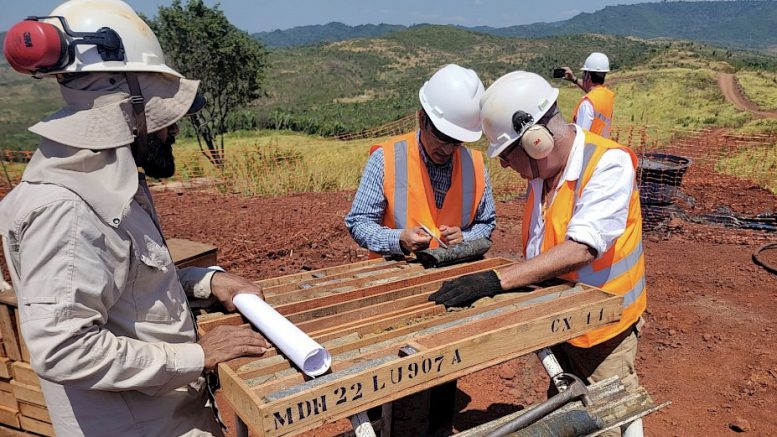
Drill results from Bravo Mining’s (TSXV: BRVO, US-OTC: BRVMF) platinum-palladium (PGM metals) Luanga project in northern Brazil show potential to upgrade and expand its resource, as the company looks to publish a prefeasibility study in the third quarter. Shares rose.
Highlight hole DDH26LU312, one of several drilled in the Central sector, returned 51 metres grading 3.67 grams PGM and gold per tonne, 0.14 gram rhodium and 0.33% nickel from 259 metres depth, Bravo reported Monday. That included 23 metres at 5.59 grams PGM and gold, 0.21 gram rhodium and 0.44% nickel. Luanga is in the Carajás mineral province of Pará state, about 2,700 km north of Rio de Janeiro.
Global scale deposit
“[Luanga] is one of the few large-scale PGM open-pittable deposits globally, located outside major geopolitical risks and labour or infrastructure challenges (for contrast, global PGM supply is currently tied mostly to Russia and South Africa),” National Bank of Canada analyst Rabi Nizami wrote in a note on Monday. “The project’s unique address near other permitted precedent mines and ready rail access could mean faster response time to develop and gain access to global PGM smelter markets; this could differentiate Luanga from PGM development opportunities elsewhere.”
The company’s plan to lead development of a PGM smelter inside a newly created free trade zone in Brazil makes Bravo more attractive for M&A interest, Nizami added.
Continuity and thickness
The Central sector drill results showed grades and thicknesses that exceed those from shallower drilling, Bravo CEO Luis Azevedo said in a release.
“The sections presented in this release also illustrate the Central sector’s strong continuity and consistent thickness as we drill deeper toward the limits of open pit mining,” he said.
The results strengthen the case for upgrading Luanga’s resource ahead of a prefeasibility study, reinforcing its potential for being one of the world’s largest undeveloped PGM projects.
Bravo shares gained 4% to $3.40 apiece on Monday morning in Toronto, valuing the company at $466.5 million. The stock has traded in a 12-month range of $2.66 to $5.52.
Other noteworthy results from the Central sector include hole DDH26LU316, which cut 50 metres grading 2.55 grams PGM and gold, 0.08 gram rhodium and 0.2% nickel from 296.6 metres depth. That hole included 31.34 metres at 3.2 grams PGM and gold, 0.22 gram rhodium and 0.15% nickel.
Another highlight hole, DDH26LU314, returned 29 metres at 2.12 grams PGM and gold, 0.13 gram rhodium and 0.12% nickel from 168.2 metres depth.
Upgrading to indicated
The infill and extensional drilling program for this year at Luanga is aimed at increasing drill density towards upgrading Luanga’s resources from inferred to indicated, Bravo said. Thirteen holes have been drilled so far for a total of 3,494 metres.
A preliminary economic assessment (PEA) from last year outlined an open pit project for Luanga with a base case after-tax net present value (discounted at 8%) of $1.25 billion and an internal rate of return of 50%. Initial capital costs are pegged at $496 million, with a payback period of 2.4 years.
Luanga is forecast to produce annual payable metal averaging 255,000 oz. palladium, 158,000 oz. platinum, 15,000 oz. rhodium, 8,500 oz. gold and 8,549 tonnes of nickel over a mine life of 17 years.
It hosts measured and indicated resources of 158 million tonnes grading 0.98 gram palladium per tonne, 0.62 gram platinum, 0.09 gram rhodium, 0.05 gram gold and 0.12% nickel for 4.9 million oz. of contained palladium, 3.1 million oz. platinum, 450,000 oz. rhodium, 262,000 oz. gold and 194,848 tonnes nickel.
Inferred resources add 78 million tonnes averaging 0.97 gram palladium, 0.59 gram platinum, 0.08 gram rhodium, 0.05 gram gold and 0.13% nickel for 2.4 million oz. contained palladium, 1.4 million oz. platinum, 202,000 oz. rhodium, 128,000 oz. gold and 97,719 tonnes nickel.
Be the first to comment on "Bravo drill results at Luanga platinum-palladium site highlight project growth"