
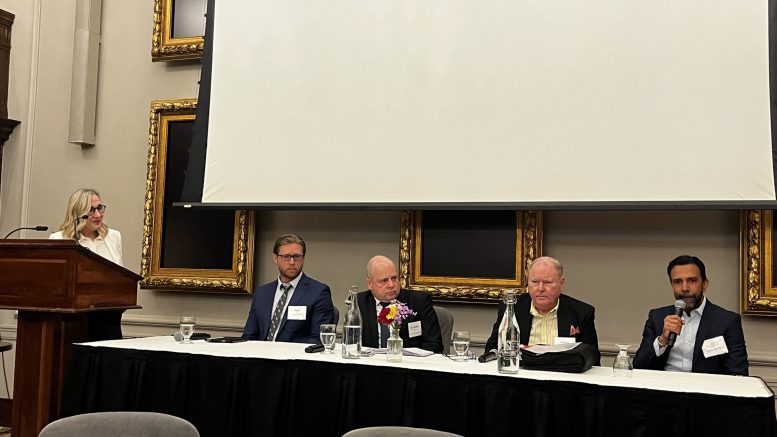
In the West’s efforts to catch up with China’s lead in critical minerals development, more companies are warming to government financing than in previous years when governments were regarded as a burden, a conference panel heard Wednesday.
Public-sector backing is increasingly becoming a key part of financing strategies, said executives from companies focused on rare earths, tungsten, phosphate and platinum group metals (PGMs) at the Critical Minerals Institute Summit 5 in Toronto.
“Having the government coming in and doing the diligence, the nod of confidence, and really talking about why we were so strategic – without them doing that, I don’t think that money would have come in so quick,” USA Rare Earth (Nasdaq: USAR) Vice-President of Mining and Processing Alex Moyes said about raising $1.5 billion (C$2 billion) before its acquisition of Serra Verde in April.
China’s challenge
The attitude shift marks a change from past years when many miners largely viewed governments as regulators and permitting authorities rather than financing partners. Companies realize the scale of the challenge presented by China’s 60-plus year-lead on critical metals development, especially with rare earths. The Trump administration is not just funding projects, but taking equity stakes in companies such as Perpetua Resources (Nasdaq, TSX: PPTA), Lithium Americas (TSX, NYSE: LAC) and others.
Panellists said government support can now help unlock private investment by validating projects through technical reviews and strategic endorsements.
Moyes pointed to his company’s January announcement of a proposed $1.6-billion financing package with the Department of Commerce under the CHIPS Act, including $277 million in proposed direct funding and a $1.3-billion senior secured loan. The company is also developing the Round Top rare earths project in Texas and a magnet manufacturing facility in Oklahoma.
Governments demand results
Moyes described the government review process as more rigorous than many commercial financings, involving months of due diligence, technical assessments and milestone requirements.
“They’re not just giving us the money. We have to perform,” Moyes said. “You have to hit these very, very strict milestones.”
American Tungsten (CSE: TUNG; US-OTC: TUNGF), which is advancing the IMA project in Idaho, has also pursued support from U.S. state and federal agencies. CEO Ali Haji said the Toronto-headquartered company secured a $25.5-million conditional financing package from the Export-Import Bank of the United States tied to future technical studies and project milestones.
“I think the government helps keep you more honest rather than a private investor,” he said.
The company is interested in Prime Minister Mark Carney’s C$25-billion (US$18.2 billion) sovereign fund for large scale projects, Ali said. Still, he prefers partnerships with various different government branches and minority stakes rather than majority stakes “because then we’re essentially a socialist country.”
Bipartisan support
Executives said critical minerals are getting backing across party lines in U.S. industrial-policy priorities because of their importance in defence systems, semiconductors, energy infrastructure and manufacturing.
“Critical minerals seem to be one of the most bipartisan areas of focus right now,” Moyes said. “If it goes from Republican to Democrat, the focus is executing. It’s going to be very hard for any political party to throw stones if we’re actually getting it done.”
Greenland Mines (Nasdaq: GRML) CEO Bo Stensgaard said Europe has also accelerated efforts to support domestic critical minerals supply chains, though complex regulations and long permitting timelines remain challenges. Greenland Mines is developing the Skaergaard PGM project in southeast Greenland.
Stensgaard argued governments should focus on helping de-risk infrastructure, transportation and processing rather than replacing private-sector investment.
“It’s not about owning the rock,” he said. “It’s about owning the middle part and how we get into the refined product.”
Red tape
Not all executives welcomed heavier government involvement. Nevada Organic Phosphate (CSE: NOP; US-OTC: NOPFF) CEO Robin Cornwell criticized U.S. federal permitting delays and environmental review requirements on public lands in Nevada, saying they remain cumbersome and expensive for junior explorers. The company is developing an organic phosphate project in northeastern Nevada.
Panellists also pointed to growing investor interest in U.S. stock exchanges for critical minerals companies as Washington ramps up industrial policy support for domestic mineral supply chains.
“There’s a lot more doing in the U.S. than there is talking,” Moyes said.
Be the first to comment on "Government funding now a plus not a burden, miners say"