
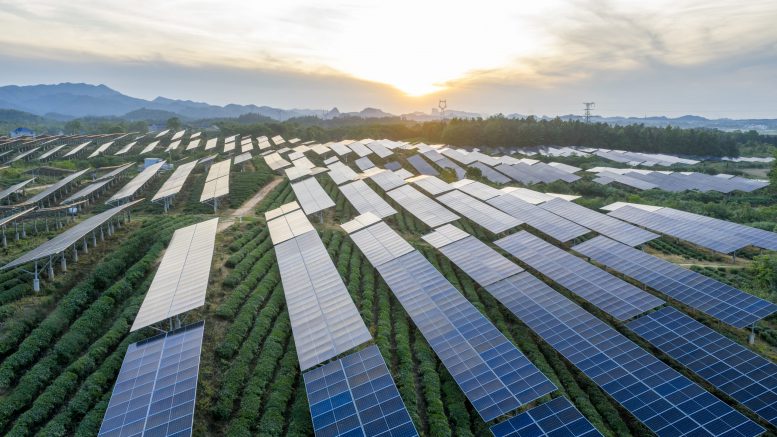
Soaring silver prices and surging solar demand are forcing panel manufacturers to rethink how much of the white metal goes into every cell. But analysts warn the efficiency gains may not be enough to offset a structural squeeze.
Silver demand has been consistently outpacing supply for the last six years, with the Silver Institute’s World Silver Survey 2026 projecting a 46.3-million oz. deficit. Tightened physical supply alongside geopolitical uncertainty and investment demand helped silver briefly top $120 per oz. in January from $30 an oz. a year earlier before pulling back. The price was around $74 per oz. on Thursday.
“Silver at $80 really encourages a very aggressive move for thrifting [and] outright substitution in favour of copper,” Philip Newman, managing director of London-based consultancy Metals Focus, which researches the World Silver Survey, said in an interview. Thrifting refers to using less silver per panel without reducing performance.
According to the Silver Institute, which published the World Silver Survey 2026, silver use in photovoltaics fell 6% last year to 186.6 million oz. and is forecast to decline a further 19% in 2026 to around 151 million ounces.
Key driver
Photovoltaics, the largest industrial source of silver consumption, have emerged as a key driver of demand growth in recent years, helping push the market into repeated deficits. Between 2020 and 2024, silver use in photovoltaic applications more than doubled to roughly 197 million oz., up from about 82 million ounces.
That surge also triggered a rapid response from manufacturers. The rise in silver prices pushed the metal’s share of solar cell costs from roughly 8% to more than 20%, accelerating efforts to reduce silver loadings and preserve margins.
However, thrifting may not be enough to curb demand. In North America, policy support and utility-scale buildout drove photovoltaic installations in 2025. U.S. demand for silver powder used in solar manufacturing rose 4% year over year, according to the World Silver Survey.
Momentum is expected to slow in 2026 as global installations flatten, with some banks and insurers also pulling back financing and coverage amid uncertainty over subsidy eligibility and evolving trade rules tied to China-linked supply chains.
Green energy support
China remains the key swing factor. The country accounts for roughly 80% of global solar manufacturing capacity, while firms including LONGi and Trina Solar expanded aggressively into the U.S. after the Biden administration’s 2022 clean-energy incentives helped trigger roughly $43 billion in announced solar manufacturing investment and an estimated 48,000 jobs.
However, new U.S. rules limiting Chinese ownership and control in subsidized factories have created regulatory uncertainty, prompting some buyers, lenders and insurers to avoid China-linked projects.
Installations in China hit a record 315 GW in 2025, though activity was heavily front-loaded as developers rushed to meet policy deadlines before slowing later in the year amid grid constraints and weaker pricing conditions.
On the manufacturing side, some Chinese producers shifted capacity offshore in response to U.S. tariffs and trade restrictions, while demand from emerging markets continued to support output growth. China’s solar market is expected to cool in 2026 as policy support normalizes and overcapacity pressures persist.
Thriftier approach
Thrifting has played a major role in moderating solar demand for the precious metal in panel manufacturing. “It varies considerably by year, but even when prices were very low, there was an element of thrifting,” metals consultant Newman said.
However, the process has accelerated over the last two years. Manufacturers are refining how silver paste is applied inside solar cells and adjusting cell layouts to reduce the amount needed, cutting silver use by around 10% compared with earlier designs. New “zero busbar” techniques and ultra-fine printing methods can reduce silver use by another 10% to 20%.
Production has also shifted towards TOPCon cells, a newer high-efficiency solar technology now dominant in China. The technology improves electrical efficiency inside the cell.
Other companies are developing copper electroplating and pure copper pastes that could further reduce silver use.
The industry expects average silver loadings in mainstream photovoltaic cells to fall below 5 milligrams per watt by 2027, according to World Silver Survey data.
While there are ways to reduce silver use, Robert Godin, co-lead of the University of British Columbia Okanagan’s solar energy research cluster, said the technology remains difficult to scale. He said that while substituting with copper could decrease the amount of silver per module by tenfold (90%), silver is still relatively cheap compared with more advanced alternatives.
The properties of silver make it good at this job, Godin told The Northern Miner. “It works, it’s cheap, and people are not looking too hard at changing that process.”
Godin said that while reducing silver amid rising prices and supply deficits is driving the thrifting and substitution narrative, removing silver from the process is a low priority on the research and development side. There are also design barriers to how far efficiency can be pushed.
“There are some hard physical limits that we’re getting pretty close to,” he said. “But [panels] can definitely be twice as cheap.”
Uneven demand
Policy signals in the U.S. have added another layer of uncertainty, as the Trump administration moves to scale back parts of the federal energy transition agenda while maintaining support for domestic industrial buildout and grid reliability.
The result is a more selective policy environment, with clean-energy projects increasingly shaped by financing conditions, subsidy eligibility and trade exposure rather than broad deployment targets.
Ian Lange, an economist at the Colorado School of Mines’ Payne Institute for Public Policy, said that disconnect is often missed in transition planning. Most models assume deployment targets are met and then work backwards into material demand, Lange said. In reality, he said, higher input costs feed directly into build decisions.
“If silver is higher, we just don’t install as many solar panels,” Lange said.
That creates a feedback loop between commodity markets and deployment that is often absent from energy transition forecasts, where mineral inputs are treated as scalable rather than price sensitive. For silver, that means demand is not a straight line from installed capacity.
Thrifting and substitution are reducing the metal intensity per panel, but price signals are also shaping how many projects get built in the first place. Outside solar, structural demand growth is still coming from grid expansion, automotive applications and AI-driven power demand, which continue to underpin industrial consumption.
Lange said silver’s designation as a critical mineral should drive research and innovation. “Within the U.S. federal system, the criticality is really supposed to be a marker for let’s find a substitute,” Lange said. “That’s supposed to direct federal research dollars [but] I’ll say I haven’t seen good evidence that it actually does that.”
The World Silver Survey forecasts industrial fabrication to decline by 2%this year, to a four-year low of around 650 million ounces. Newman points out that photovoltaics are the most volatile area of silver demand.
Energy security
The policy backdrop has also shifted the tone of the solar buildout itself. What was once largely framed through decarbonization is increasingly being driven by energy security and supply-chain resilience.
“When we put the survey together back in late March, we had to make an assumption about the war in Iran being short-lived,” Newman said.
With the Strait of Hormuz still closed as of late May, and energy prices astronomically high, Newman said the market could respond by investing in alternative energy solutions like solar.
“That security standpoint carries a lot of momentum — there’s more investment going on,” he said. “Even if installations go to the races, I don’t see it getting back to what we saw the past three years.”
Be the first to comment on "Solar silver thrifting not enough to curb demand "