
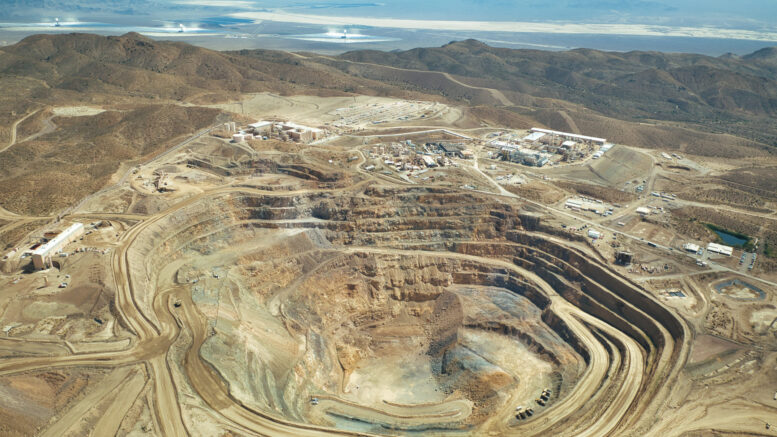
Some mining stories deserve a second look because their significance wasn’t fully appreciated at the time. Taking a cue from The New York Times’ obituaries of people overlooked in its earlier coverage, this instalment of From the Archives revisits California’s Mountain Pass mine. Its role in building America’s rare earth industry deserves renewed attention as the United States seeks to reclaim that industrial strength.
Before rare earths became a source of friction between Washington and Beijing, a California mine helped bring a brighter red into the world’s living rooms.
Mountain Pass, in the Mojave Desert southwest of Las Vegas, supplied europium for the phosphors used in colour television screens. During the 1960s, an expanding consumer market helped turn a deposit discovered by uranium prospectors into a leading source of minerals whose names few viewers would have recognized.
“The most important invention in the evolution of Mountain Pass was the commercialization of color television in the mid-1960s,” a 2007 U.S. Geological Survey account of the deposit’s geology and history noted.
For this instalment of From the Archives, we’re revisiting a development whose significance deserves a fuller look: America’s rise as a rare earth supplier, decades before securing those materials became an urgent national priority.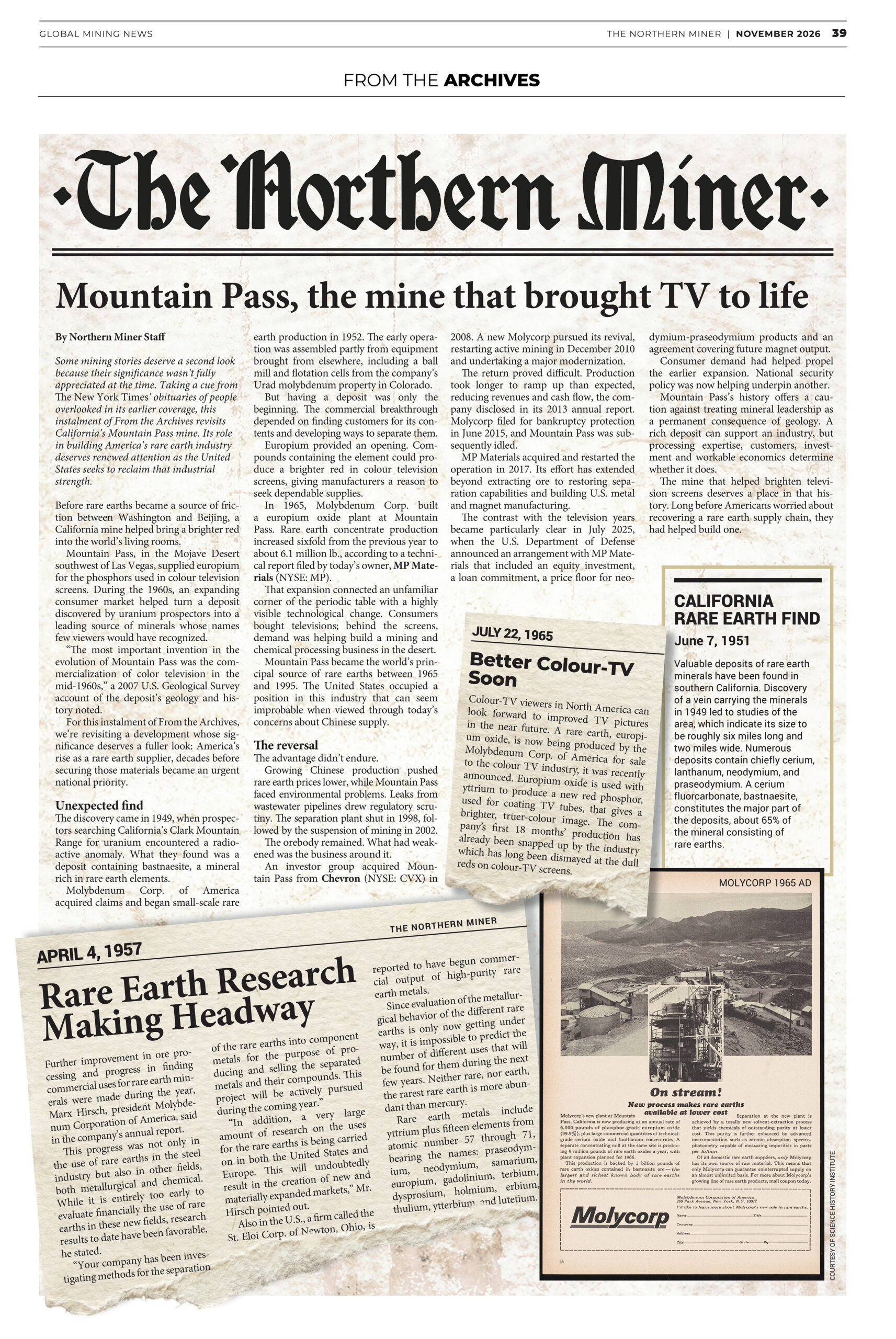
Unexpected find
The discovery came in 1949, when prospectors searching California’s Clark Mountain Range for uranium encountered a radioactive anomaly. What they found was a deposit containing bastnaesite, a mineral rich in rare earth elements.
Molybdenum Corp. of America acquired claims and began small-scale rare earth production in 1952. The early operation was assembled partly from equipment brought from elsewhere, including a ball mill and flotation cells from the company’s Urad molybdenum property in Colorado.
But having a deposit was only the beginning. The commercial breakthrough depended on finding customers for its contents and developing ways to separate them.
Europium provided an opening. Compounds containing the element could produce a brighter red in colour television screens, giving manufacturers a reason to seek dependable supplies.
In 1965, Molybdenum Corp. built a europium oxide plant at Mountain Pass. Rare earth concentrate production increased sixfold from the previous year to about 6.1 million lb., according to a technical report filed by today’s owner, MP Materials (NYSE: MP).
That expansion connected an unfamiliar corner of the periodic table with a highly visible technological change. Consumers bought televisions; behind the screens, demand was helping build a mining and chemical processing business in the desert.
Mountain Pass became the world’s principal source of rare earths between 1965 and 1995. The United States occupied a position in this industry that can seem improbable when viewed through today’s concerns about Chinese supply.
The reversal
The advantage didn’t endure.
Growing Chinese production pushed rare earth prices lower, while Mountain Pass faced environmental problems. Leaks from wastewater pipelines drew regulatory scrutiny. The separation plant shut in 1998, followed by the suspension of mining in 2002.
The orebody remained. What had weakened was the business around it.
An investor group acquired Mountain Pass from Chevron (NYSE: CVX) in 2008. A new Molycorp pursued its revival, restarting active mining in December 2010 and undertaking a major modernization.
The return proved difficult. Production took longer to ramp up than expected, reducing revenues and cash flow, the company disclosed in its 2013 annual report. Molycorp filed for bankruptcy protection in June 2015, and Mountain Pass was subsequently idled.
MP Materials acquired and restarted the operation in 2017. Its effort has extended beyond extracting ore to restoring separation capabilities and building U.S. metal and magnet manufacturing.
The contrast with the television years became particularly clear in July 2025, when the U.S. Department of Defense announced an arrangement with MP Materials that included an equity investment, a loan commitment, a price floor for neodymium-praseodymium products and an agreement covering future magnet output.
Consumer demand had helped propel the earlier expansion. National security policy was now helping underpin another.
Mountain Pass’s history offers a caution against treating mineral leadership as a permanent consequence of geology. A rich deposit can support an industry, but processing expertise, customers, investment and workable economics determine whether it does.
The mine that helped brighten television screens deserves a place in that history. Long before Americans worried about recovering a rare earth supply chain, they had helped build one.
Be the first to comment on "From the archives: Mountain Pass, the mine that brought TV to life"