
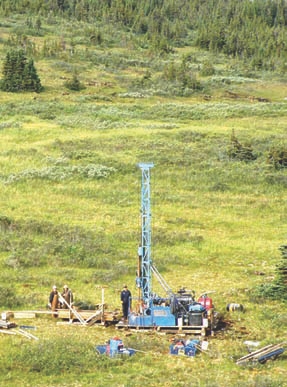
VANCOUVER — These are busy days for Capstone Mining (CS-T, CSFFF-O). The company is drilling to expand resources at its Minto copper-gold mine in the Yukon, acquiring new ground in Mexico covering the strike extension of its Cozamin mine resource, and has just finished a revamped scoping study for its Kutcho copper-zinc project in British Columbia.
At Minto, Capstone recently completed an infill drill program designed to upgrade the confidence in its expansion resource. The last sets of assay results have all come from Minto North, an untapped zone 600 metres north-northwest of the current open pit that has been returning some significant intercepts since its discovery just nine months ago.
Hole 504 cut 40.6 metres of 2.14% copper, 1.39 grams gold per tonne, and 8.4 grams silver from 59 metres depth. Hole 507 returned 23.4 metres grading 3.66% copper, 1.95 grams gold and 13.5 grams silver from 84 metres down-hole. Hole 511 intercepted 22.4 metres averaging 3.32% copper, 1.95 grams gold and 13.8 grams silver from 83 metres depth. And hole 527 hit 2 metres grading 19.89% copper, 4.8 grams gold and 86.6 grams silver.
Minto North has a high-grade core that is covered by a thick, near-surface, moderate-grade horizon. A preliminary estimate in June pegged indicated resources at Minto North at 1.24 million tonnes grading 2.49% copper, 1.86 grams gold and 9.7 grams silver, and inferred resources at 634,000 tonnes averaging 1.88% copper, 1.03 grams gold and 6.4 grams silver.
The June study also estimated resources for two other nearby deposits, which are also amenable to open-pit mining. Combining the remaining resource at Minto Main with Minto North and the other two zones, the total untapped resources at Minto come in at 29.9 million measured and indicated tonnes grading 1.22% copper, 0.46 gram gold and 4.4 grams silver, plus 6.5 million inferred tonnes averaging 1% copper, 0.32 gram gold and 3.3 grams silver, at a 0.5% copper cutoff grade. Compared to the last estimate, completed in 2007, the project’s resources grew by 32.4% in terms of contained copper, 38.3% in terms of contained gold, and 28.1% in terms of contained silver.
Capstone is currently planning a fourth expansion at Minto, which would see daily throughput increase to between 4,000 and 5,000 tonnes from 3,200 tonnes, based on current resources.
However, if the cutoff grade is lowered to 0.2% copper, the resource grows substantially and as such, expansion plans would require an even bigger throughput increase. At a 0.2% copper cutoff, Minto currently hosts 60.7 million measured and indicated tonnes grading 0.76% copper, 0.26 gram gold and 2.7 grams silver, as well as 17.4 million inferred tonnes grading 0.58% copper, 0.16 gram gold and 1.9 grams silver.
Over at its other operating mine, Cozamin in Zacatecas state, Mexico, Capstone has just inked a deal to acquire three mineral claims adjacent to its property. The new claims cover the potential downdip and strike extensions of the resources in the principal San Roberto area of Cozamin, as well as the downdip extension of the San Rafael area.
Two of the new claims hold potential downdip extensions of San Roberto mineralization. Capstone says, however, that the best chance to find additional resources is within the third claim, known as La Esperanza, as it lies immediately east of and on strike with the highest-grade and widest copper-silver mineralization in the San Roberto area. The La Esperanza claim is also immediately downdip of the zinc-silver-rich San Rafael mineral resource. Since underground development work was already in progress in San Roberto, Capstone immediately started work on a drift towards La Esperanza to aid exploration.
Capstone paid US$1 million for the claims, and agreed to a 1.5% net smelter return (NSR) royalty on the first 1 million tonnes of production from the claims rising to a 3% NSR on tonnage thereafter. The NSR also escalates by half a percentage point for each US50¢ increase in the price of copper above US$3 per lb.
And third on the Capstone news docket is a scoping study of its Kutcho project in northwestern B. C. Previous development studies on the copper-zinc project considered a large, open-pit operation with mill throughput between 4,000 and 6,000 tonnes per day. But the capital and operating costs for such an operation were difficult to swallow. So Capstone decided to take a “radically different approach,” as described by president and CEO Stephen Quin, and commissioned a new scoping study to investigate the merits of a smaller-scale, high-grade underground mine.
The results show the new approach may just work. The new mine development plan carries significantly reduced costs and, as an underground operation, reduces the project’s environmental footprint considerably.
A mill would churn through 2,500 tonnes of ore each day to produce separate copper and zinc concentrates. Byproduct gold and silver would report to the copper concentrate. In a year, the operation would produce 33.9 million lbs. copper, 41.7 million lbs. zinc, 2,858 oz. gold, and 454,000 oz. silver.
Tailings would either be filtered and disposed of underground, as paste backfill, or filtered and dry stacked within a lined facility, which means there would be no need to develop a conventional tailings storage facility.
The cash cost to produce a pound of copper, net of gold, silver, and zinc credits, is expected to be US$1.41. Capstone hopes to lower that cost by investigating optimization options suggested in the report, which include improved recoveries and reduced power costs.
The Kutcho property hosts three volcanogenic massive sulphide (VMS) deposits. The deposits — Main, Sumac, and Esso — are aligned on a westerly plunging trend. The Main, which is the largest of the three deposits, comes to surface at the eastern end of the trend and reaches 250 metres depth; 1.5 km to the west the Esso deposit sits at 400 to 600 metres below surface. The trend remains open down-plunge, where Capstone and its predecessors have only conducted cursory exploration.
Together, Main, Esso, and Sumac host a resource of 10.4 million measured and indicated tonnes grading 2.14% copper, 2.85% zinc, 0.36 gram gold and 32.4 grams silver. Inferred resources add 1.89 million tonnes averaging 2.09% copper, 2.93% zinc, 0.46 gram gold and 33.6 grams silver.
The reason metallurgical recoveries are yet to be optimized is that the Kutcho deposits, like many VMS deposits, are composed of fine-grained mineralization. To extract metals from a fine-grained deposit requires a fine primary grind followed by a very fine regrind. Based on test work by various Kutcho owners, Capstone currently expects recoveries to average 84% for copper, 74% for zinc, 27% for gold, and 52% for silver.
Using metal prices of US$2.25 per lb. for copper, US70¢ per lb. for zinc, US$750 per oz. for gold and US$12 per oz. for silver, the new plan at Kutcho gives it a pretax net present value (NPV) of $63 million, using a 10% discount, and a pretax internal rate of return of 19%. Capital cost payback would be achieved in 5.2 years.
In the first six months of the year, Capstone saw US$48.9 million cash flow from its operations, stemming from sales of 45.1 million lbs. copper, translating into adjusted net earnings of US$47.3 million. As of the end of June, the company had US$111.6 million in working capital, including US$70.4 million in unrestricted cash, and carried a total debt load of US$29.3 million. The company reduced its debt load considerably when it raised US$49.5 million through a bought-deal equity financing in May and then used most of that cash to repay a US$40-million credit facility.
Capstone’s share price is currently hovering above $3, closing recently at $3.25. In December, its shares could be had for just 75¢. The company has 196 million shares outstanding.
Be the first to comment on "Capstone On A Tear From Yukon To Mexico"