
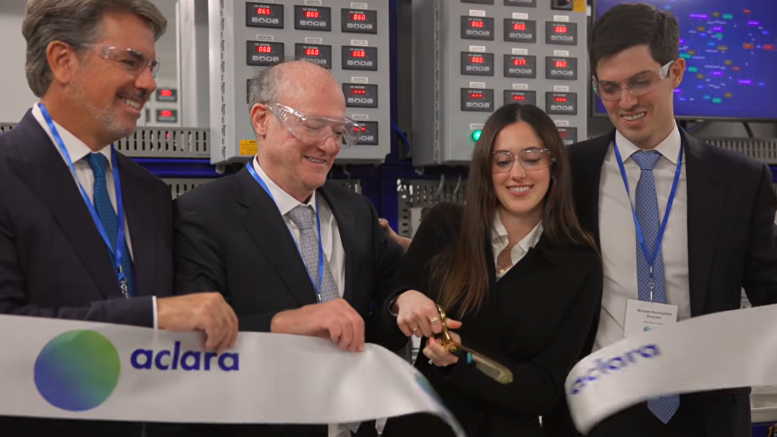
Aclara Resources (TSX: ARA) has inaugurated its rare earths separation pilot plant in Virginia, marking the start of one of the few integrated supply chains for the metals outside of China.
The now-commissioned facility is to validate Aclara’s proprietary rare earth separation technology and support the development of the company’s commercial-scale separation plant in Louisiana, according to a statement issued Thursday. The Virginia Tech plant at Blacksburg is expected to produce its first separated light rare earth oxides in May and heavy rare earth oxides in August, mined from Aclara’s ionic clay sites in Brazil and Chile.
Western catch-up push
Once operational, the pilot and Louisiana plants would position Aclara among a small handful of Western companies with rare-earth separation capabilities, a key technological bottleneck where the West is still playing catch-up to China. Energy Fuels (TSX: EFR; NYSE: UUUU) and MP Materials (NYSE: MP) in the United States and Lynas Rare Earths (ASX: LYC) in Australia and Malaysia are the core Western producers outside of China that can separate rare earths at scale. Aclara’s facility in Port of Vinton, La. is due for completion in 2027.
The Virginia milestone adds to wider momentum for rare earths in North America, with the U.S. International Development Finance Corporation (DFC) in February investing $565-million in Serra Verde, which operates the Pela Ema site in Brazil, Latin America’s sole rare earths miner. Apple and the U.S. government last year also invested in MP Materials.
Despite Aclara’s announcement, its shares fell almost 15% to $2.74 apiece in Toronto on Thursday morning in Toronto, amid a broader stock-market selloff caused by the war in the Middle East. Aclara has a market capitalization of $653.4 million. The stock has traded in a 12-month range of 49¢ to $4.65.
$50M for development
The announcement comes as Aclara closed on Thursday a $50 million (C$68.6 million) private placement, whose proceeds it plans to spend on developing projects such as Carina.
Blacksburg will produce the separated light rare earths neodymium and praseodymium (NdPr) and heavy rare earths dysprosium and terbium. A team of Virginia Tech researchers are working on optimization and advanced analysis at the plant, located about 300 km southeast of state capital Richmond. The company invested about $5 million in the plant, Broadhurst said.
The separation process for the heavy rare earths involves 340 stages and the goal is to produce samples that demonstrate quality for customers, he added.
“It’s not too difficult to produce the lights, but producing the heavies is a much more intense process, which is why we have so many stages.”
Brazilian anchor asset
The main feedstock for the Virginia and Louisiana plants will come from Aclara’s Carina deposit in Brazil’s Goiás state. The open-pit project could produce 149 tonnes dysprosium, 25 tonnes terbium and 1,170 tonnes of NdPr annually over an 18-year life, according to a prefeasibility study from November.
Carina has a post-tax net present value (at an 8% discount rate) of $1.07 billion and an internal rate of return (IRR) of 21.8%. Initial capital costs of $548.3 million could be repaid in 4.5 years.
The DFC has pledged up to $5 million in development funding for that study.
Aclara submitted its Environmental Impact Assessment for Carina last May and plans to complete a feasibility study in the second quarter of 2026. Early works could start at the site by mid-2026, with operations starting in mid-2028.
The Vancouver-based company is also developing the Penco Module project in Chile. Penco is estimated to produce about 774 tonnes of rare earth oxides (REO) annually over 14 years, according to a preliminary economic assessment from 2021.
At a base case price of $96 per kg of REO, Penco has an after-tax NPV (at a 5% discount rate) of $178 million and an IRR of 23%. Initial capital of $119 million could be repaid post-tax in 4.7 years.
Aclara’s major shareholders include Eduardo Hochschild, with 37%; Hochschild Mining (LSE: HOC), with 20%; and CAP S.A., with 10%.
Be the first to comment on "Aclara nears new rare earth supply chain outside China"