
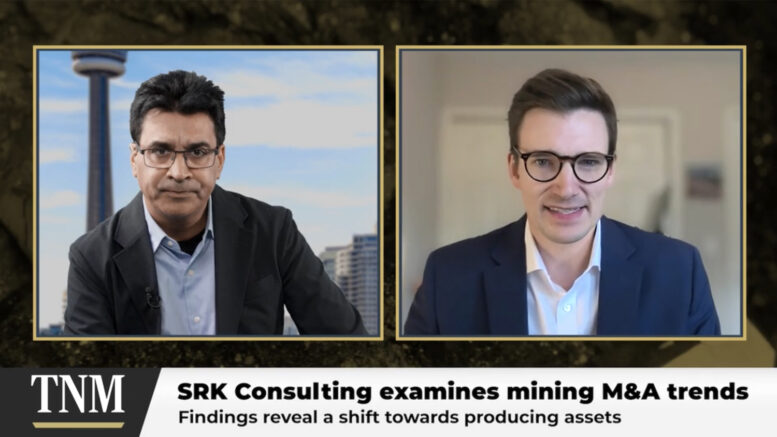
Longer permitting timelines and construction cost overruns are pushing mining companies towards acquisitions, but buying an operating mine brings its own liabilities, says Stuart Smith, SRK Consulting’s chief operating officer for North America.
Smith spoke with The Northern Miner about the forces shaping mining mergers and acquisitions, opportunities for juniors and why technical due diligence matters when buyers weigh growth against risk.
The Northern Miner: What’s changed in mining M&A over the past five years?
Stuart Smith: First of all is the build versus buy decision. Build seems to be losing to buy. Permitting timelines are becoming longer in a number of jurisdictions. We see capital cost overruns hitting the headlines and producing or near producing assets seem to be garnering more attention.
Secondly, we’re seeing new entrants in terms of capital available to people who are trying to move projects forward, whether that’s streaming companies being more active in the market, state-backed lending institutions, or even equity institutions. And finally, OEMs [original equipment manufacturers] with vertical integration into their battery supply chains.
Finally, and perhaps not new, but more important than ever, is timing and discipline still matter. You’re seeing transactions in price environments that, in hindsight, look good or bad, depending on the time of the transaction.
TNM: Why does gold generate so many deals, while copper attracts larger investments?
SS: Gold’s historically a more fragmented market. You see record prices creating megadeals, but even if those do occur, you see spinoffs of tier two or non-core assets kind of perpetuating that fragmentation.
In terms of the copper space, certainly majors are going after large tier one long-life assets. That’s really supported by this longstanding theme of electrification and the supply-demand imbalance that a lot of people are predicting in the future.
TNM: What risks come with buying an operating mine?
SS: Well, we’re certainly seeing clients lean to producing assets, or at least have some form of near producing criteria, whether that be a completed PFS [prefeasibility study], FS [feasibility study], or permits in hand. It’s a bit of a double-edged sword in our view.
With a project, you can engineer the risks out, but when you buy a producing asset, you’re inheriting risks, whether that’s water treatment, geochemistry issues, tailings, or closure.
This is where when looking at producing assets, due diligence really earns its keep.
TNM: Where does that leave junior exploration companies?
SS: I personally think that there’s still plenty of place for juniors in our market. M&A moves assets around, but it doesn’t create them.
The other thing that we see is these post-merger spinoff assets can create a world in which juniors can acquire a quite good quality asset and build a portfolio around it. From our perspective, what really matters here is juniors need to be in a place where they have data and a story of the asset that stands up to due diligence.
TNM: Will investors pay more for assets in Canada and Australia?
SS: In short, yes. Australia and Canada are blessed geologically as well, so there’s certainly more assets available.
But getting those assets through permitting also provides a premium in those jurisdictions where it’s been historically difficult sometimes to get assets all the way to production. There are risks associated with other jurisdictions, whether you see what happened in Panama or in Mali, which are these low likelihood, high consequence risks that are hard to price in, but a safe jurisdiction certainly looks good.
But the final thing I’ll say about that is that even if you’re in a good jurisdiction, a good jurisdiction doesn’t fix a poor asset.
TNM: How do Chinese buyers approach acquisitions differently?
SS: Well, Chinese firms can look at deals differently. They’re taking the approach of a longer time horizon. Supply security is key. They’re able to act counter-cyclically, which we can’t see out of a number of the Western firms, where they can make deals that in hindsight look very well timed.
The issue that they’re facing now is they’re limited by a number of things like foreign investment reviews in some jurisdictions, and this is pushing them into areas like Africa and Latin America, as you suggest, where competition’s becoming quite hot for good assets.
The final thing I’ll say there is I think the narrative of Chinese firms having not as strong ESG [environmental, social and governance] credentials as the West is dying out and Western firms no longer automatically have the upper hand in that area.
TNM: How does SRK bring technical expertise and local knowledge together?
SS: SRK looks at the entire mining lifecycle through exploration, geology, mining environment, all the way through to closure.
And by taking that holistic picture, we’re able to understand the true picture of the asset across all the disciplines; not only from a technical basis, but we have people around the world in all the major mining jurisdictions and we can really bring that local understanding, but also a global context.
TNM: How do you help clients assess risk in a volatile market?
SS: Risk tolerance is really going to come down to the acquirer, the buyer and their unique situation. I think where we like to set ourselves apart is being able to understand the technical fundamentals of the asset and link that to the business transaction that’s being contemplated.
And so we’re not just looking at the pure technical, but also the context of our client and that’s really the fundamentals that matter regardless of the environment.
TNM: Where do you see the next opportunities in mining M&A?
SS: Well, I think we’re going to see the copper theme continue to play out. Electrification is not going away.
The recent retreat in gold price will, I think, change the market slightly, but the tailwinds are still certainly there, and I think it’s a very constructive time to be in the mining stream.
The preceding sponsored article is PROMOTED CONTENT paid for by SRK and produced in co-operation with The Norther Miner. Visit: https://www.srk.com/en/ for more information.


Be the first to comment on "Sponsored Q&A with SRK video: Stuart Smith on mining’s shift from build to buy "