
First Canadian Graphite (TSXV: FCI; US-OTC: GRAPF) plans to start drilling its Zone 13 discovery at Lac Guéret South in Quebec next month and deliver a first resource estimate early next year.
CEO John LaGourgue is targeting as much as 20,000 metres of drilling to test whether the broad surface mineralization extends at scale below ground. The project is roughly 6300 km by road from Quebec City through Baie-Comeau.
“We’re not messing around,” LaGourgue told The Miner last month. “We could go from discovery to a resource estimate inside of about a year.”
The drilling is the key scale test for a junior whose only defined deposit is an older, high-grade Zone 1 estimate that it now treats as historical. A larger Zone 13 resource would put Lac Guéret South alongside more advanced projects in Quebec’s emerging Manicouagan graphite district.
It includes neighbouring Nouveau Monde Graphite’s (TSX: NOU; NYSE: NMG) Uatnan project and Focus Graphite’s (TSXV: FMS; US-OTC: FCSMF) Lac Tétépisca deposit about 5 km north of Uatnan.
Summit
The timing comes as Ottawa pushes graphite higher on its critical-minerals agenda. Focus attended Prime Minister Mark Carney’s Canada Investment Summit in Toronto, where its Lac Knife project featured in the investor deal book alongside Abasca Resources’ (TSXV: ABA) Loki graphite project in Saskatchewan. Ottawa is also backing Nouveau Monde’s Matawinie mine with a seven-year commitment to buy 30,000 tonnes of concentrate annually and $459 million in financing.
FC Graphite shares have gained 43% over the past year. They traded at 40¢ near press time in Toronto, valuing the company at $18.5 million (US$13.3 million).
Scale test
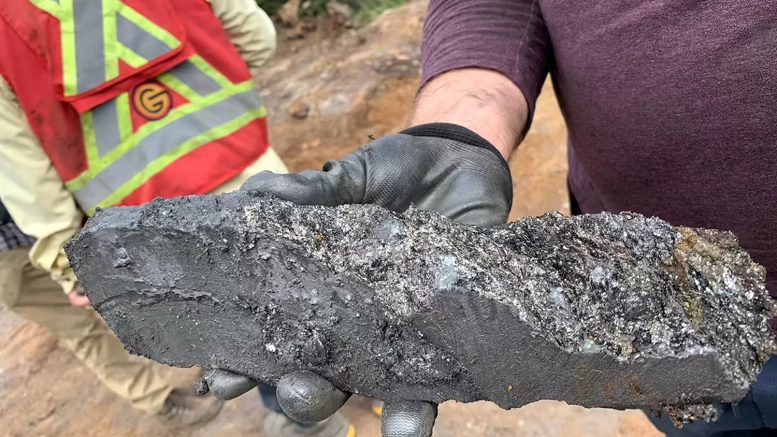
An airborne electromagnetic survey early this year outlined a Zone 13 conductor about 3.8 km long and up to 600 metres wide. Field crews later traced graphite-bearing outcrops and near-surface mineralization across about 3.3 kilometres. Forty-six surface samples returned as much as 43% graphitic carbon, with more than 30% of them grading above 20%.
FC must show the surface mineralization continues at depth with enough width and continuity to support a resource.
A second helicopter survey was underway last month to trace conductors beyond the original coverage. LaGourgue plans stripping and channel sampling this month to tighten drill targets before moving a rig onto the property. The work remains subject to Quebec authorization.
The company has amassed more than 200 sq. km of claims and optioned ground around Lac Guéret South, 234 km north of Baie-Comeau in Quebec’s Côte-Nord region. Zone 13 sits among seven main conductive targets identified across the property.
Zone 1 provides evidence of high grades but not the scale FC Graphite is seeking. A 2019 estimate outlined 1.76 million indicated tonnes grading 17% graphitic carbon and 1.53 million inferred tonnes at 16%. The company now treats those figures as historical.
Mine strategy
FC Graphite plans a simpler development route than several North American peers pursuing mines alongside downstream battery-material plants. It wants to mine graphite, produce concentrate and sell it to processors rather than build its own spherical graphite or anode-material facilities.
“It’s hard enough to run a mining business,” LaGourgue said. “We want to be miners.”
Quebec City-based Corem is testing four roughly 20-kg samples from Lac Guéret South, including two from Zone 13. The work will assess graphite liberation, flake size, concentrate purity and how readily the material responds to flotation. FC Graphite expects those results to help define a saleable product before it approaches buyers and strategic investors.
LaGourgue said he would prefer several customers rather than depend on a single buyer and does not plan to target China. That leaves FC Graphite exposed to the still-developing Western processing market, but avoids adding the cost and technical risk of building downstream plants itself.
The property has year-round road access. Hydro-Québec’s Manic-5 complex provides nearby grid power, while Baie-Comeau offers a deep-sea port on the St. Lawrence. FC Graphite has hired Pessamit Innu-owned Groupe Nipi for field access and environmental work on the property, which lies on the Pessamit Innu’s Nitassinan ancestral territory.
Capital plan
FC Graphite had about $3 million, according to LaGourgue. He estimated a 20,000-metre program would cost about $4 million, meaning the full campaign would require more funding even though the company says its planned work through this year is financed.
Quebec exploration incentives could reimburse about 45% of eligible spending, according to LaGourgue, reducing the amount FC Graphite would need to raise. He wants to limit dilution and retain enough cash to move into economic studies if drilling confirms the scale he is targeting.
Be the first to comment on "FC Graphite pushes towards first resource"