
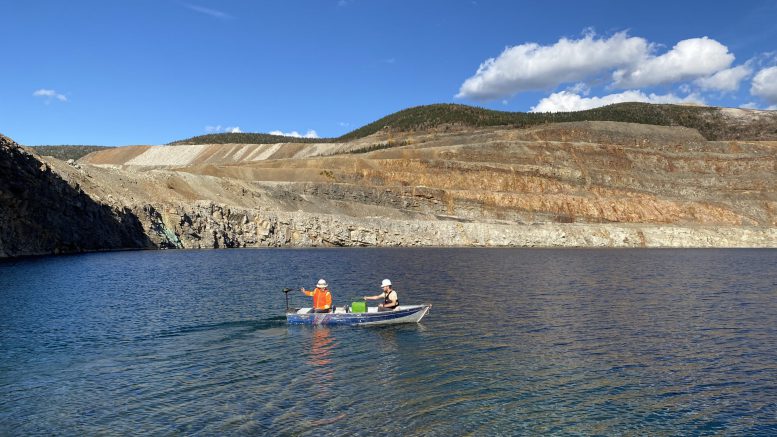
Osisko Metals (TSX: OM; US-OTC: OMZNF) expects its Gaspé copper project in Quebec to get even bigger as new drilling fills gaps in the resource and deeper mineralization is added to the extraction plan.
Crews are on track to complete Osisko’s 50,000-metre drill program by mid-October, which would allow the assay database to be ready in January, CEO Robert Wares said. Management is even weighing whether to publish an interim resource this fall that would incorporate tonnes from the Porphyry Mountain deposit.
The latest drilling results, released Sept. 28, extended mineralization outside the current resource model around Needle Mountain. Drill hole 30-1243 cut 211.5 metres grading 0.59% copper, including 28.5 metres grading 2.31% copper and 11.8 grams silver per tonne. Drill hole 30-1236 returned 86.5 metres grading 1.36% copper, including 18 metres at 4.53% copper and 23.3 grams silver.
The results also included drill hole 30-1239, which cut 63.8 metres grading 0.98% copper, including 16.1 metres grading 2.54% copper and 8.98 grams silver per tonne. Osisko said the higher-grade intercepts support a potential westward expansion of the pit in the next resource update.
Osisko’s latest Gaspé resource, dated April, more than doubled the site’s copper content. Gaspé is estimated to hold 1.83 billion measured and indicated tonnes grading 0.27% copper, 0.017% molybdenum and 1.57 grams silver per tonne for 10.77 billion lb. copper, 673.2 million lb. molybdenum and 92.8 million oz. silver of contained metal.
Osisko calls the former Noranda mine, which closed in 1999, one of the largest undeveloped copper resources in North America.
“There’s still significant growth ahead in the next six months,” Wares told The Northern Miner in an interview.
“With the new underground resources we can define, the tonnage and grade will be significant. In fact, it’s going to end up being certainly the biggest mine in Quebec, and probably the biggest mine in Canada at this rate.”
Material change
Once built, Gaspé will be about 3 km long, 2 km wide and 1 km deep, Wares said. It will rank alongside Rio Tinto’s (NYSE, LSE, ASX: RIO) Bingham Canyon operation in Utah, which is 4 km long and 1.2 km deep, among the world’s biggest copper mines.
That depth could materially change the economics of the project by allowing workers to extract ore previously considered unattainable. A large open pit would allow Osisko to access deeper ore sources through ramps from the bottom of the pit, according to the CEO.
“The deeper deposits before weren’t really accessible, but with a pit that’s going to reach 1 km depth, then all of a sudden, they do become accessible,” Wares said.
Porphyry Mountain illustrates the opportunity. Although the deposit sits about 1 km below surface, that’s less of a constraint with a pit of similar depth. Osisko is now modelling Porphyry Mountain with the rest of the project and plans to include it as an inferred resource, Wares said.
NB spinoff
To sharpen its focus on Gaspé, Osisko announced plans last month to spin off its New Brunswick copper assets into a new publicly traded company. Dubbed Osisko Critical Minerals, the company should be listed by November, Wares said.
“As we’ve done a number of times in prior companies, we recognize that the value of these other assets is not being appreciated by the market,” he said. “When you spin them out into a new company, it gives you the opportunity to raise fresh capital.”
Executive chairman John Burzynski, the Canadian Mining Hall of Fame member who will be CEO until a new management team has been hired, is excited by the challenge.
“It is truly a raw exploration project, but we have high hopes that there’s the potential to find another big copper deposit there,” he said in the interview. “We’ll find out in the coming year.”
Round the clock
In the meantime, Osisko is continuing to advance Gaspé, which it sees producing between 500,000 and 600,000 tonnes of copper concentrate annually. The material would be shipped through the port of Gaspé, about 75 km away.
Osisko is considering a round-the-clock shipping operation using 40-tonne trucks, with two trucks per hour moving between the mine and Gaspé, Wares said. Glencore (LSE: GLEN), the mine’s previous owner, has agreed to buy all concentrates produced at the site.
“Glencore sold us the property for a bag of chips, but we gave them 100% offtake on basically everything,” Wares said. “Even if we produced road gravel, they get an offtake on it.”
Once the updated resource has been published, Osisko’s next milestone will be a preliminary economic assessment, which Wares expects by late 2027.
Before then, the company will need to advance plans to dewater the historical mine workings and proposed pit area.
With testing now complete, Osisko plans to apply for full permits around June, Wares said. Permitting should take about two years, potentially allowing the pit to be dewatered around 2029, he said.
Power is another key consideration. Osisko has held talks with provincial utility Hydro-Québec for more than a year about electricity requirements, Wares said.
The mine will require an upgrade of the region’s existing transmission infrastructure. One option is a new 250-MW line between Chandler on the south side of the peninsula and the north shore of the St. Lawrence River, Wares said.
Supply deficit
For Osisko, Gaspé’s appeal rests primarily on its scale and exposure to a copper market that the company expects to remain undersupplied. Global mined copper production could drop in 2026 for the first time in nearly a decade amid disruptions and declining grades, Sprott Asset Management said in a report last month.
“We’re entering global deficit space this year. I can’t see the world getting out of that for at least another five years, which will lead to higher copper prices,” Wares said.
With copper up 47% in the 12 months through August, many analysts have increased their price targets. Forecasts for the next four years generally range between $5 (C$6.95) and $6 per lb., Wares said.
Osisko itself will use $5 copper in its PEA. On that basis, Gaspé’s annual free cash flow could reach C$1 billion ($719 million), Burzynski said.
Copper isn’t the only metal buoying the project’s economics. Gaspé contains enough molybdenum to turn Osisko into Canada’s biggest producer of the metal, Wares said. Molybdenum could account for about 15% of Gaspé’s life-of-mine revenue, he said.
At about $42 per lb. as of the print story’s press time, molybdenum was trading well above the $20 per lb. price assumption that Osisko is using in its model.
“We never talk about moly, but it’s going to be a very nice sweetener to the operation,” Wares said. “The marginal cost of producing a pound of molybdenum is going to be 50¢ a pound. Producing that molybdenum is going to be very lucrative.”
Mining revival
As Osisko prepares to revive Gaspé, Burzynski can’t help but marvel at the path he and his colleagues have travelled in two decades.
Along with Osisko Mining co-founder Sean Roosen, Wares and Burzynski previously developed Canadian Malartic in Quebec, now owned by Agnico Eagle Mines (TSX, NYSE: AEM), and advanced Windfall, sold in 2024 to Gold Fields (NYSE, JSE: GFI) for about C$2.2 billion.
“We spent our careers reimagining a lot of old mining camps,” Burzynski said. “I would not have imagined when I got my geology degree that we would ultimately inherit the assets of companies like Noranda or Lac Minerals. These were giants of our time. Now they’re all gone.”

Be the first to comment on "Osisko plots major resource increase for Gaspé"