
Mining is entering a generational handover as veteran founders and dealmakers begin stepping back, leaving a younger group of executives to prove they can build lasting companies through changing commodity cycles.
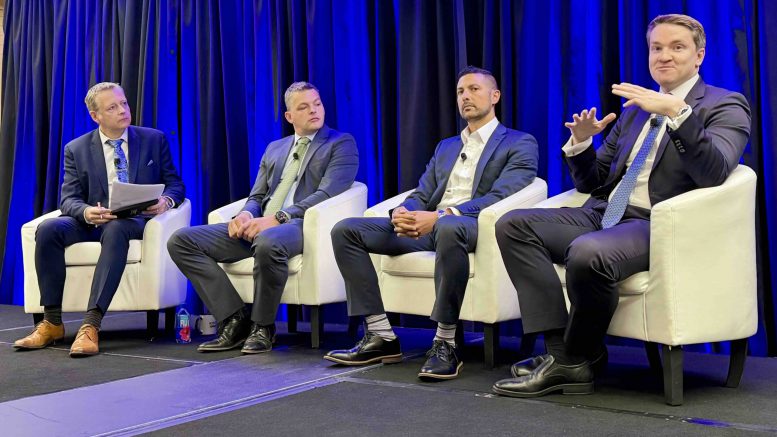
That shift was on display this week at the Precious Metals Summit in Beaver Creek, Colo., where Elemental Royalty (TSX, NASDAQ: ELE) CEO Frederick Bell, First Majestic Silver (TSX: AG; NYSE: AG) president Mani Alkhafaji and Heliostar Metals (TSXV: HSTR; US-OTC: HSTXF) CEO Charles Funk outlined markedly different tests ahead: a $290-million acquisition, succession at an established silver producer and the planned construction of a new gold mine.
“Most CEOs pass their careers without really doing much of note,” panel moderator Paul Harris said Tuesday. “That’s one of the reasons why the elite teams stand out, because they’re the movers and shakers who actually do things and get things done.”
For investors accustomed to following mining figures such as Pierre Lassonde, Ross Beaty and the Lundin family, the question is whether the next generation can turn early successes and greater access to capital into durable companies and gains per share, rather than simply accumulating ounces, assets and debt.
Market test
Gold’s retreat offers an immediate test of those plans. Front-month futures settled at $4,345.80 per oz. on Monday, down 0.9% on the day and about 18% below their January record settlement of $5,318.40, according to Dow Jones market data.
With bullion no longer lifting every gold stock, acquisitions, mine builds and financing decisions will have to stand up on their own merits. Execution and returns per share matter more when the metal price offers less cover.
Funk designed Heliostar to avoid being stranded by the next downturn.
A physics graduate who moved into geophysics and geology, he travelled widely for large Australian miners before moving to Canada with his wife in 2016. He intended to buy a project, but another company got there first. A job with a junior explorer followed, then a discovery that raised his profile and opened doors to capital.
That success also pigeonholed him as an explorer. Funk wanted a company that could generate cash, build mines and buy assets when others couldn’t.
“I wanted to build a business that worked all through the cycle,” he said.
Heliostar’s acquisition of the La Colorada and San Agustin mines moved it towards that goal, but left Funk with another label: turnaround specialist. Now he wants to show Heliostar can build a mine.
“Spite’s an underrated motivator,” he said. “The first version of Heliostar failed as well.”
Building Ana Paula
Ana Paula will test that ambition. Heliostar expects to finish a feasibility study in the second quarter of 2027 and make a construction decision around mid-year, according to its Monday update. The company targets first gold before the end of 2028 but still needs approval for its revised underground plan and a construction financing package.
Heliostar plans to use cash from La Colorada and San Agustin with new debt to fund the project, reducing its reliance on another equity issue. It plans to order equipment with long delivery times in the fourth quarter.
Funk targets annual production of 500,000 oz. by the end of the decade and eventually wants four or five large gold mines. He said that growth must also improve performance per share.
“Our biggest goal is that when people see our company’s name, like certain other companies out there, there’s an assumption of good work,” Funk said. “That’s what we aspire to in five to 10 years.”
Deal scale
Bell learned early how quickly a commodity downturn can overturn a business plan.
The history graduate entered mining through an Australian uranium explorer whose shares lost 80% after the Fukushima disaster. A gold exploration venture then ran into another market collapse. Those experiences drew him to royalties, which can generate cash without requiring the holder to build and operate mines.
Elemental’s first acquisition was worth less than $2 million. To complete it, the company raised half the money and gave a private equity fund half the economics, Bell recalled. Its latest deal shows how much its capacity has changed.
“We still do the $10-million deals, but we can also do the sort of $290-million deals today,” he said.
Elemental’s greater scale now allows it to retain more of the upside rather than syndicate deals. “But that’s taken time and that’s taken building a track record and team,” Bell said.
Elemental agreed to pay Orion Mine Finance $200 million in cash and $90 million in shares for the portfolio. It secured a commitment to increase its revolving credit line to $250 million. The acquisition is expected to close in the fourth quarter, subject to conditions.
Bell expects the portfolio to help lift annual output from about 20,000 gold-equivalent oz. this year to 50,000 oz. in 2031. Larger operators and financed mine expansions support much of that outlook, but those operators still have to deliver while Elemental services its acquisition debt.
Succession plans
Alkhafaji said his promotion to president and chief corporate development officer formed part of First Majestic’s succession planning, though he declined to characterize himself as CEO Keith Neumeyer’s eventual replacement.
“I’m not going to speak on behalf of Keith, but it is part of succession planning,” he said.
Alkhafaji has worked with Neumeyer for 14 years, serving as a mine general manager and leading supply chain functions before taking his current role. He said learning the business from the ground up prepared him to make financing and acquisition decisions.
First Majestic’s reputation and trading liquidity helped it raise $350 million in December through convertible notes paying annual interest of 0.125% and maturing in 2031. The initial conversion price was about $22.36 a share. The company used part of the proceeds to repurchase older debt and retained the balance for corporate purposes, including acquisitions.
Alkhafaji said the terms reflected years spent building a following and keeping the shares liquid enough to attract convertible-bond investors. He spent about 250 days travelling last year to meet investors and attend conferences.
The low coupon preserves cash, but conversion into shares could dilute existing owners. Any investment made with the proceeds must therefore earn enough to improve returns per share.
First Majestic remains focused on silver and favours North American opportunities, Alkhafaji said. It can also expand within its existing mining districts, an advantage when suitable acquisition targets remain scarce.
“We don’t want to grow for the sake of growing,” he said. “That’s not our vision.”
Be the first to comment on "Beaver Creek: Mining’s next generation takes the wheel"