
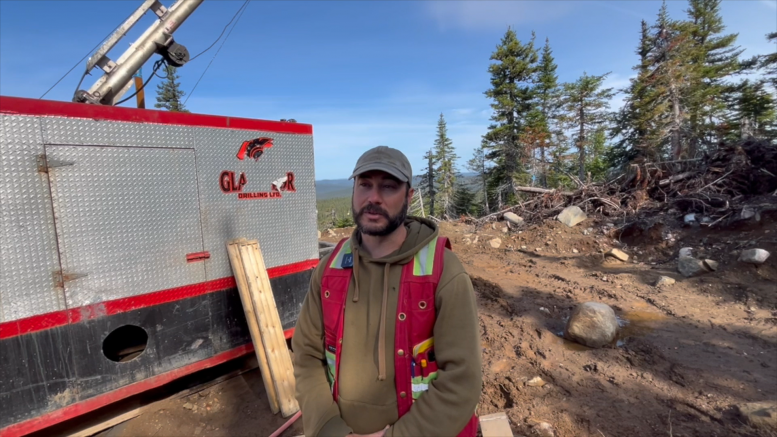
Cartwright, Labrador – Over the past several months, the sounds of trucks, ATVs and drill rigs have broken the silence among thick forests in a remote eastern corner of Labrador as the hunt for the critical metals titanium and vanadium picks up pace.
The ramped-up movement is happening around Saga Metals’ (TSXV: SAGA; US-OTC: SAGMF) Radar project, which has expanded its staff and activities significantly over the past year. Radar is about 10 km south of the fishing village of Cartwright and 390 km east of Labrador’s largest community, Happy Valley-Goose Bay.
“In the space of four years, we’ve taken a project that had almost no historical data whatsoever to putting 22,000 metres on it and advancing it to an initial resource and looking beyond that to see how we can continue to advance it,” Saga’s Chief Geological Officer Michael Garagan told The Northern Miner during a September visit, almost one year after the Miner’s first visit.
Watch a video of the site visit
Saga’s progress brings one of Canada’s very few potential sources of titanium and vanadium closer to Western markets seeking secure supplies of the metals used in alloys, aerospace and energy applications. Rio Tinto (ASX, NYSE, LSE: RIO) operates Canada’s only titanium mine – Lac Tio – in eastern Quebec. There are no vanadium mines in the country.
One year ago, there was little at Radar to suggest its significance save for some cleared trails leading to a few staked trenches that a small field team had dug on a mountain side. Radar is made up of the Hawkeye, Trapper and Falcon zones, all on heavily forested slopes near the Mealy Mountains range.
Click here for The Northern Miner‘s visit to Saga’s Wolverine project in Labrador
Mobilizing for resource
Now, its workforce has grown five times to more than 50 people including geologists, surveyors, labourers, kitchen staff, managers and drivers. Most of them are based just outside Cartwright at a permanent camp, which has dormitory, dining and office trailers.
“We’ve got about 35 people from Cartwright itself working and operating on the field team, the cut team, the sample team, the core techs and our kitchen staff,” Garagan said. “A lot of our geologists come from either within Newfoundland or Nova Scotia, or a few from out west.”
The expansion comes with Saga’s 22,432-metre drill program it launched last November. The program’s results support the initial indicated resource for Trapper, expected to be released before the end of the year.
Titanium-vanadium bounty
Winter drilling produced some of the highest grades at Trapper, such as hole R-0009 that cut 87.2 metres grading 50.67% iron, 10.15% titanium oxide (TiO₂) and 0.339% vanadium oxide (V₂O₅) from 94 metres depth in January.
Drilling from the summer produced some of the thickest, most continuous intervals. Hole R-0061, reported on Aug. 17, returned 163 metres at 43.07% iron, 6.19% TiO2 and 0.293% V2O5 from 109 metres depth, including 92.3 metres grading 47.36% iron, 6.73% TiO2, 0.353% V2O5.
“We’ve drilled a total of 92 holes across the property,” Garagan said. “We had high-grade semi-massive oxide zones in Trapper South, large components of Trapper North that are very wide and exceptionally high grade. It was fairly consistent that we hit these areas throughout almost every section that we drilled across the property.”
On-site processing?
Though Radar is early stage, Saga is already lining up the potential processing piece of the puzzle. In July, critical metals developer Temas Resources (ASX: TIO; CSE: TMAS; US-OTC: TMASF) validated samples from Radar that returned very high recoveries.
Temas’ proprietary Regenerative Chloride Leach (RCL) technology delivered test results with titanium recoveries up to 90.8%, vanadium up to 97.4% and iron up to 91.5%.
Ultimately, the results could open up the option of a metal processing plant at or close to Radar, Garagan said, which is preferrable to sending ore 1,425 km away to facilities in Sorel-Tracey, southern Que., where Rio Tinto ships its titanium from Lac Tio.
“There’s already a deep water port in Cartwright,” Garagan said. “If we can prove and validate that Temas’ process is successful, that creates a scenario where we can combine our ore with their patent to come up with a downstream product of titanium, vanadium, and iron that you could send to markets straight from site.”
Labrador mining tailwinds
That could be part of an even larger puzzle, Garagan suggested, noting that the federal government on Aug. 17 earmarked up to $10 billion to support new hydroelectric and transmission infrastructure in Labrador. Ottawa also pledged $1 billion for a Labrador West transmission line intended to support new mining and industrial development.
“The policies coming out of the federal government now with critical mineral supply chains, economic and infrastructure advancement in remote northern communities, we recognize they’re possible with this project,” he said.
But all of that is still several stages ahead of Saga’s current position at Radar. Garagan declined to comment on a timeline for a preliminary economic assessment, saying his focus is now on further exploration and development at Radar.
“We have 20 kilometres of strike length of oxide layering. We would love to target a lot more of that and prove that this could be as large as the deposits in China,” he said, citing Panzhihua in Sichuan province, regarded as the world’s largest iron-titanium-vanadium deposit.
“We’ll be releasing our resource on Trapper, but that still represents a very small percentage of what we actually have on the property.”
Saga shares traded at 39¢ apiece on Wednesday afternoon in Toronto, valuing the company at about $41 million. The stock has traded in a 12-month range of 28¢ to 98¢.
Be the first to comment on "Site visit: Titanium, vanadium light up Saga’s Radar in Labrador"