
Stillwater Critical Minerals (TSXV: PGE; US-OTC: PGEZF) has established an initial indicated resource and more than tripled inferred tonnage at its Stillwater West project in Montana, sharply increasing its inventory of nickel, copper and platinum group metals.
The Glencore (LSE: GLEN)-backed explorer’s new indicated resource totals 29.4 million tonnes grading 0.18% nickel, 0.09% copper and 0.02% cobalt for 119 million lb. contained nickel, 59 million lb. copper and 11 lb. million cobalt, Stillwater said Thursday.
“The establishment of our first indicated mineral resource and the continued refinement of our geological model significantly enhance our understanding of this large and evolving mineral system,” CEO Michael Rowley said in a release. “The 2026 resource estimate provides a stronger technical foundation for advancing metallurgical studies, engineering and future economic evaluation.”
Compared with a January 2023 resource, the new inferred estimate now contains 3 billion lb. of nickel, 1.5 billion lb. copper and 283 million lb. cobalt, almost tripling the nickel and more than tripling the copper and cobalt over the previous estimate from 2023. That is contained in 805.1 million tonnes. Contained platinum and palladium total 2.8 million oz. and 3.9 million oz., respectively, more than doubling their amounts. Gold more than doubles to 864,000 ounces.
The project is beside Sibanye-Stillwater’s (JSE: SSW; NYSE: SBSW) platinum group metals (PGM) mines and processing, the only primary PGM complex in the United States. Glencore holds 13% of Stillwater and provides technical support. The explorer has applied for Department of Defense funding.
Indicated resource
Stillwater shares gained 13% on Thursday to 45¢ in Toronto, giving the company a market value of about $139 million. The shares have traded between 23¢ and 67¢ over the past year.
Other metals in the indicated category include platinum which grades at 0.12 gram, as well as 0.22 gram palladium, 0.043 gram gold and 0.016 gram rhodium tonne. It amounts to 359,000 oz. of platinum, palladium, gold and rhodium.
In the inferred category, platinum grades at 0.09 gram and palladium at 0.16 gram, as well as , 0.034 gram gold and 0.012 gram rhodium per tonne. That contains 7.4 million oz. of platinum, palladium, gold and rhodium. Both resources use a 0.2% nickel-equivalent cut-off.
The 2023 resource of 254.8 million inferred tonnes contained 1.05 billion lb. nickel, 499 million lb. copper, 91 million lb. cobalt, 1.26 million oz. platinum, 2.05 million oz. palladium, 395,000 oz. gold and 115,000 oz. rhodium.
Stillwater also more than doubled its inferred chromium inventory to 6.6 billion lb. from from 2023. Chromium isn’t included in the nickel-equivalent calculation and the company has made no recovery or economic assumptions for the metal.
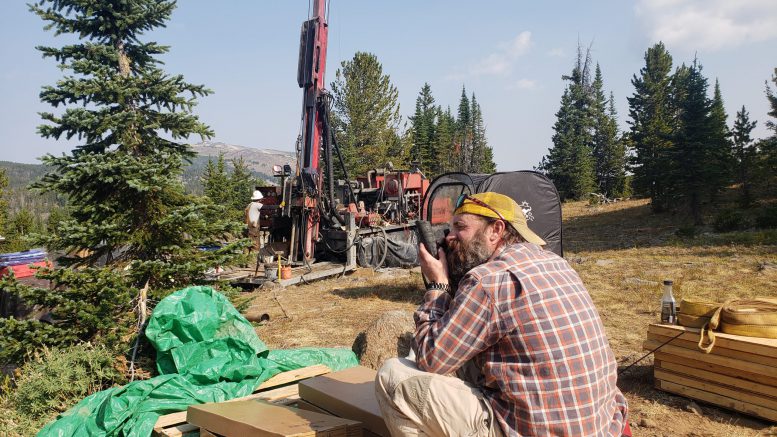
The new estimate incorporates 14 holes totalling 5,781 metres drilled during the 2023 and 2025 campaigns, as well as historical holes added following a quality-control review. Mine Technical Services prepared the resource, which assumes open-pit mining.
Mine studies next
Most of the resource remains in the lower-confidence inferred category and Stillwater has yet to complete an economic study. The new grade-block model is intended to support metallurgical testing, mine planning and development scenarios, including examining whether higher-grade zones could be mined earlier.
The resource covers about 10 km of Stillwater’s 32-km property across the Stillwater Igneous Complex. Its 2026 drilling campaign is focused on extending mineralization at Chrome Mountain and joining the CZ-Central deposits with HGR at Iron Mountain.
Vancouver-based Couloir Capital identified resource expansion as a key valuation driver before Thursday’s update. The firm raised its target price on Stillwater to 93¢ from 45¢ in October while maintaining a buy recommendation, saying it expected the 2025 drilling program to support a larger resource.
Couloir’s target predates the new estimate. Its Stillwater research is commissioned by the company.
Be the first to comment on "Stillwater more than triples Montana resource"