
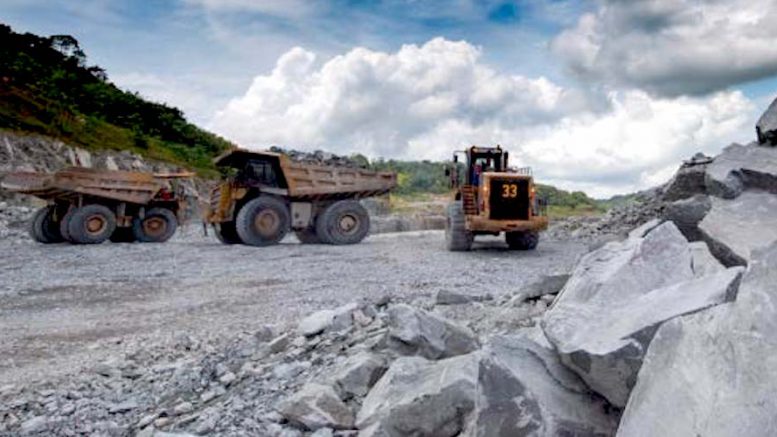
Gold Fields (NYSE, JSE: GFI) CEO Mike Fraser criticized Ghana’s mining policies on Tuesday, saying the government is treating the sector as an “easy target” for revenue as uncertainty hangs over the renewal of leases at the company’s Tarkwa gold mine.
Five of Tarkwa’s mining leases are due to expire in April 2027. Gold Fields submitted a detailed technical study and renewal application in November and followed with a commercial proposal in July aimed at supporting another 20 years of investment in the operation. The company said it has yet to receive a proper response from the government.
“We are waiting for a formal response from the government, but we did flag today in our results that the timing outcome and the terms of the renewal remain uncertain,” Fraser said on the company’s first-half results call.
The dispute adds jurisdictional risk to one of Gold Fields’ key operations as Ghana seeks to capture more revenue from record gold prices. Recent changes to the country’s royalty regime could make it less attractive for investment, Fraser said.
“What we’ve seen in Ghana is certainly, in some respects, unhelpful because certainly we think that it starts placing Ghana in a fairly uncompetitive position for inward investment,” he said. “Despite that, this is a country that’s under some financial stress and therefore saw the sector as an easy target.”
Investment
Gold Fields and other miners have lobbied Ghana’s government directly and through the country’s Chamber of Mines against measures they argue could undermine longer-term investment. Fraser contrasted Ghana with Western Australia, where he said royalty rates have remained stable despite movements in the gold price.
“What you do need as investors is predictability,” Fraser said. “It’s really important that we make those messages clear, and that’s why you see sovereign risk in certain jurisdictions.”
The uncertainty comes after Gold Fields exited its Damang mine in Ghana following a dispute over the renewal of its mining lease. The company completed the transfer this year.
Tarkwa, in southwestern Ghana, is one of Gold Fields’ largest mines. Production slipped during the first half because of lower mill-feed grades, increased processing of stockpiles, higher waste movement and adverse weather, though the company expects performance to improve in the second half.
Sharing
Gold Fields says its proposal to Ghana would unlock Tarkwa’s potential for another 20 years while providing what Fraser described as a fair sharing of value among the government, local communities and shareholders. The company is also holding back the sequencing of some growth spending at Tarkwa while the leases remain unresolved.
The uncertainty is already weighing on Gold Fields’ valuation, Fraser said.
“I think Tarkwa has been a drag on our share price, and if you look at the underperformance in the last six months, we’ve underperformed by about 10%, which is probably the kind of value attributable to Tarkwa or thereabouts.”
The Ghana concerns came as Gold Fields reported sharply stronger first-half results on higher production and record gold prices. Attributable production rose 12% year over year to 1.27 million oz., while its average realized gold price increased 51% to $4,678 per ounce. Adjusted free cash flow more than doubled to $2.2 billion (C$3.04 billion).
‘Mixed’ results
BMO Capital Markets mining analyst Raj Ray called the results “mixed,” noting that second-quarter production was in line with expectations and costs were slightly better than forecast. Headline earnings of $2.08 per share missed BMO’s $2.63 estimate and the $2.65 consensus because of lower sales and higher exploration and tax expenses.
Free cash flow of $2.23 billion topped BMO’s $2.08-billion estimate, mainly because of lower capital spending. Gold Fields cut its 2026 capital spending guidance to $1.6 billion to $1.8 billion from $1.9 billion to $2.1 billion, reflecting deferred spending at its Windfall project in Quebec and the reclassification of some spending there as exploration.
The company maintained its 2026 production guidance of 2.4 million to 2.6 million oz. and expects output towards the upper end of the range. It also allocated another $500 million to shareholder returns, taking the program announced since November to $1.25 billion.
Gold Fields’ New York-listed shares rose 2.4% to $48.32 in Tuesday afternoon trading, valuing the company at $42.3 billion. Fraser said resolving Tarkwa, advancing Windfall into construction and continuing to deliver shareholder returns could help close Gold Fields’ valuation gap with its peers.
“Hopefully the combination of resolution on Tarkwa, the announcement of Windfall into execution, and continued delivery on our commitments on capital returns should see us rewarded,” he said.
Be the first to comment on "Gold Fields says Ghana treating miners as ‘easy target’"