
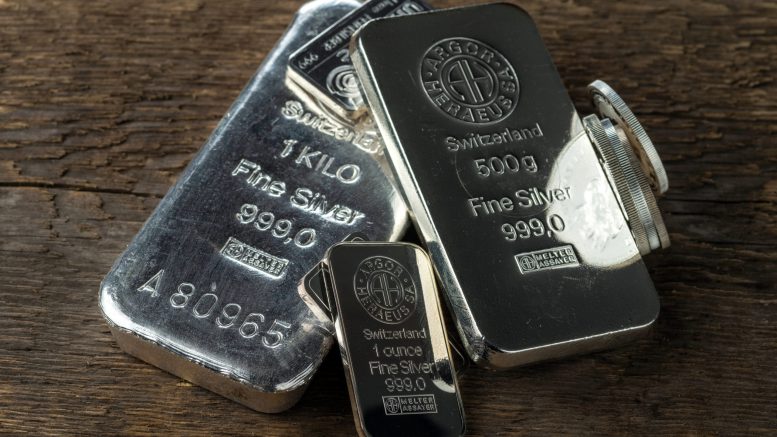
Silver inventories at the world’s two largest bullion trading hubs have fallen sharply from pandemic-era peaks, underscoring a sustained drawdown in visible stocks even as definitions of available supply diverge across markets.
At the CME Group’s COMEX exchange in New York, registered silver inventories – metal eligible for delivery against futures contracts – stood at about 79.9 million oz. in mid-May, down more than 75% from 2020 highs. In London, LBMA-reported vault holdings totalled 27,454 tonnes (roughly 883 million oz.) at the end of April, about 20% below the record 34,346 tonnes set in January 2021.
The drawdown has reinforced a broader narrative of tightening supply, which intensified as silver briefly traded above $121 per oz. in January before a sharp correction. As of late-May, silver was trading around $75 per oz., up from roughly $33 per oz. a year earlier.
“The market is in deficit again this year,” Philip Newman, managing director at Metals Focus, a London-based independent precious metals consultancy which produces the World Silver Survey, told The Northern Miner.
The World Silver Survey 2026, published every year through the Washington, D.C.-Silver Institute, projects a deficit of 46.3 million oz. “That will be the sixth in a row,” Newman said.
Roughly 762 million oz. have been drawn from above-ground stocks since 2021, according to the survey, which attributes the deficits to adjustments within a broad stock pool spanning exchange inventories, investor holdings and industrial supply chains, rather than a shortage of available metal. Balances shift in response to price and investment flows.
However, not all analysts accept that framing.
Disappearing deficit
Jeffrey Christian, managing partner at CPM Group, a New York–based commodities research and advisory firm which publishes the annual Silver Yearbook, said there are two issues related to shortages: current accounts and capital accounts.
Widely cited deficit figures depend heavily on how investment flows and inventory movements are treated within the accounting framework, Christian said. Once those flows are separated from industrial consumption, the idea of a structural annual shortfall becomes less clear.
Silver held for investment purposes remains part of above-ground stocks and is not consumed in the way industrial demand is, he told The Northern Miner, noting that such metal can re-enter the market when prices or conditions shift.
Other market analysts have also pointed to the role above-ground inventories continue to play in balancing the market. In a February podcast and research note, J.P. Morgan said silver’s multi-year deficits have been largely buffered by sizable above-ground stocks, even as heavy transfers of metal from London to New York have contributed to tighter physical market conditions and increased volatility.
Invisible stockpiles
Christian also pointed to the scale of above-ground inventories outside exchange reporting systems. COMEX and LBMA figures, he said, are frequently used as shorthand for tightness, but represent only a narrow slice of total holdings.
“The vast majority of it is either in investor holdings for gold and silver or in working inventories,” he said.
COMEX registered stocks reflect the portion of metal explicitly earmarked and available for delivery against futures contracts. LBMA vault data, by contrast, captures total silver held across London vaults under a range of custody arrangements – including metal-backed exchange-traded products, institutional storage, and pooled or allocated holdings on behalf of investors.
Because of those differences, the two datasets are not directly comparable. One reflects deliverable exchange inventory; the other captures a broader pool of vaulted metal that may not be immediately available to the futures market but remains part of the global stock base.
Constantly moving
Working inventories, silver moving through refineries, manufacturers and fabrication chains rather than sitting in vaults, also complicate the idea of scarcity.
“There’s about 800 million oz. of silver used every year that’s fabricated,” Christian said. “Depending on what it’s used in, if it’s in jewelry or in electronics, that metal may pass through eight or 10 different companies.”
Along the chain, silver is repeatedly refined, melted and recast into intermediate industrial forms. Because of that flow, Christian said the key question is not just how much silver exists above ground, but where it sits at any given point, including material held in refineries, factories and trading channels that is rarely reported in full.
Some market commentary treats these stocks as effectively unavailable because they are tied up in industrial use or held by investors awaiting higher prices, he said. In practice, however, they remain part of a much larger and constantly shifting pool of refined metal.
Well-supplied
Christian said the risk of structural shortage is often overstated, pointing instead to the scale and responsiveness of above-ground inventories. “There’s also billions of ounces of silver in old jewelry, electronics, silverware and statues that can be refined much more quickly to increase supply,” he said.
According to the World Silver Survey, fabricators are looking to see how they can reduce or eliminate their silver use to offset the rising price. Industrial silver fabrication is forecast to fall 3% this year to a four-year low.
Ultimately, higher prices tend to do what commodity prices do: draw out supply and curb demand.
“The silver bulls and promoters want you to believe it’s not really available, that people wouldn’t sell it,” Christian said.
But he points to past periods of higher prices between 1979 and 1980, and again in 2008 and 2010.
“You saw a lot of that silver come back – not billions of ounces, but hundreds of millions of ounces came out as scrap and were sold back into the market,” Christian said. “There is a lot of silver out there.”
Be the first to comment on "Silver stockpile drawdown risk is misunderstood "