
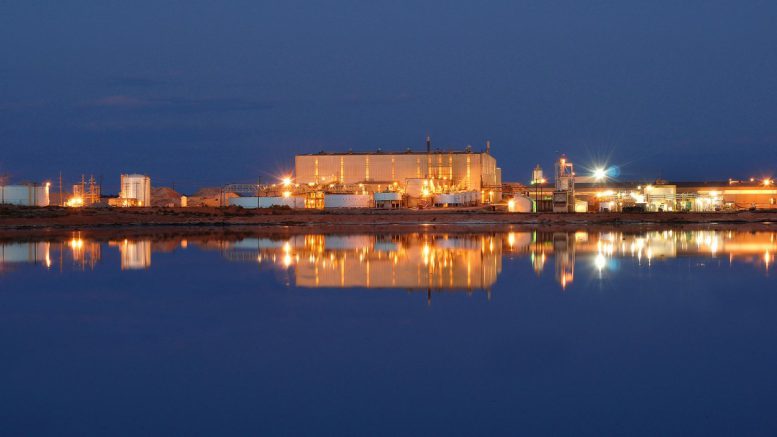
Energy Fuels (NYSE: UUUU; TSX: EFR) expects to meet its 2026 uranium production guidance by mid-year as ore processing at Utah’s White Mesa Mill pauses to rebuild stockpiles. Shares soared.
Uranium oxide (U3O8) production will reach 1.6 million lb. by the end of June, Energy Fuels said Thursday in a statement. That’s within the company’s previously published full-year range of 1.5-2.5 million pounds.
“Our uranium segment continues to differentiate Energy Fuels as the clear leading U.S. uranium producer through our strong operating performance, production and costs,” CEO Ross Bhappu said in the statement.
Shares of Energy Fuels surged about 11% to $21.09 in late afternoon Toronto trading, sending the company’s market capitalization to $5.3 billion (US$3.8 billion). The stock has traded between $7.12 and $38.37 in the past 12 months.
Improving grades, costs
Energy Fuels said it expects to produce more than 265,000 lb. a month of finished uranium from White Mesa — the only fully licensed and operating conventional uranium mill in the United States. Two mines, Pinyon Plain in Arizona and Utah’s La Sal Complex, will supply the ores.
Uranium ore processing at White Mesa is on track to be completed by the end of June to rebuild ore stockpiles, Energy Fuels said. Processing at the mill would then resume in the fourth quarter, subject to continued strong ore production at conventional mines and other conditions, the company added.
Ore grades and contained uranium are expected to improve during the second half of the year, Energy Fuels said. Production for the first six months should range between 750,000-850,000 lb. of contained U3O8 in ore, the company said.
The processing cost of the ore at White Mesa is expected to fall to between $9-$12 per lb., near historic lows. Cost of sales is expected to continue to drop in 2026.
Rare earth upgrades
In addition to uranium, the mill also produces rare earth elements (REE) through processing natural monazite sand sourced globally. Commercial separation of the critical minerals began two years ago, starting with neodymium-praseodymium (NdPr). Since then, Energy Fuels has added capabilities to produce the so-called “heavy” rare earths such as samarium, europium, gadolinium, terbium and dysprosium.
Energy Fuels plans to begin further modifications to the existing stage one REE circuits at the White Mesa starting in July. The upgrade would allow the company to commercially produce the heavy rare earths in addition to the commercial quantities of NdPr.
The modifications would also include a circuit to process certain uranium-bearing mixed REE carbonates (MREC) sourced from mines globally, including MRECs from ionic adsorption clays. Because MRECs can be fed directly into solvent extraction separation, the new circuit is expected to enable the mill to process both uranium and separated REEs simultaneously, Energy Fuels said.
The modifications are expected to be operational in late 2027 to early 2028. A subsequent expansion also being planned to increase White Mesa’s REE capacity to nearly 6,300 tonnes per annum. Permitting remains on schedule.



Be the first to comment on "Energy Fuels to hit 2026 uranium target by midyear"