
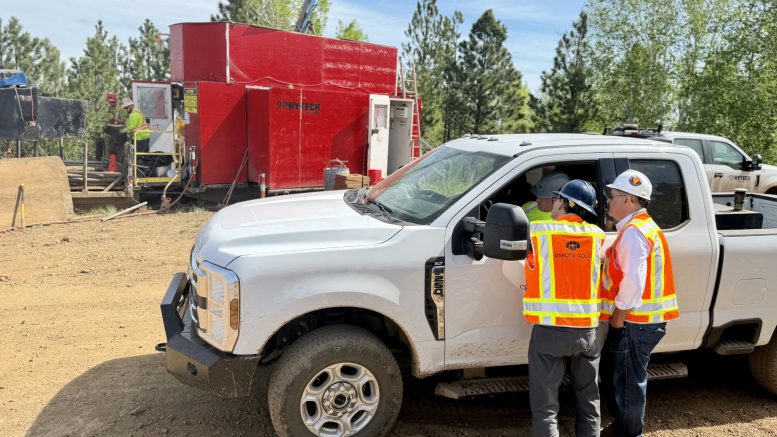
Developer Dakota Gold (NYSE-A: DC) said new drilling at its Richmond Hill oxide heap leach gold project in South Dakota delivered additional high-grade intercepts ahead of a prefeasibility study (PFS) expected later this year.
Standout hole RH26C-417, drilled in an area north of the existing resource, cut about 14 metres of 5.24 grams gold per tonne and 4.43 grams silver from 110 metres downhole, Dakota Gold said Thursday in a statement. Hole RH26C-418, meanwhile, cut about 21 metres grading 3.33 grams gold and 5.81 grams silver from 130 metres depth.
“The northeast expansion area continues to deliver intercepts well above the initial assessment with cash flow mine plan grade, suggesting meaningful potential for resource growth,” Scotia Capital mining analyst Eric Winmill said in a note.
Richmond Hill’s upcoming PFS will add to the project’s sizable resource, economics and location in the historical Homestake gold district, where miners have operated for more than a century.
Dakota Gold has completed about 94% of its planned 17,273 metre drilling campaign at Richmond Hill, which it plans to wrap up by the end of the month. Gold and silver assay data from more than 350 drill holes completed this year and last will be incorporated into the PFS.
Extensions test
Drilling is focused on testing extensions to the north of the current resource model, where previous programs have already outlined mineralization hundreds of metres beyond the limits of the proposed pit shell.
Other highlights released Thursday include hole RH-26C-420, which returned about 11 metres grading 1.13 grams gold and 2.05 grams silver from 120 metres downhole. Hole RH-26C-427, meanwhile, cut about 7 metres of 1.6 grams gold and 3 grams silver from surface.
Mineralization in the northeast zone remains open in all directions, Dakota Gold said. This indicates that the area has not yet been fully delineated by drilling.
Located about 320 km west of South Dakota’s capital, Pierre, Richmond Hill is part of a 180-sq.-km land package controlled by the company near the historic Homestake mine. It hosts a large oxide gold system amenable to conventional open-pit mining and heap leach processing.
Homestake produced about 40 million oz. of gold during more than 145 years of mining. It ceased operations in 2002.
2029 target
Dakota Gold CEO Robert Quartermain previously built Pretium Resources and developed the Brucejack mine in British Columbia before agreeing to be bought by Newcrest – now Newmont Mining (TSX: NGT; NYSE: NEM) – for about C$3.5 billion ($2.5 billion) in 2021. He formed Dakota Gold the following year to explore in South Dakota.
Richmond Hill could produce 2.6 million to 3.9 million oz. of gold over a potential mine life of 28 years, according to an S-K 1300 Initial Assessment report from July. With a post-tax net present value of $1.6 billion (C$2.4 billion) to $2.1 billion, the project has a post-tax internal rate of return of 55% to 59%, with initial costs of $384 million. Dakota targets production for 2029.
The project hosts 244.7 million measured and indicated tonnes grading 0.46 gram gold and 4.83 grams silver for 3.6 million oz. of contained gold and 38 million oz. silver, according to an initial resource released in February 2025. Inferred resources total 230.6 million tonnes at 0.35 gram gold and 3.09 grams silver for 2.6 million oz. gold and 22.7 million oz. silver.
Dakota Gold shares fell 0.2% to $4.61 in U.S. trading Thursday morning, giving the company a market capitalization of about $613 million. The stock has traded between $3.60 and $7.25 in the past year.



Be the first to comment on "Dakota Gold books 5.24g at Richmond Hill project"