
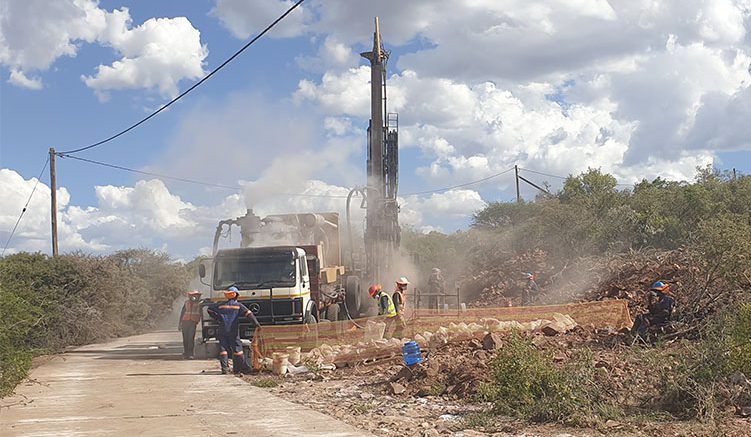
A feasibility study for Giyani Metals’ (TSXV: EMM) K. Hill open pit manganese project in Botswana outlines a much costlier operation and with lower value than in a previous economic study, though it’s now backed with proven reserves.
At an 8% discount rate, the study gives K. Hill a post-tax net present value of $481.5 million (C$666.2 million), half of the value estimated in the 2023 preliminary economic assessment (PEA), Giyani reported Thursday.
Initial capital costs rose 88% to $535 million, the internal rate of return fell by 9 percentage points to 20% and manganese production is down 57% to 1.5 million tonnes, Giyani said. Mine life is also cut by more than half to 25 years. K. Hill is about 60 km southwest of the capital Gaborone.
“These results… endorse K. Hill as a unique, mine to-market battery-grade supplier of manganese to meet growing Western demand, and provide a solid foundation for further optimization and continued development of the project,” Giyani’s Interim Executive Chair Nigel Robinson said in a release.
“Building on the successful production of both high-purity manganese oxide (HPMO) and high-purity manganese sulphate monohydrate (HPMSM) from our demonstration plant in Johannesburg, we are now well-positioned to meet the evolving requirements of the battery and energy storage markets.”
Small supply chain
Manganese, a key ingredient in steelmaking and increasingly valued in the form of HPMSM for electric vehicle batteries, is mined mainly in countries such as South Africa, Australia and Gabon, while China dominates battery-grade manganese processing. Few Western countries produce manganese in significant quantities outside Australia and, to a lesser extent, Brazil.
Giyani shares gained 5% to 11¢ apiece on Thursday morning in Toronto, for a market capitalization of $33.1 million. The stock has traded in a 12-month range of 6¢ to 14¢.
Adds proven reserves
The feasibility study upgraded the deposit over the 2023 PEA. It estimates that K. Hill hosts proven and probable reserves of 5.3 million tonnes grading 12% manganese oxide for about 642,000 tonnes of contained metal.
Construction of the mine at K. Hill could start in early 2027, with commissioning in late 2028 and process plant ramp-up in 2029, the study shows.
Be the first to comment on "Giyani Metals’ study shows leaner, pricier manganese project in Botswana"