
Rising demand for nuclear energy is sustaining interest in uranium projects around the world. Here’s a list of four companies to watch.
ATHA Energy
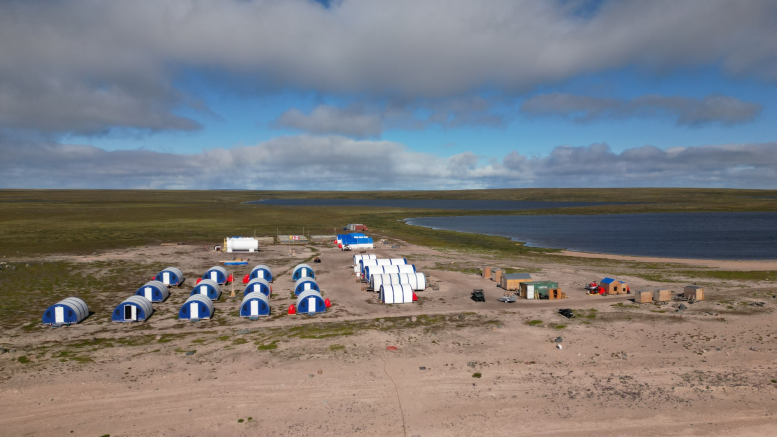
ATHA Energy (TSXV: SASK) is advancing its main Angilak uranium project in southern Nunavut’s Angikuni Basin. The project hosts the Lac 50 deposit, one of the largest high-grade uranium deposits in Canada outside Saskatchewan’s Athabasca Basin.
Exploration last year focused on target areas along three mineralized corridors – Lac 50, KU-Nine Iron and RIB.
The 21-km-long Lac 50 corridor is located just outside the northern margin of the Angikuni Basin and hosts the Lac 50 deposit, which remains open.
Atha has not completed a modern resource estimate for Lac 50, but the company’s 2024 exploration target ranges from 60.8 million lb. uranium oxide (U3O8) to 98.2 million lb. U3O8with an average grade of 0.37% U3O8to 0.48% U3O8.
The conceptual 2024 target was based on diamond drillhole data including drill program results from 2024 and the ranges of potential quantity and grade were derived from conceptual vein wireframes, drill core assays, grade interpolation and applied uncertainty ranges.
The 14-km-long KU-Nine Iron Corridor lies within the northern Angikuni Basin, extending from the KU discovery to the Nine-Iron area, while the 18-km-long RIB Corridor is situated along the western edge of the Basin.
The first drillhole in the RIB Corridor, RIBN-DD-001, returned 34.7 metres of total composite uranium mineralization, including 13.6 metres grading 0.53% U3O8and 1.1 metre grading 4.81% U3O8.
In February the company reported final assays from its 2025 drill program, which confirmed high-grade mineralization at the project’s KU and Mushroom Lake targets, as well as expansion of the J4/Ray zone mineralization beyond the Lac 50 deposit exploration target area.
Also in February, the company closed a private placement of US$25 million ($34.9 million) of unsecured convertible debentures from Queens Road Capital Investment (TSX: QRC). Queens Road is a leading financier in the global resource sector and was a critical supporter of NexGen Energy’s (TSX: NXE) development, investing US$100 million between 2020 and 2023.
In addition to Angilak, Atha has other drill-ready targets in the Athabasca Basin, most of which it acquired in 2022 through syndicate deals backed by NexGen and IsoEnergy (TSX: ISO). Atha also has targets in the Central Mineral Belt of Labrador.
The company holds a 10% carried interest in key Athabasca Basin exploration projects operated by NexGen and IsoEnergy.
Atha Energy has a market cap of about $281 million (US$205 million).
CanAlaska Uranium
CanAlaska Uranium (TSXV: CVV; US-OTF: CVVUF) is fully funded for a busy exploration year across multiple projects on its 5,000-sq.-km land package in the eastern Athabasca Basin.
The company plans to drill at its Key Extension and Nebula projects, which are located 15 km and 30 km, respectively, south of Cameco (TSX: CCO; NYSE: CCJ) and Orano Canada’s past-producing Key Lake mine and currently operating Key Lake mill. That mill is about 530 km north of Regina. The drill programs will focus on high-priority target areas that were identified through recent airborne geophysical surveys.
CanAlaska has also started a co-funded $15 million exploration program with three drill rigs on the West McArthur project, which it holds in a joint venture with Cameco.
CanAlaska owns 89% of West McArthur, which sits about 20 km west of Cameco’s McArthur River mine in the southeastern Athabasca Basin. The drill program this year will focus on step-outs from the Pike zone, where previous highlights include 8.6 metres grading 34.6% U3O8, including 5.5 metres at 53.9% U3O8in drillhole WMA079-01.
The company is evaluating a ground-based electromagnetic survey on its Waterbury South project, about 10 km southeast of Cameco’s Cigar Lake mine in the basin’s northeast. The survey aims to identify conductive corridors to generate drill targets and follow up on historical mineralization and geochemistry anomalism that was intersected during earlier drill programs.
At its Cree East project in the eastern Athabasca Basin, CanAlaska is considering a summer drill program. In the meantime, it is evaluating a ground-based electromagnetic survey to refine historical geophysical targets that were identified before last year’s exploration program. Cree East is 35 km west-northwest of the Key Lake mine and mill.
CanAlaska is also evaluating the potential for drill programs this summer on its Voyager and Enterprise projects, 20 and 30 km south, respectively, of the Key Lake mine and mill.
In addition, the company and its joint-venture partner, Denison Mines (TSX: DML; NYSE-AM: DNN), plan to pursue geophysical exploration at the Moon Lake South project. The project, quarter-owned by CanAlaska, is adjacent to Denison’s Wheeler River property. It hosts the Gryphon and Phoenix deposits, where Denison is advancing Canada’s first in-situ recovery mine.
CanAlaska Uranium has a market cap of about $159 million.
Future Fuels
Future Fuels’ (TSXV: FTUR; US-OTC: FTURF) principal asset is the Hornby project in northwestern Nunavut’s Hornby Basin, about 95 km southwest of Kugluktuk near the border with the Northwest Territories.
The 3,407-sq.-km project contains over 40 underexplored uranium showings and the historic Mountain Lake System.
A 2025 ground gravity survey delineated several high-priority gravity anomalies spatially associated with major structural corridors, stratigraphic boundaries and known uranium mineralization.
The company started the permitting process to begin drilling at Hornby in early December. If successful, two helicopter-portable rigs will drill up to 10,000 metres this summer. Future Fuels will also undertake geological mapping, prospecting, geochemical sampling, drone photogrammetry, ground and airborne geophysics and downhole surveys. The program will be carried out by a 25-person helicopter-supported exploration camp near Mountain Lake.
The last extensive exploration in the area occurred in the 1970s. Esso discovered the Mountain Lake deposit in 1976, completing a non-compliant historical resource of 1.6 million inferred tonnes at 0.23% U3O8for 8.2 million lb. contained U3O8.
In February, Future Fuels entered into an agreement to acquire Hatchet Uranium, a subsidiary of ValOre Metals (TSXV: VO; US-OTC: KVLQF). Hatchet Uranium has five claim blocks in the Athabasca Basin.
The 977-sq.-km claim package lies in the Wollaston Lake area along the eastern Athabasca Basin margin. The claims – Hatchet Lake, CBX/Shoe, Usam, Genie and Highway – have been explored since the 1960s with airborne and ground geophysics, geological mapping, prospecting, geochemical sampling and limited diamond drilling.
More recent work has consisted of data compilation and target generation using VRIFY artificial intelligence, airborne Mobile MT surveys, ground geophysics, prospecting and rock sampling.
The Highway property is under an option agreement with Skyharbour Resources (TSXV: SYH; US-OTC: SYHBF) and once completed, the project will be subject to a 2% net smelter return royalty (NSR).
Uranium-bearing pegmatite and granite boulders at Highway produced spectrometer readings of up to 4,366 counts per second (cps) and 230 parts per million (ppm) uranium.
A 2% NSR is also payable to Skyharbour on the CBX/Shoe, Usam and Genie blocks.
Hatchet Lake is subject to a 2% NSR payable to Rio Tinto‘s (LSE, NYSE, ASX RIO) Canadian exploration unit. Spectrometer readings at Hatchet Lake returned up to 22,000 cps and 1,637 ppm uranium.
Future Fuels has a market cap of about $43 million.
Geiger Energy
Geiger Energy (TSXV: BEEP; US-OTC: BSENF) holds 3,900-sq.-km of exploration claims in the Athabasca Basin and 955-sq.-km in Nunavut’s Thelon Basin.
The company was previously known as Baselode Energy before it acquired Forum Energy Metals last June and renamed itself Geiger in October.
Its primary asset, Aberdeen in Nunavut, hosts the high-grade Tatiggaq and Qavvik uranium discoveries. Aberdeen is about 70 km west of Baker Lake and 1,300 km east of the territorial capital Iqaluit.
Tatiggaq is a basement-hosted prospect defined over a 300-metre strike length consisting of multiple steeply dipping, east-northeast trending mineralized lenses lying at a depth of between 80 and 180 metres. Notable drill intercepts include 11.1 metres grading 2.25% U3O8.
Qavvik is a similar basement-hosted prospect, characterized by steeply dipping, mineralized east-northeast trending lenses across a 100 x 100 metre area, extending from surface to about 400 metres depth. The system is open for expansion over a 500-metre area and at depth.
Aberdeen also contains over 50 high-priority exploration targets, some of which have never been tested and others that show strong alteration and anomalous uranium from limited historical drilling.
In the Athabasca, Geiger’s Hook project hosts the ACKIO near-surface uranium prospect that extends for more than 375 metres along strike and 150 metres width. ACKIO consists of at least nine distinct uranium pods with mineralization beginning at 28 metres from surface down to 300 metres. The system remains open at depth and along strike to the north, south and east.
Drill results released in March from ACKIO include AK26-148, which intersected radioactive mineralization from 80.7 metres depth with counts averaging 428 cps and a maximum of 958 cps, and at depths from 187 metres, counts averaged 2,291 cps, with a high of 11,491 cps from 202 metres.
Hook also hosts two interesting hydrothermal clay alteration systems – the TT area 5.5 km southwest of ACKIO and the TAB area 5 km to the northeast of ACKIO. Hydrothermal clay alteration is a key indicator of uranium-bearing systems.
At Aberdeen, the company will start its summer drill program in June with 10,000 metres focused on the project’s Loki and Tatiggaq areas. Step-out holes at Loki will target the north end of a 4 km gravity anomaly and at Tatiggaq, the prospects are a high-grade basement-hosted zone consisting of two pods over a 300-metre area. Tatiggaq’s 1.5 km gravity anomaly remains open along strike and at depth and sits about 5 km west of Orano’s Andrew Lake deposit.
Geiger Energy has a market cap of about $15 million.


Be the first to comment on "Uranium spotlight: Four companies worth a look – Part 1"