
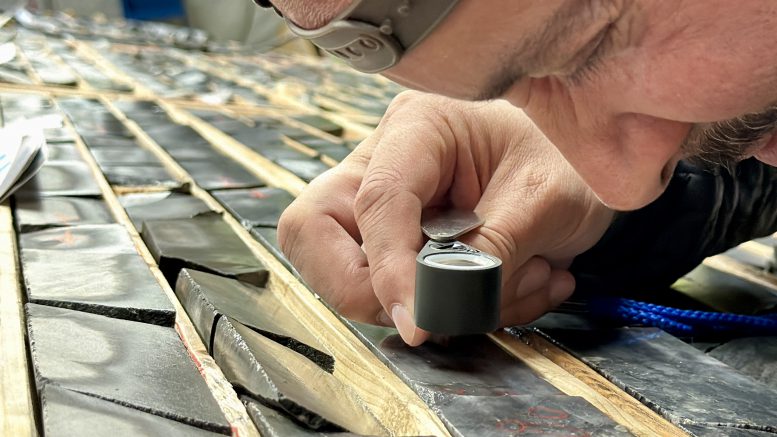
Yellowknife, N.W.T. – Gold Terra Resource (TSXV: YGT; US-OTC: YGTFF) is among a small group of explorers seeking to rebuild a mining pipeline in the Northwest Territories amid the closure of diamond mines and few new emerging projects.
The Newmont (NYSE: NEM; TSX: NGT)-backed company is working to turn the past-producing Con mine into Yellowknife’s next producer as part of its expansive Yellowknife City gold project. Gold Terra plans to release an updated resource on the Con mine option shortly, a second update in September and a preliminary economic assessment by year-end.
“We have an opportunity with the gold price, with the timing, to recreate value and a future for generations in Yellowknife as we bring back mining,” chairman and CEO Gerald Panneton told The Northern Miner during a site visit this week. Panneton is the founder and former CEO of Detour Gold, who brought the Detour Lake mine into production in just over six years before Agnico Eagle Mines (TSX, NYSE: AEM) took over Detour Lake after it merged with Kirkland Lake Gold in 2022.
Con, which started production in 1938, effectively created Yellowknife by anchoring an economy in an area that was remote and sparsely populated in the early 20th century. The opening of Con, located just 2 km south of downtown Yellowknife, led to a gold rush and the start of a permanent community. Con produced 5.1 million oz. grading 16 to 20 grams gold per tonne from the Campbell shear until 2003, when it closed due to low gold prices.
The proposed Con transaction can be a win-win situation for both companies. Gold Terra signed an option agreement with Newmont in 2021, due to last until 2027, that will give the explorer the opportunity to acquire Newmont subsidiary Miramar Northern Mining. Gold Terra must still spend at least $8 million (US$5.8 million) on exploration, complete a prefeasibility study showing 1.5 million oz. in all resource categories, secure approvals and make a final $8 million cash payment. Gold Terra has drawn the attention of Eric Sprott, who raised his interest to 10% last November and the Mackenzie Fund which hosts a 7% stake.
Watch a video of the site visit:
Brownfields advantage
The Yellowknife City gold project entails a rare brownfield setup closely linked with hydro power, road and airport access and an existing mining lease that should shorten the permitting path. It sits on 70 km of the Campbell Shear in what Gold Terra calls the largest underexplored high-grade gold camp in Canada.
The site itself looked more advanced than many restart stories. Newmont’s local closure team said the property has largely completed reclamation and now sits in a steady state of water collection, treatment and compliance monitoring.
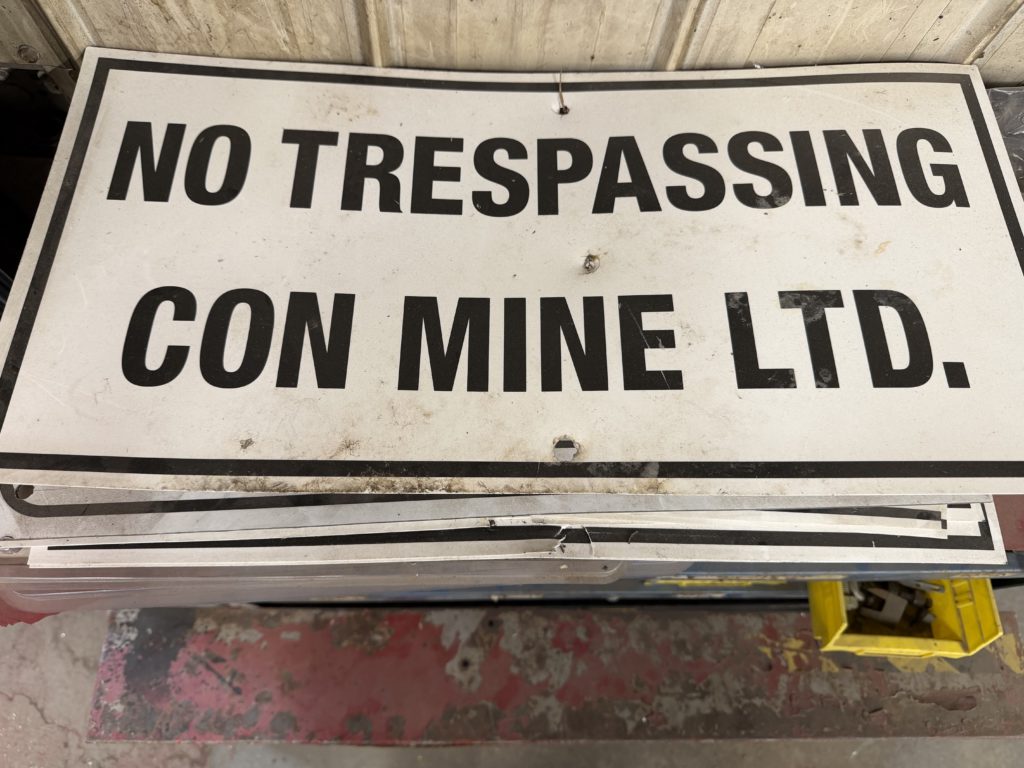
A pile of disused signs in storage at the former Con mine, Yellowknife. Credit: Henry Lazenby
That legacy work is one reason Con stands apart from most juniors. Newmont’s site manager Dwight Grabke said the proposed transaction offers “the opportunity for us to bring some economy back into town in the form of mining.”
Gold Terra wants in on a site with roads, buildings, mobile equipment and existing water infrastructure.
Industry under pressure
Across the wider territory, mining is under real pressure, Deputy Premier Caroline Wawzonek told The Miner in late January. But the planned closure of the diamond mines had “galvanized the territory” and forced a more urgent question: “what do we need to do to bring the barriers down?” She said “access, energy and regulatory delays can’t wait anymore” and that there is now “real momentum” to solve them.
Government data shows the diamond mines still employ more than 1,000 Northerners and account for about 20% of territorial gross domestic product (GDP). Diavik alone supported more than 1,100 jobs annually and nearly 10% of GDP until it closed last month.
“We’re already fielding inquiries from skilled workers looking for work at the Con mine,” Panneton said.
541,000 gold ounces
The company already has a reasonable resource base to work from. Con hosts 450,000 indicated tonnes grading 7.55 grams gold for 109,000 oz. of contained gold; and 2 million inferred tonnes at 6.74 grams gold for 432,000 ounces, according to a September 2022 initial resource.
The 10,000-metre winter drill program in the Yellorex zone, the main target in the larger Campbell Shear at Con, has started to add weight to the restart case. Drilling at Yellorex completed 23 holes for about 6,000 metres.
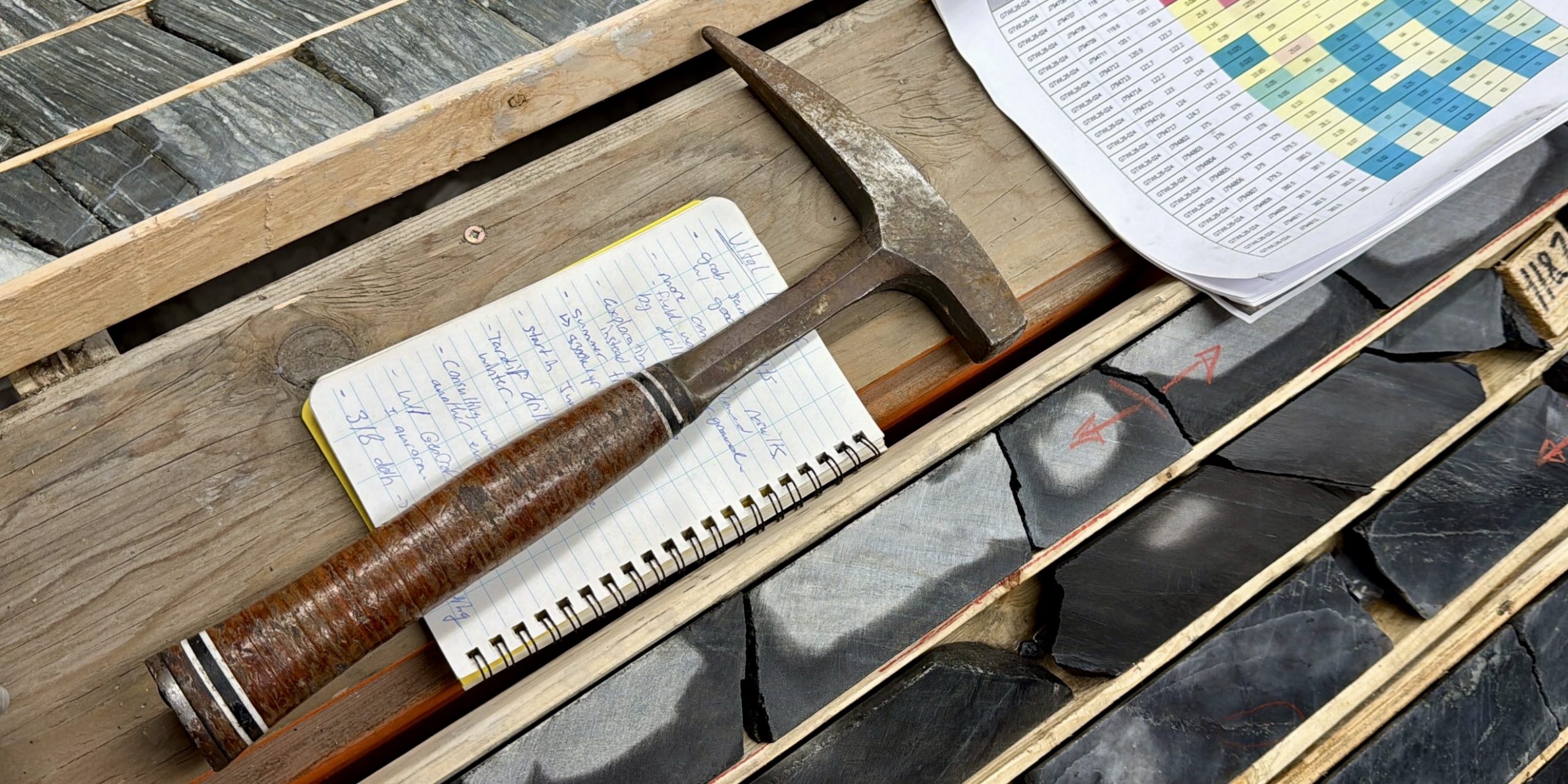
Gold Terra is tracing high-grade gold in Yellowknife. Credit: Henry Lazenby
Last month Gold Terra reported a highlight result of 20.35 metres grading 8.2 grams gold from 242.5 depth in hole GTY26-001, including 6.75 metres at 18.8 grams goldfrom 254.75 metres downhole. Earlier this month, it followed with 11.1 metres grading 9.53 grams gold 211.3 metres downhole in GTY26-013, including 4.5 metres at 18.94 grams gold from 217.9 metres depth. In the Walsh Lake target, in the northern portion of the project, the company reported 5.7 metres grading 22.46 grams gold from 119.6 metres depth in hole GTWL26-024.
Yellorex matters because it “could be where we start operations if Con Mine were to be restarted,” Ryan Buchinski, Gold Terra’s senior project geologist, said.
District scale
The mine plan calls for developing Yellorex through a decline rather than going straight underground through the old Robertson shaft. Gold Terra is also sizing up the North 103 target, which Panneton said could hold a larger near-term resource. He told visitors the bulk of the coming resource update could come from North 103, which might host 500,000 to 600,000 ounces.
Panneton said the company wants a smaller-footprint start and is willing to rethink other deposits, including Sam Otto – north of the city – to avoid bigger open-pit concepts close to town. He said a ramp at Yellorex and North 103 could support a 2,000-tonne-per-day start, while other deposits to the north would get more time for baseline work and later permits.
Beyond the near-term Con restart case, Gold Terra is still building district-scale optionality in the North Belt, where the Mispickel area added the MP-Ryan and Zone 14 high-grade zones in 2022. Walsh Lake remains a newer high-grade discovery the company says warrants more drilling.
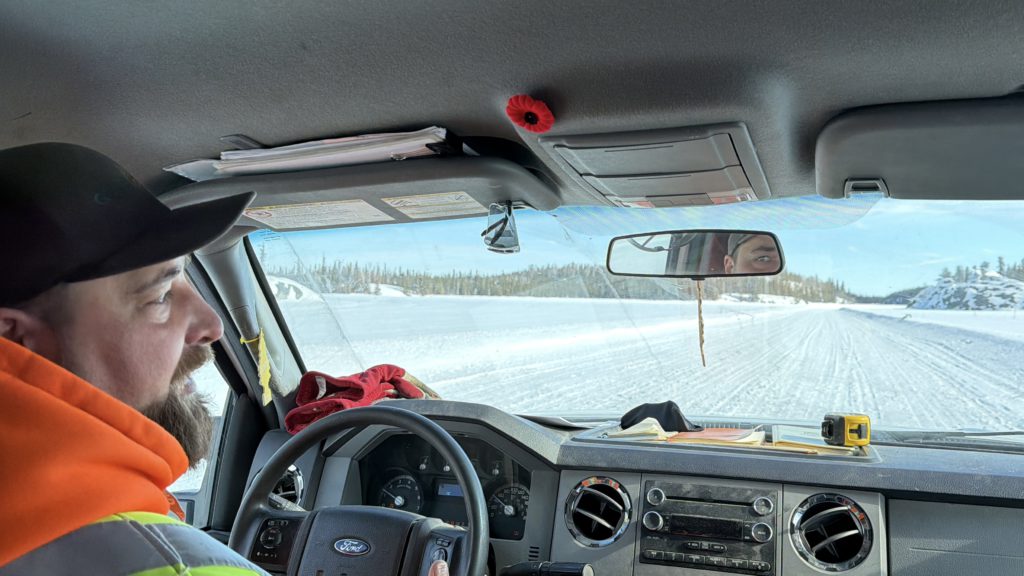
Using ice roads to access the Mispickel drill pads north of Yellowknife with one of the company’s geologist contractors. Credit: Henry Lazenby
Regulatory challenge
One of the biggest territorial bottlenecks is not a lack of rules but a complex system that requires federal departments, Indigenous governments and co-management boards to move together, Mining Minister Caitlin Cleveland told The Miner in January.
“The territory’s regulations under the Mineral Resources Act are being finalized with Indigenous governments and should bring a great amount of certainty by 2027, because they tell companies exactly what steps they have to go through,” she said.
While Gold Terra acknowledges the complexity of taking the project through permitting, it has managed to secure its land use and water licence permits.
The company aims to start the Con mine permitting process in 2027, after submitting its project description, mine plan and closure plan. If all goes well, first production could happen by 2029.
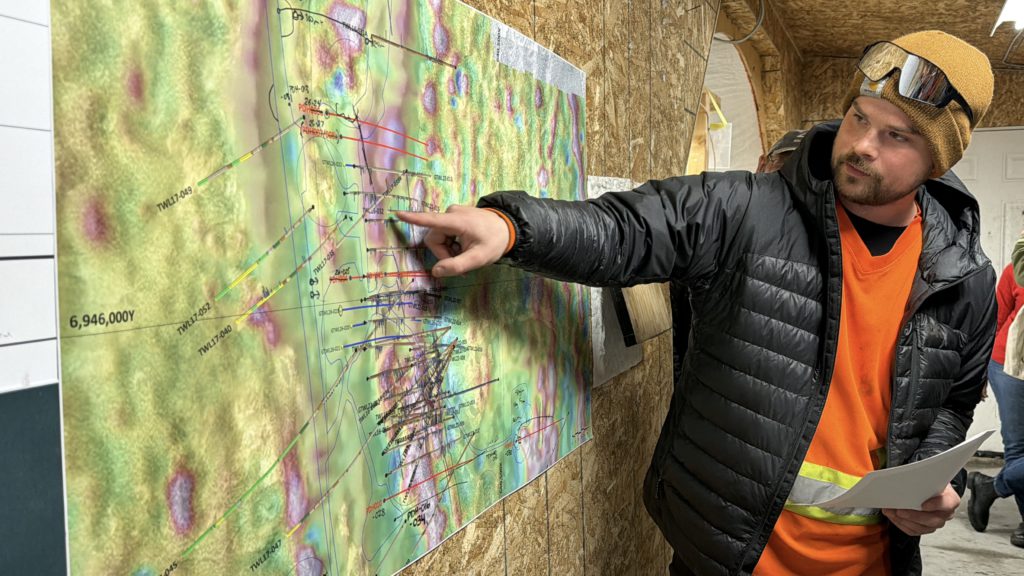
Ryan Buchinski, Gold Terra’s senior project geologist, explains the exploration strategy to visitors. Credit: Henry Lazenby
Execution
To reach production, Gold Terra still has to finance the work, convert more ounces, close the Con acquisition with Newmont and prove that a restart can meet modern technical and social standards.
The company has about 468.7 million shares outstanding and 477.5 million fully diluted. Panneton said the company has spent roughly $19 million on the Con option since taking it on, while Eric Sprott, Mackenzie Investments and other long-term backers count among the top shareholders.
For now, that is enough to make Con more than another junior exploration story. Gold Terra has a city-adjacent brownfield asset, fresh drill results, a timetable for two resource updates and a territory that is openly asking how to get new mines through the gate before the diamond hole gets deeper.


Be the first to comment on "Site visit: Gold Terra bets Con can help fill Yellowknife’s post-diamond hole"