
SITE VISIT
Windhoek, Namibia — Strong uranium prices have re-ignited the search for new uranium mines, and Namibia, holding Africa’s second-largest reserve, is experiencing a resurgence of interest as a result.
But just as uranium’s much-touted upside as a source of cleaner energy has questions concerning public health and safety attached to it, Namibia’s good reputation has questions of its own.
Justifiably considered one of Africa’s most stable regions, Control Risk, a London-based risk assessment firm, gives Namibia’s political and security risk the same ranking as Canada. However, questions regarding long-term power supply, and the implementation of Black Economic Empowerment (BEE) loom.
The government’s lack of a clear mandate on the implementation of BEE — it has released a declaration of intent, but has not passed legislation on the policy — has been made murkier by a lack of public support.
Professor Henning Melber, director of research at the Nordic Africa Institute and former head of the Namibia Economic Policy Research Unit, says many Namibians — including the head of the national workers’ union — are enraged that BEE has thus far done little for smaller companies and workers, instead “fattening” the well-connected and wealthy. Currently, BEE is implemented by mining companies on a voluntary basis.
On the power front, Namibia has long been reliant on South Africa for energy, and until recently that reliance was not subject to much scrutiny.
But with half of South Africa’s Koeberg Nuclear reactor shut down, and the other half shutting down next month for repairs, questions about the security of Namibia’s power supply have begun to surface.
In the short term, NamPower — Namibia’s parastatal energy supplier — has been coping with energy demand by restarting coal and diesel-fuelled plants. Here in Namibia, The Northern Miner has witnessed roaming brownouts.
The situation has Namibia looking to other African nations for more secure sources of power. The Western Corridor project would link Namibia with other African countries allowing them to share power resources. The government says transmission lines running power from Zambia will be in place by June 2006.
“I don’t want to say we are in a crisis,” NamPower’s managing director Leake Hangala told a Namibian newspaper in early February. “But there’s a major challenge facing us.”
Rossing Uranium has been operating a large-scale uranium mine since 1976 in Namibia. Director of communications, Alwyn Lubbe, says power shortages have not been an issue for the company.
“As a responsible user of electricity and water in our mining operation, we have not experienced significant shortages over the years,” Lubbe says.
Rossing, which is 68% held by Rio Tinto (RTP-N, RIO-L) is the grandfather of uranium mining in Namibia. Having planted its roots there long before the country achieved its independence from South Africa in 1990, it is familiar with doing business in the arid nation.
So while others wait for a clear direction on what the government will do on the BEE front, Rossing says it’s already in good stead because of its long-standing practice of integrating the company with the country and the community.
“Ninety-six per cent of our employees are Namibian,” says company spokesperson Diane Harmon. “The chairman of our board is Namibian.”
In addition, the government of Namibia holds 3% of the company. Other shareholders are Industrial Development Corp. of South Africa with 10%, and the government of Iran with 15%. Local individual shareholders make up the remaining 3%.
Rossing’s comfort in Namibia and its belief in robust uranium prices going forward have prompted its recent announcement of US$112 million in spending to extend the mine’s life to 2017. In the process, it will ramp back up to its full production capacity of 4,000 tonnes a year within two years, and will hire another 150 workers. Rossing wasn’t producing at full capacity due to depleted uranium prices and a lower American dollar (uranium is sold in U.S. dollars).
Rossing gained an international reputation by producing 7.7% of the world’s uranium oxide (U3O8) from one of the world’s largest open-pit uranium mines. It accounts for 10% of the gross domestic product of Namibia.
The massive open pit consists of a low-grade 300 ppm of U3O8 that is alaskite hosted. Uranium occurs at a rate of 55% uranite and 40% beta-uranophane. The remaining 5% is betafite.
The mine currently employs 833 people, plus about 350 contractors. The workforce is used to both mine and process uranium on-site so that yellowcake can be shipped to energy producers the world over.
Next in line
Forty kilometres southwest of Rossing lies Namibia’s newest entry into the uranium market — Paladin Resources’ (PDN-T, PDN-A) 100%-owned Langer Heinrich project. While not on the same scale, when completed later this year it will represent Africa’s first producing uranium mine since Rossing.
Langer Heinrich is Paladin’s first operating mine, and the company has put itself on a tight timeline to get it started. The on-site uranium processing plant is slated to be up and running by Sept. 22, 2006.
While the project is on track and on budget, just two out of six flotation tanks are complete.
“Last week, that one wasn’t even up,” says project manager Garnet Halliday, looking up at the second tank.
That speed wouldn’t be possible if Paladin wasn’t able to get the power it needs for operations. NamPower was able to run a power line to the plant in record time.
And while Halliday says both power and water are the two big issues in Namibia, the question of their abundance hasn’t slowed Paladin down yet. The site is currently abuzz with three tower cranes, and peak construction will see some 560 mostly Namibian workers on the company books. NamWater is slated to run an above-ground waterpipe to the project before September.
The pace of work at Langer Heinrich isn’t coming at the expense of safety and working conditions at the site. Paladin’s safety standards and base camp are enviable, as it’s evident the company is covering all of its bases to ensure its US$9.2-million project comes off without a hitch.
With regards to BEE, Paladin has been following government guidelines in the absence of a mandated policy. Those guidelines include: employing, training and developing local people, providing appropriate conditions of employment and using Namibian goods and services, where appropriate.
Halliday says that in compliance with the government’s affirmative action policy, 60% of the work force will be local, and already 85% of the management team is Namibian.
Once in production, Langer Heinrich will turn out 1,180 tonnes of U3O8 per year. That rate will slip to 401 tonnes during years 12-15, as lower-grade stockpiles are processed. Average life-of-mine operating costs are projected at US$14.18 per lb. U3O8, based on uranium prices ranging from US$26 per lb. to US$35 per lb. over the 15-year lifespan. Paladin anticipates the mine will pay for itself in 3.5 years.
The open-pit operation will draw from a measured and indicated resource of 32.3 million tonnes grading 0.07% U3O8, for 20,200 contained tonnes. Another 40 million tonnes of inferred material runs 0.06% U3O8, for 23,800 contained tonnes. The estimates employ a cutoff grade of 0.025% U3O8.
But the resource could increase. Once the uranium is being processed, Paladin plans to get aggressive about further exploration on the property.
“We’re not doing 1.5 million tonnes per year forever,” says Halliday. “We’re miners and we’re going to get at it.”
The site’s uranium mineralization is near surface and occurs over a 15-km shallow valley. Along the mineralization, uranium occurs in higher-grade pods that are encased by a lower-grade envelope. The uranium is calcrete hosted.
With a firm handle on where the uranium is coming from, Paladin is beginning to
get a clearer picture of where it’s going.
The company recently announced contracts for the purchase of its future yellowcake. The contract calls for the supply of about 973 tonnes of yellowcake to a major U.S. utility between 2007 and 2012. The company says pricing will reflect market conditions at the time of delivery. A subsequent contract will see Paladin supply another utility company with 943 tonnes under similar conditions over the same period.
New kid on the block
Toronto-based Forsys Metals (FSY-V) is another up and comer in Namibia’s uranium scene.
On the BEE front, its policy is similar to Rossing’s in that it believes in incorporating BEE policies at the outset of operations.
Ongopolo Mining and Processing, a BEE-recognized company, is a 10% holder in its Valencia uranium project.
Located 35 km from Rossing, Forsys envisages Valencia as an operation that will mine low-grade uranium from an open pit as Rossing does — albeit on a much smaller scale.
Exploration manager Rick Bonner says uranium at Valencia occurs mainly as uranite, plunges at 30, and is exposed at surface.
A National Instrument 43-101-compliant report was completed by Snowden Mining, updating the 1981 resource estimate on the project by Gold Fields (GFI-N, GOF-L). The inferred resource for the project stands at 49 million tonnes grading 0.02% U3O8.
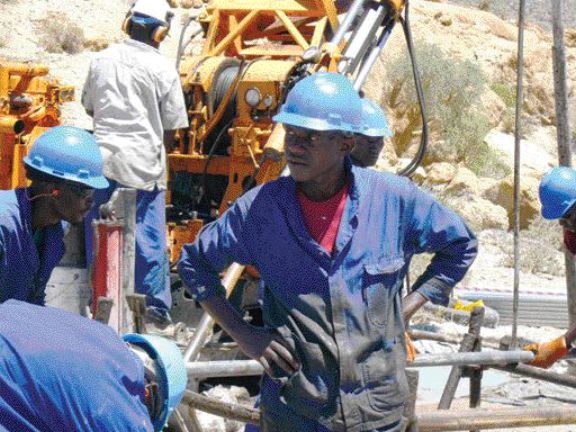
Forsys has two drill rigs on-site and is in the process of completing its third and fourth holes. It is bringing a third drill rig on-site to make up for slower than anticipated progress, and it plans to have a prefeasibility completed by the end of the year.
Bonner says the purpose of the drilling program is threefold: it will twin holes to verify historical drilling, complete infill drilling to confirm the 70 by 70-metre grid laid out by Gold Fields, and continue exploration drilling to expand the potential resource.
On Feb. 23, Forsys announced that a spectrometer grid survey over the alaskite body at Valencia had indicated a potential extension of mineralization over an area that had never been tested. As a result, the company is expanding its drill program from 10 holes and 3,000 metres to 18 holes and 5,300 metres.
Goldfields Namibia explored the site between 1973 and 1977. Its work included borehole drilling, chemical analysis, and radiometric-sorting tests on bulk-ore samples. It also carried out two preliminary feasibility studies in 1981 and 1989. Goldfields decided the project was uneconomical due to low uranium prices at the time.
In all, 96 holes were drilled. Fortunately for Forsys, much of the drill core is still on-site and available for testing.
With strong historical data and recently attained financing, Forsys is pushing ahead at Valencia. But it, too, is conscious of Namibia’s water and power issues.
“Whatever we do, we keep water in mind,” says Bonner, who drilled a borehole to supply the camp’s current limited water needs.
Company president and chief executive, Duane Parnham, says that should Valencia become a producer, a water pipeline could be splintered off the pipeline leading into Rossing; the same could be done with power. Rossing verified that option, saying there would be enough power and water to accommodate an operation such as Forsys’.
Perseverance
Whatever the issues currently facing it, Namibia’s recent history shows that it has found a way to overcome adversity with reason and through peaceful means.
This was, after all, a country colonized by Germany until the Second World War, and then occupied by South Africa — with its policy of apartheid — from the late sixties until it won its independence in 1990.
In the early nineties, the party responsible for gaining independence, the South West African Peoples Association (SWAPO), had Marxist affiliations, creating unease in the West. But once in power, SWAPO toned down the Marxist rhetoric and established a democracy committed to a free-market economy.
By 2002, the SWAPO government had established a mineral policy widely regarded as mining friendly, re-affirming the nation’s long history of encouraging mining.
Under both German and South African rule, companies exploring the land were required to submit all compiled data to the government. That policy, combined with surveying by the current ministry of mines, has resulted in 65% of the country being mapped. The ministry anticipates having the entire country covered by 2009.
Minerals currently account for roughly 20% of Namibia’s gross domestic product, and 50% of export earnings — 70% of which is from diamonds.
And while diamonds grab the lion’s share of attention, the country has long been known for its uranium deposits as well. With uranium prices climbing to US$37 per lb. in January 2006 from US$7 per lb. in December 2000, the rumbling of heavy machinery in Namibia’s desert will only grow.
Be the first to comment on "Uranium gaining attention in Namibia"