
It has been almost 40 years since
While it perseveres in the permitting process for its Victor project in northern Ontario, De Beers has received its final permit, a Class A water licence, for construction of the Snap Lake underground mine in the Northwest Territories. Receipt of the permit follows the territorial government’s approval of environmental and socio-economic agreements. The terms of the agreement between De Beers and the government, though confidential, are said to honour the commitments previously made by De Beers during public hearings.
The environmental agreement calls for the establishment of a monitoring agency, managed by a panel of representatives from four aboriginal groups: Yellowknives Dene Band, Lutsel Ke Dene, North Slave Mtis Alliance, and Dogrib Treaty 11 Council.
The socio-economic agreement includes commitments regarding training, particularly in the areas of literacy, apprenticeships and encouraging women’s interest in non-traditional jobs.
Separately, De Beers is still negotiating impact-benefit agreements with the four aboriginal groups and will continue to do so over the coming weeks and months.
The Snap Lake project will employ up to 450 people during construction and create upwards of 550 permanent positions over the 20-year mine life. Forty per cent of the workforce during construction will consist of territorial residents, and this number will rise to 60% after startup. At least half will be aboriginal workers native to the region.
Also, De Beers will provide $500,000 over five years to help fund training opportunities at the newly built Kimberlite Career and Technical Centre in Yellowknife. The centre currently houses training labs for welding, construction, electronics and small engine repair. Other initiatives include a literacy program and a training course to help northern residents pass their trades entrance exams.
There have been concerns about De Beers’ commitment to supplying rough diamonds to territorial cutting centres. However, in late 2002, De Beers Canada President Richard Molyneux informed the Mackenzie Valley Environmental Impact Review Board that a proportion of the diamonds mined at Snap Lake would indeed be sold directly to local industry, without being mixed with other, non-Canadian production.
The economic feasibility of diamond cutting and polishing in the territories depends on the success of creating a market premium for the Canadian stones, based on their clean and pristine image. It was argued that this perceived premium would be lost if Canadian rough were to be mixed with stones of African or Russian origin.
Molyneux faced criticism for his remarks, made a year and a half ago, that De Beers had no intention of pursuing Canadian branding opportunities as it felt the current market for Canadian brands was limited and could be met by production from other Canadian producers.
Two cutting factories in Yellowknife recently went into receivership.
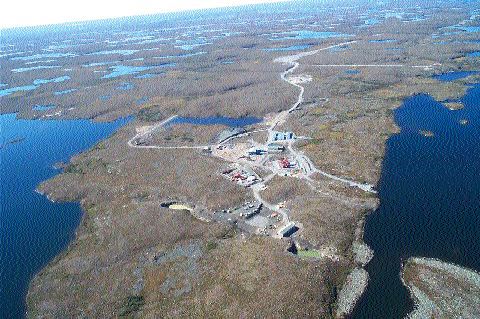
The Snap Lake project is 220 km northeast of Yellowknife, just south of the tree line. De Beers has proposed a 3,000-tonne-per-day (1.1-million-tonne-per-year) underground diamond mine on the shallow dipping-to-flat lying Snap Lake kimberlite dyke. The project is expected to deliver 1.5 million carats annually, based on a minable resource of 22.8 million tonnes of kimberlite grading 1.46 carats per tonne, equivalent to 32.3 million carats. The diamonds are valued at US$76 per carat.
At an estimated capital cost of $490 million and an operating cost of $103 per tonne, the mine is expected to generate $180 million annually in revenue.
By opting for an underground-only operation using room-and-pillar mining methods, De Beers has limited the surface footprint of the mine to 2.5 sq. km on the northwestern peninsula of Snap Lake. The above-ground facilities will include a kimberlite processing plant, materials and ore storage areas, water and sewage treatment plants, a water management pond, fuel storage, a power-generating plant, an airstrip, and housing for up to 350 people.
In anticipation of receiving the final permits, De Beers issued $38 million in contracts and purchase orders for the first phase of development. The winter road to Snap Lake opened in February, and over a 5-week period, 249 truckloads of equipment, fuel and goods were transported to the site. The 2004 program will provide key technical information for completion of final mine and process plant designs, as well as equipment selection.
Now that the permits are in hand, De Beers’ Snap Lake team will install a water treatment plant and expand the capacity of the fuel tank farm. The existing underground development will be dewatered and extended by an additional 4,000 metres. The test-mining of some 150 eighty-tonne samples will assist in performance reviews of new underground mining equipment and modifications performed on the bulk-sample processing plant, which included the addition of an optical waste rock sorter, a high-pressure roll crusher, and a new X-ray sorter.
De Beers will attempt to confirm dilution estimates and improve water treatment processes. Completion of the winter road in early 2005 will mark the beginning of construction, putting Snap Lake on schedule for startup and commissioning by the second quarter of 2007.
Be the first to comment on "Snap Lake receives final permit"