
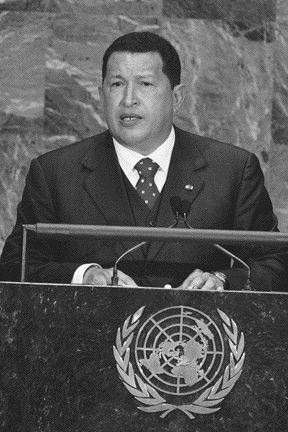
Lima, Peru — Venezuela’s firebrand president Hugo Chavez is not one to mince his words. “Don’t mess with me, girl!” he told U.S. Secretary of State Condoleeza Rice this month after the American government described Venezuela as a menace to Latin American democracy.
Such a warning also appears to apply to mining companies who want a share of the South American nation’s rich mineral reserves. Last September, Chavez, an unpredictable former paratrooper who says he is fighting imperialism to benefit the poor, announced: “I’ve decided, after looking into this and that, to cancel all mining concessions.”
The comments, which were seen as part of Chavez’ self-proclaimed socialist revolution to exercise sovereignty over natural assets, sparked panic among investors. Shares in Canada’s Crystallex International (KRY-T, KRY-X), which is waiting on an environmental permit to develop Venezuela’s biggest gold mine, Las Cristinas, lost almost half their value on the news.
Now miners, including Toronto-based Bolivar Gold (BGC-T, BGCNF-O) and Denver’s Gold Reserve (GRZ-T, GRZ-X), are playing a waiting game. The results of Chavez’ mining contracts and concessions review, started in October, were promised at the end of last year and are still pending, while foreign mining investment has been frozen. According to Venezuela’s mines minister, Victor Alvarez, the new policy is “no more concessions.” Chavez, who is flush with money from high oil prices and has won friends in Latin America for his anti-U.S. posturing, says that deals signed with mining companies before his 1998 election victory were “stealing” Venezuela’s natural resources.
But other senior officials say they just want to put the sector in order. Optimistic analysts and mining companies see the government following the same policies it implemented in the oil sector, the motor behind the country’s economy. In 2004, Chavez raised royalties for foreign oil companies and ordered others to switch to joint ventures giving the state oil company PDVSA a controlling share. That, says Chavez, allows poor Venezuelans who make up more than half the population the chance to benefit from the nation’s oil wealth.
Meanwhile, Alvarez says there are just a few cases left to look at before the review results are announced. He believes that the review is part of a plan to give the government control of mining concessions that have been idle for years.
“The government is not going to allow mining concessions to remain inactive,” he asserts.
New mining agency
What has been decided upon is the creation of a state-run mining agency, which will absorb Corporacion Venezolana de Guayana, (CVG), which oversees some 480 concessions and 500 mining contracts, and state-owned CVG Minerven, which increased its gold production by 16% last year to 3,756 fine kg. The new agency will also run currently inactive concessions or hand them to small Venezuelan miners.
According to Alvarez, Venezuela plans to invest around $2 billion in its productive industries, mainly in mining, over the next few years to start new exploration projects, increase mineral production and modernize state-owned aluminum producer Alcasa. Much of that money will come from Venezuela’s international reserves. Lawmakers in Caracas also want the government to grant permits to unlicensed miners to develop projects.
Crystallex chief executive officer Todd Bruce is naturally hopeful of a favourable outcome when it comes to Las Cristinas, potentially one of the world’s top gold mines. While Chavez says that Las Cristinas “belongs to Venezuela” and wants the new state-run company to develop the site, the government this month granted Crystallex the right to explore and develop a quarry to build Las Cristinas.
“The issuing of the quarry permit is an important step in widening our options to secure aggregate for Las Cristinas,” says Bruce, who has repeatedly said that Chavez’ plans “will not impact our contract.”
Crystallex shares have slowly recovered their value on the Toronto Stock Exchange and the company’s message that Venezuela plans “rationalization, not nationalization” in the mining sector appears to be getting through, although even Venezuela’s mining chamber, Camiven, is unclear of what the Chavez government really has planned for mining.
No clear mining strategy
“The extent of the Chavez administration’s future economic policy radicalization remains uncertain as no clear strategy has been articulated by the government and policy reversals are frequent,” says the U.K.-based Economist Intelligence Unit in a new report on Venezuela. Camiven has also argued that reviews of mining concessions should be done on a case-by-case basis, not on a large, revolutionary scale.
The apparent battle over Las Cristinas is perhaps understandable. Chavez is keen to pursue development of gold mining and increase Venezuela’s bullion reserves as prices reach record highs. Venezuela’s gold production has been low in recent years, and the Las Cristinas site has 13.6 million oz. in reserves. Crystallex aims to begin production in 2007, having invested more than $90 million there since 2002. A 20,000-tonne-per-day processing plant is expected to cost $290 million and Crystallex could invest another $150 million in Las Cristinas once output starts, to double processing capacity from 2008. The upgrade would allow Cristinas an average production of around 500,000 oz. per year for more than 20 years, up from an initial target of 300,000 oz.
Chavez, who survived a brief coup in 2002 and was emboldened by his victory in a recall referendum in early 2004, appears to at least be clear on plans to end alumina-based raw material exports by 2012 to divert production to the domestic market. That would cut exports by around 400,000 tonnes per year as Chavez aims to develop shipbuilding and railway industries, reactivating local manufacturers in a country heavily dependent on imports, although analysts question whether the economy is large and diversified enough to absorb the high volumes of metal.
Nevertheless, investors appear willing to fight to get a piece of Venezuela, which also produces limestone, sands and gravel, despite Chavez. Phillipines-based company Mindenao Gold Mining (MDGM-O) says it is negotiating a concession for the Grand Pacaraima Gold property in southern Venezuela, while many juniors, as well as Hecla Mining (HL-N) of the United States and China’s Shandong Gold Mining, are keen to remain active in the country.
— The author is a freelance writer based in Lima, Peru.
Be the first to comment on "Miners play the waiting game in Venezuela"