
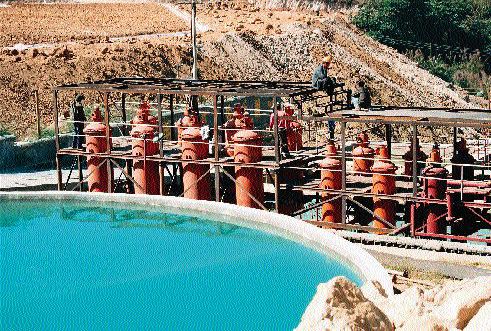
China’s gold mine production reached a record 213 tonnes in 2003, but this amount is still insufficient to satisfy the demand for gold for jewelry and industry, which is running at around 250-300 tonnes a year.
Some estimates suggest that China’s demand for gold may reach 600 tonnes a year within the decade. As in the past, the shortfall will need to be met by imports. The mining industry is fragmented, though it is being reorganized. There are many small mines, where pollution and safety are major issues. Even the larger mines produce a maximum of only a few tonnes.
Exploration has been impeded by the re-organization of the industry. Investment by foreign companies has been sporadic and small. The mining majors have yet to commit.
The Chinese government, as the ultimate owner of all minerals, is well aware of this situation and has taken steps to stimulate industrial growth. On the one hand, grants and subsidised loans have been abolished. But at the same time, the medium-sized mines are being consolidated into holding companies. The state is using China National Gold Group Corp. as its holding company for its shares in mining companies.
Three companies — Zhongjin, Shandong Gold and Fujian Zijin — have been allowed to float, with great success, on the domestic and Hong Kong stock exchanges. Another 12 company flotations are said to be in the pipeline. Also, foreign banks have been allowed to invest in domestic shares in gold mines through the QFII Scheme. UBS, for example, holds a stake in Shandong Gold through its QFII.
For foreign mining companies, the picture is not rosy. While deep mining techniques would be of benefit to gold mining in China, none of the foreign majors has yet committed significant financial resources, and some have quietly downgraded their local representation. There are many reasons for this — for example, China’s tortuous approval process, inter-departmental and local conflicts, and restrictions on the grade of ore that can be exploited. Mining juniors are currently returning to China; many of them had left because they were uncertain of the legal enforceability of their claims against strong vested interests.
Lower mining costs in China are not seen as a major attraction. Some of the major Chinese domestic mines appear to be operating at international levels, but China holds out the possibility of major new finds, particularly in Xinjiang in the West, where foreign companies are being encouraged to invest. It seems likely that most provinces in China will have some exploitable gold. Guizhou, for example, in the south, has the Lannigou (Jinfeng) deposit, which contain an estimated 160 tonnes of gold.
Despite these difficulties, the structure of the gold industry in China in 2004 is almost completely unrecognizable from the situation a few short years ago. Gone is centralized buying by the central bank (PBoC) from the mines and corresponding allocation of gold to jewelers, all at uneconomic prices (dubbed the Monopolistic Purchase and Allocation Management System, or MPAM). Sales and purchases of gold on the Shanghai Gold Exchange among its membership of 108 miners, bankers and jewelers are, in effect, now completely free; they closely follow the world price and are running at around a tonne per day.
The Banking Act has been amended to allow all banks (not just the Bank of China) to participate in this gold dealing. The import of gold bullion is, however, still restricted, and jewelry is still subject to import duties. This may account for reports of persistent smuggling.
The gold industry has also not escaped the recent government reforms introduced by the new prime minister, Mr. Wen Jiabo, in March 2003, when two state commissions (SETC and SPDC) were abolished and replaced by the State Development and Reform Commission. This powerful commission has overall responsibility for gold, and is now drafting the influential Eleventh Five-Year Plan, which will chart official policy and further reforms from 2006 to 2010, including plans for the gold industry.
The role of the Ministry of Land and Resources (MOLAR) remains unchanged. This ministry, set up in 1998 and responsible for mining China’s natural resources, is conscious that foreign investment in the mining sector, including gold, remains poor for both legal and bureaucratic reasons (some of which are beyond the control of MOLAR). If progress is to be made, it must be at the administrative level. Until recently, only one foreign company,
A new gold-mining trade representative body, run by its members, the China Gold Association (CGA), has been formed from the old state-run Gold Bureau. The CGA has a wide remit, and could become a powerful body, representing, as it does, mining, refining, marketing and planning interests. However, there are, as yet, no foreign members, to give it a wider voice.
Deregulation of supply
The deregulation of supply to the Chinese gold market, driven by internal reforms and the demands of WTO membership, is fast approaching completion. Gold is now traded freely at world prices on the Shanghai Gold Exchange; individuals can purchase gold in all forms: jewelry, coins, ingots, and as a “paper” investment. Gold smuggling into and out of China, though not eradicated, is no longer running at annual rates in excess of total national production (150-200 tonnes).
China’s membership in the World Trade Organization (WTO) has also required changes in import taxes on gold and silver items; these will fall from 33.3% currently to 20% by 2005. This still makes foreign jewelry more expensive than the domestic item, and may be a motivation for smugglers.
The Chinese economy continues to grow at an extraordinary pace, with gross national product running in excess of 9% in both 2003 and 2004, though it appears to be decelerating. Domestic consumption and wages are also rising, at about 9%, while inflation is muted at 2-3% (though some estimates would place it nearer 8% in 2004). Given this background of rising purchasing power, it is not surprising that demand for gold in all its forms is also strong, particularly in the affluent cities of China’s eastern seaboard.
But at the bedrock of Chinese society, some 800 million peasant farmers, the first beneficiaries of economic reform in the 1980s (and at times major consumers of gold as a hedge against poverty), are now seeing their incomes fall behind the affluent town and city dwellers. WTO rules are cutting back their farm subsidies, and farmers are afraid of the rising depredations of land seizures by local authorities intent on “get rich quick” development projects. This situation aggravates the growing polarization between rich and poor. Indeed, government policy is increasingly aimed at rectifying this imbalance between urban and rural development.
One major unknown affecting consumption is the current stock of gold in China, which is variously estimated at an enormous 5,000-8,000 tonnes. Another is the intentions of the PBoC in its reserves policy. Gold’s 2% share at 600 tonnes seems underweight at 1.6% of official reserves if contrasted with the European Central Bank’s 15%. An increase to 15% would require approaching two years of world production.
Looking at the competition, platinum has also been a major success story in China, with consumption for jewelry running at 50 tonnes a year, almost all of which is imported since China produces only tiny quantities.
On the macro-economic side, it is still unclear if there might be a hard landing for the Chinese economy in 2004 or 2005, engineered by tougher credit controls. The power of external shocks also cannot be excluded. China is increasingly dependent on imported oil, and the price move above US$40 a barrel will bring its own form of economic discipline.
Government tax revenues are shrinking, and an aging population is making increased calls on the unfunded pension and health care system. The ability of the banking system to purge its bad lending habits remains in doubt, despite massive recapitalizations from the foreign exchange reserves.
China is nonetheless set to grow over many decades. True, there will be a number of economic downturns and short-term shocks along this path, and there is great potential for serious trouble in the financial and government revenue sectors, but the Chinese people are generally becoming more affluent, and gold, while no longer the sole destination for investment, will certainly play its ancient role as a conspicuous display of wealth, as an adornment, and as a perceived (if not always actual) store of wealth.
— The preceding information was culled from Gold Mining in China, published by Gold Fields Mineral Services and China Financial Services. The report sells for US$1,950. To order a copy, e-mail GFMS at info@gfms.co.uk.
GFMS is the world’s foremost precious metals consultancy, specializing in research into the global gold, silver, platinum and palladium markets. GFMS is based in London, but has representation in Australia, China, India and Russia, and a vast range of contacts and associates across the world.
China Financial Services specializes in providing consultancy on the Chinese market, with special reference to precious metals. It worked in conjunction with GFMS and the World Gold Council on the 2004 China Gold Report, and has also brought senior gold officials to the U.K. for training.
Be the first to comment on "Growing China will need gold imports"