
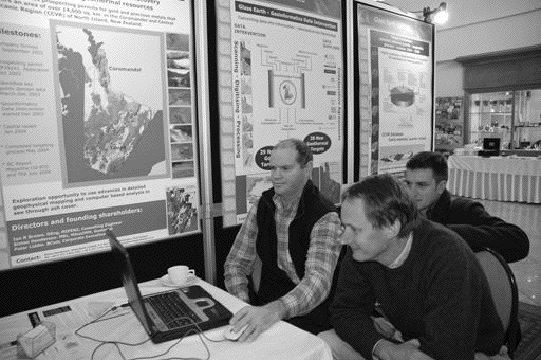
Perth, Western Australia — Glass Earth (GEL-V) will this year test its claim that New Zealand, compared to other epithermal gold regions in the world, is grossly underexplored.
The company, which includes a blend of Kiwi and Canadian expertise, added to its landholding on both the North and South Islands of New Zealand in late December by acquiring HPD New Zealand, a subsidiary of London-listed Patagonia Gold (PGD-L). Approval from regulators is pending.
Chief operating officer Simon Henderson, who works from Glass Earth’s base in the New Zealand capital of Wellington, says that in 2005 the company did a lot of groundwork, including low-level aeromagnetic and gravity surveys, and meetings with North Island private landholders.
Two key focal points are the Central Volcanic Zone (CVZ), in the heart of the North Island, and farther north, the Waihi region near the base of the Coromandel Peninsula, where Newmont Mining (NMC-T, NEM-N) is mining the mature Martha open-pit mine and developing the Favona underground mine.
Last year’s work turned up 29 prime gold targets, including mainly virginal zones in the CVZ and a mix of virginal and lightly mined and explored areas in and around Waihi, extending east and south to the mothballed Golden Cross gold-silver mine and the historic Karangahake gold field.
Henderson, an experienced Kiwi gold geologist who undertook mine-finding work in Australia’s Northern Territory in the 1990s, says that in the CVZ a total of 21 targets have been identified for drilling, and hopes to have rigs on-site by April.
As well as identifying targets on Glass Earth’s ground and neighbouring areas, last year’s program employed ground resistivity and other field work to assess the potential depth of targets on key areas.
Henderson has seen big changes in New Zealand’s mining industry, where exploration was hog-tied in the 1980s and 1990s by political inertia, the then-powerful green lobby and cumbersome legislation.
To facilitate a rapid move into drilling this year, Henderson and his brother Hamish (who works in farming and rural economics) visited 50 landholders in the CVZ to get access agreements.
The chief executive says clearances were received from all parties and Glass Earth also has had positive negotiations with the government agency LandCorp, which handles some private landholder issues, and with the Department of Conservation.
The HPD acquisition should see Glass Earth become the biggest tenement holder in the Waihi district. This may result in positive dialogue with Newmont subsidiary Newmont Waihi Gold, as the major is aggressively exploring for new deposits to optimize its Waihi gold plant.
The expected phase-out of ore from Martha’s open pits late this year or early next and the transition to Favona underground ore will mean that the gold plant may be working at less than half capacity.
Newmont is known to be a willing talker and has had discussions with local company Heritage Gold NZ (HTM-A), which is resurrecting adit mining on unmined, high-grade zones at the Karangahake gold mine.
The HPD deal takes in a package of licences elsewhere — mainly mesothermal gold targets in South Island’s Otago region, including Nenthorne and Chinaman’s Flat, immediately south of Oceana Gold‘s (OGD-A) Macraes gold mine. There are also leases in the Bendigo field, north and northwest of Macraes, in the same region where Canadian uranium explorer CanAlaska Ventures (CVV-V, CVVLF-O) holds targets, including the Rise and Shine prospect with Oceana Gold, where positive first-pass drill results were received last year.
CanAlaska is looking at spinning off subsidiary Golden Fern Resources and having it take over the company’s New Zealand prospects with a listing on the New Zealand Stock Exchange.
Another Canadian listing in the New Zealand mix is Geoinformatics Exploration (GXL-V, GXLIF-O), a mining science and technology company that was set up by Australians, including geoscientist Nick Archibald, and Canadian mining and finance specialists.
The company, which operates in Canada, the United States, Australia and at least three other countries, provides support to Glass Earth on some of its CVZ properties for a 2% royalty.
Geoinformatics recently arranged a US$20-million convertible, unsecured loan from Geologic Resource Fund, though it also plans to carry out equity financing to lighten the financial load.
— The author is a freelance writer in Perth, Western Australia.
Be the first to comment on "Glass Earth scoops up New Zealand prospects"