
The indefinite tenure of Niger’s President Mamadou Tandja has been cut short and Canadian junior miners in the country are sorting out what the implications of his removal mean for business.
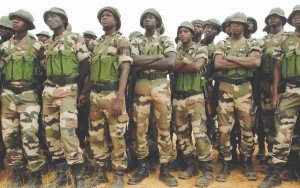
In an unpopular move, Tandja changed the country’s constitution in August 2009 to allow himself to remain as president for an indefinite amount of time. Now, however, a military coup — which seized the presidential palace on Feb. 18 — has interfered with those plans.
Col. Salou Djido, who is promising to bring a new election and a new constitution to the impoverished West African nation of 15 million people, leads Tandja’s over-throwers.
As their first order of business the junta — which calls itself the Supreme Council for the Restoration of Democracy — has suspended the constitution and dissolved all state institutions.
It says its aim is to restore democracy and save the population from “poverty, deception and corruption.”
Early word from miners on the ground in the uranium-rich country is that people on the streets were “ecstatic” over news of the coup and it was business as usual for the miners.
Members of Island Arc Exploration’s (IAX-V) geological team in the country have sent correspondences to company president and chief executive Jim Gillis.
Gillis says his team has sent positive remarks, saying it was business as usual, the army is united in its support of the coup, and anyone can enter and leave the country as they please.
But Gordon Davidson, VP of exploration for Bayswater Uranium (BYU-V) says the recent unrest is just the latest in a long list of obstacles that have deterred Bayswater from working on its permits in the country.
“We’ve not been doing work there at all,” Davidson says. “One of the issues that we encountered before the coup was that it was hard to secure contractors. We talked about getting an airborne geophysical contractor in and they told us they would fly it if [rebels on the ground] would stop shooting at them.”
Still, Davidson says the geological potential for the country is immense, and Bayswater is maintaining its claims.
He explains that the coup has actually bought the company a greater period of time to sit on the sidelines as a disturbance like a coup will classify as force majeure, extending the period of time it can remain inactive on its permits.
But while Bayswaters’s concerns were mainly to do with Tuareg rebels in the north of the country it was not immediately clear if the Tuareg had any affiliation with the coup.
Given that the coup was carried out by the military, and the military has generally been at odds with Tuareg, their involvement is unlikely.
What is known is that soldiers are currently holding President Mamadou Tandja after they seized control through gun battles in the capital of Niamey.
Reports out of the country say there is no longer a military presence on the streets, but that heavy artillery is positioned around the presidential palace.
Niger went through a military takeover in 1999, which saw then-president, Ibrahim Bare Mainassara, assassinated. Civilian rule was restored a year later.
The 71-year-old Tandja is a former army officer voted into office in 1999 and then re-elected in 2004.
Niger is one of the world’s poorest countries, but Tandja had some success in luring large investment to the nation. French-based nuclear power conglomerate Areva (ARVCY-O)is building a $1.5-billion uranium mine there, named Imouraren.
But Bayswater’s Davidson says it takes the connections, the people and the clout of major companies like Areva to get business done in the country.
Niger placed 106 out of 180 countries in Transparency International’s Corruption Perception Index. Countries with a higher ranking are perceived to have more transparency. Niger’s position put it ahead of Egypt and Algeria and just behind Zambia and Gabon.
Other Canadian-based miners with assets in the country include NWT Uranium (NWT-V) and Semafo (SMF-T).
Be the first to comment on "Coup In Uranium-Rich Niger"