
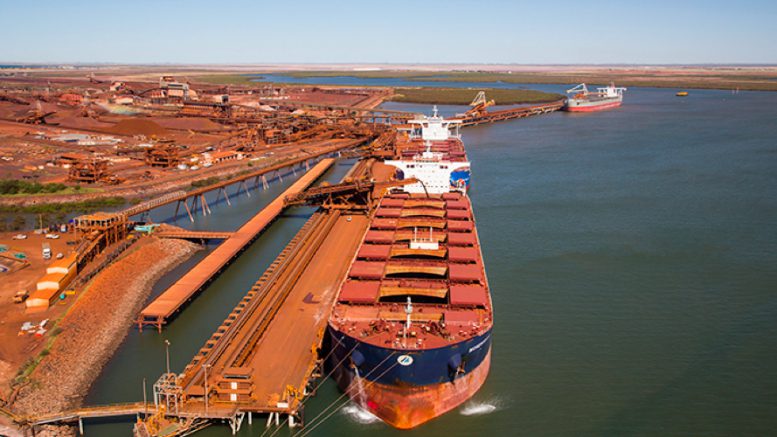
Workers at BHP’s (LSE, NYSE, ASX: BHP) Port Hedland operations in Western Australia launched the first strike at the company’s Pilbara iron ore hub since 2000 after last-ditch negotiations failed.
About 200 operators and maintenance workers represented by the Combined BHP Ports Unions walked off the job for an eight-hour stoppage beginning at 2 p.m. local time Thursday. A five-hour bargaining session on Tuesday, facilitated by Australia’s Fair Work Commission, failed to produce a breakthrough, with talks scheduled to resume July 21. BHP’s Sydney-listed shares fell 2.3%.
“We have tabled a draft agreement which includes a 16% pay increase over four years for the majority of employees, improved allowances and simplified pay structures,” BHP said in a statement. “We will hold further discussions with unions in a commission hearing next week.”
The dispute has become one of the largest union campaigns at BHP’s iron ore operations in years and could draw close attention from commodity markets if it escalates into prolonged disruptions at the world’s largest bulk-export terminal. Iron ore futures in Singapore climbed as high as $102 a tonne earlier this week, their highest level since July 2.
Six-month talks
The unions say they have spent more than six months trying to negotiate a collective agreement, arguing BHP’s reliance on individual employment contracts leaves workers on inconsistent terms and conditions.
“For eight months this company has stonewalled and gaslit the people whose labour generated $15 billion in profits last year,” Adam Woodage, Western Australia secretary of the Electrical Trades Union, said in a statement. “Today we are sending a message that Australian workers will not be worn down.”
About 575 million tonnes of iron ore moved through Port Hedland last year, although the port is also used by other mining companies unaffected by Thursday’s strike. BHP said it has contingency plans to ensure operations continue safely during the industrial action.
Investment plans
The company also reported Thursday that iron ore production fell 3% year over year in the quarter to June 30, although full-year output remained broadly unchanged despite the weaker finish to the fiscal year.
“BHP’s fiscal fourth quarter operational update was a touch better than expected, including iron ore of 68.1 million tonnes and copper of 492,000 tonnes, although the company reported a stronger than expected finish in both met and thermal coal (+9/17%),” BMO Capital Markets mining analyst Alexander Pearce said in a note on Thursday.
“Positively, fiscal 2026 costs in copper are expected to be at the “bottom end” of prior guidance,” Pearce said. “Looking ahead, maiden fiscal 2027 production guidance is as expected, which includes broadly flat year on year iron ore, but about a 12% year on year decline in copper.”
Separately, BHP said it had approved a $900 million investment in the Ministers North project, a high-grade Brockman iron ore deposit southeast of Yandi in Western Australia’s Pilbara region.
The development will add 20 million tonnes of annual production capacity once fully ramped up, supporting BHP’s medium-term production target of 305 million tonnes a year. First ore is expected in fiscal 2029.
Be the first to comment on "BHP’s first port strike in 26 years rattles iron ore supply"