
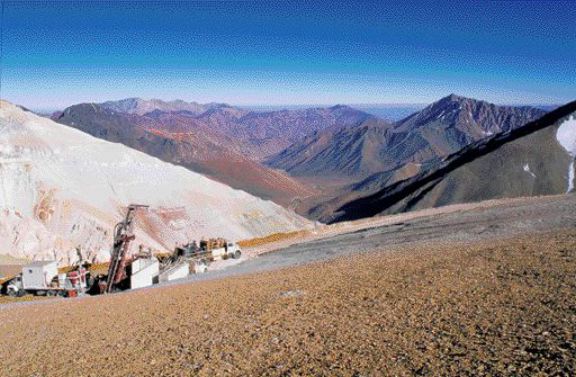
Santiago, Chile — It looks increasingly likely that Barrick Gold (ABX-T, ABX-N) will be able to build its controversial Pascua-Lama mine high in the Andes mountains, but the project’s rocky passage through the approval process highlights the changing attitudes towards the environment in Chile — a development that could have serious implications for the country’s mining industry.
Barrick Gold’s Pascua-Lama is set to be one of South America’s largest mining projects. Almost 5,000 metres above sea level in the Andes, the Canadian company plans to invest some US$1.5 billion to develop the deposit; its 17.6 million oz. gold are expected to guarantee a mine life of at least 21 years. The project would also create 5,500 jobs during construction and 1,600 positions once in operation. Barrick has indicated that its mine plan would involve the investment of another US$250 million after three years of production to expand plant capacity at the mine to 44,000 tonnes a day from 33,000 tonnes, and to build a flotation plant on-site.
Spanning the Argentinean-Chilean border, the project also marks a first in world mining history as the world’s first cross-border mine. An addendum to the mining treaty between the two countries covering Pascua-Lama, signed in August 2004, gives remarkable freedom of movement for personnel and goods moving to and within the project’s 3,041-sq.-km land position.
With production pencilled to start in 2009, the project will crown the company’s impressive expansion in the continent with new mines starting up in the last two years in both Peru (Lagunas Norte) and Argentina (Veladero). Barrick has indicated that it views the area between Pascua-Lama and Veladero as one of its main targets for exploration in the coming years. Following its acquisition of compatriot gold producer Placer Dome (PDG-T, PDG-N), including a controlling stake in the 13-million-oz. Cerro Casale project, 150 km north, Pascua-Lama is set to be the centrepiece of a true El Dorado for the world’s largest gold producer.
The development of this highly promising project has been, however, far from smooth sailing. After originally winning regulatory approval in 2001, Barrick shelved the project in 2001, citing low gold prices. The company returned to the project three years later, presenting a revised environmental impact study (EIS) for a larger version of the mine in late 2004. This time Barrick found the viability of the proposed mine being critically questioned by environmentalists, local communities and politicians who feared the project’s impact on nearby glaciers and water supplies.
Barrick managed to win some local support with a groundbreaking deal with a group of some 2,000 farmers in the mostly agricultural Huasco Valley, downstream of the proposed mine. Under the agreement, the company will provide some US$60 million over the next two decades for use in local irrigation works and other projects and provide a reservoir to ensure the mine does not affect water supplies. But the deal infuriated environmentalists who accused the Canadian firm of cynically buying off opposition to the project.
After months of study which saw Barrick present three weighty appendices of additional information to its original EIS, on Feb. 15, the environmental commission for Chile’s Atacama region (COREMA) announced that it had approved the project — although with some key provisions. Firstly, COREMA said that it would prohibit “any kind of intervention” in the three glaciers that sit above the deposit. Barrick would also have to comply with strict measures designed to protect local water resources.
How these strictures will affect the project is not yet known. For now, Barrick appears unflustered by the ruling.
“We are satisfied with the approval decision and shall now focus on developing the project,” said Jose Antonio Urrutia, associate director with Barrick Chile, shortly after the announcement.
But how will Barrick develop the open-pit mine without damaging the glaciers that lie immediately above the deposit? The company originally said that it planned to move some 8 million tons of ice from the glaciers Toro I, Toro II and Esperanza to a fourth glacier. In a later revision to the environmental impact study, Barrick halved the surface area of ice that would be affected by mining, mostly due to the effects of global warming on the glaciers, which the company reclassified as ice reservoirs.
Environmental groups, opposed to the mine project, are confused by COREMA’s decision. According to Samuel Leiva of Greenpeace Chile, the government body’s ban on any type of intervention in the glaciers clashes with a previous ruling by COREMA approving Barrick’s glacier management program for the project.
Both sides now have 30 days to appeal the ruling, which would then go before a council of government ministers for a final decision. If this occurs, it will be one of the first issues Chile’s newly elected president, Michelle Bachelet, due to be sworn in on March 11, will face.
But the conflict has raised serious questions about the quality of environmental institutions and regulations in Chile. Environmentalists have pointed out that the issue of the glaciers at Pascua-Lama was completely ignored by COREMA in the approval process, apparently because they were unaware of glaciers at the site. Similar issues have cropped up in other disputed approval processes where the relevant authorities have lacked the expertise or the resources to tackle the broad range of areas encompassed within environmental approval.
The independence of Chile’s environmental authorities has also been open to question, with the political concerns of the government of the day often having as much weight in approval processes as technical issues. It just took one note of doubt from President Ricardo Lagos about Noranda’s Alumysa project — a proposed aluminium smelter and related infrastructure in Chile’s far south — to bring the 2-year approval process crashing to a halt in August 2003.
Within days of the president’s comments, the Canadian company had shelved the US$2.75-billion investment. The company’s conclusion was clear; once the president had pronounced his dislike of the project, it was virtually impossible that COREMA would cross its boss and approve it. On the flipside, in the case of the Ralco, Chile’s largest hydroelectric project, campaigners accused the government of riding roughshod over environmental legislation when other issues, such as a feared energy deficit, were deemed more important.
Pascua-Lama has also highlighted the rise of environmental groups in Chile, many with links to global organizations. Both Greenpeace and Oceana, whose directors include Cheers actor Ted Danson, have busy Santiago offices. With funding from outside Chile, these groups have helped Alumysa and Pascua-Lama become big news. And their rise has reflected — and possibly helped — the move of environmental issues to a more prominent place in Chilean politics. When black-necked swans began dying in a nature reserve downstream from a newly inaugurated wood-pulp mill near the southern city of Valdivia, the incident provoked mass protests from local people who successfully pressured the local COREMA into temporarily closing the US$1-billion plant, a first for Chile.
On a wider level, Chileans are beginning to appreciate ever more the beauty and value of the mostly unspoiled territory they inhabit. Tourism is an increasingly important industry with many visitors to the country attracted by the chance to experience its untouched forests, clear skies and remote areas of wilderness. Similarly, Douglas Tompkins, a U.S. clothing entrepreneur who has ploughed millions of dollars into preserving huge swathes of virgin forest in Chilean Patagonia, was once viewed as either a crank or a frontman for sinister foreign powers. Now, he is held up as a model philanthropist, and some of Chile’s richest men are courting his advice on developing their own private reserves.
These changing attitudes are now being reflected in the country’s politics and have been identified as one of the key issues facing Chile by new President Michelle Bachelet. While outgoing president Ricardo Lagos placed heavy emphasis on the large infrastructure projects he had championed as minister of public works, visiting the construction site of the giant Los Pelambres copper mine during his election campaign, the country’s new leader is paying heed to environmental concerns. Bachelet has promised to correct the defects in Chile’s environmental legislation, appointing a minister for the environment and bringing environmental issues to the top table of government. She has also ruled out the use of nuclear energy in Chile during her 4-year mandate, and signed a 10-point agreement with some of the country’s leading green campaigners, which included a promise to protect the country’s glaciers.
The increasing profile of these environmental cases and the groups that champion them has raised concerns in Chile’s mining industry, which fears that growing popular environmentalism could block the development of mining projects in the future.
Recent months have seen the government order operators of the giant Collahuasi copper mine in northern Chile — in which Anglo American (aaukf-o, aal-l) and Falconbridge (FAL.LV-T, FAL-N) both have 44% stakes — to keep water use within the limits established under the mine’s permit. Collahuasi CEO Thomas Keller has said that acquiring sufficient water and energy supplies will be key in any future expansion of the operation. Minera El Tesoro — owned by Antofagasta (ANFGY-O, ANTO-L) — has also had to put an expansion on hold after the local authority questioned its rights to scarce underground water resources.
On taking up his post as president of Chile’s Mining Council, which represents the country’s largest mining companies, Francisco Costabal said that environmental regulation, along with water rights and energy supplies topped the organization’s agenda for the coming year.
“In order to maintain the global leadership in mining Chile currently possesses, it is indispensable that projects like Pascua-Lama and others come to fruition,” the BHP Billiton (BHP-N, BLT-L) executive recently noted.
It remains to be seen whether President Bachelet will have the final say on Pascua-Lama, but the country’s miners will be watching closely.
— The author is a freelance writer based in Santiago, Chile.
Be the first to comment on "Barrick’s rocky road to El Dorado"