
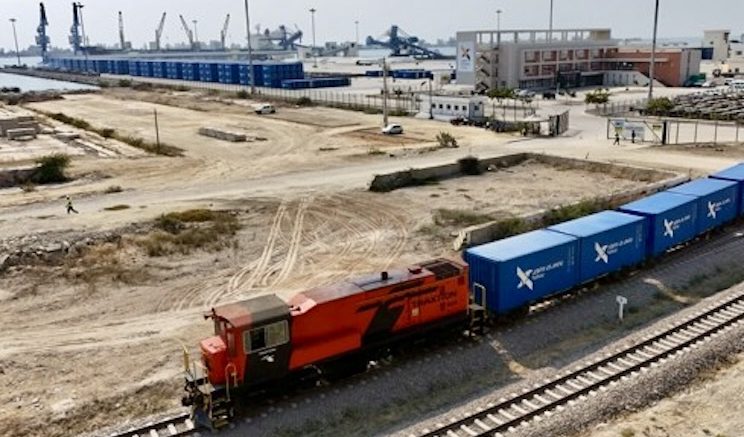
Flooding in Angola has halted rail traffic along the Lobito Corridor, disrupting a key export route for copper and cobalt from Central Africa and raising the prospect of supply bottlenecks for some of the world’s largest mining operations.
Heavy rains caused rivers to overflow their banks and damaged bridges and track near the coastal city of Benguela, forcing the Lobito Atlantic Railway to suspend operations on affected sections “until further notice,” the operator said. “As a result, rail traffic on the affected sections is suspended indefinitely,” the company said in a statement.
The shutdown affects a line that carries copper and cobalt from the Democratic Republic of Congo and Zambia to the Atlantic, while also moving sulphur and other mining inputs inland. Western governments and lenders have backed the Lobito Corridor as a strategic alternative to China-linked infrastructure in a region that accounts for the world’s second-largest concentration of copper production and reserves after Chile.
Companies including First Quantum Minerals (TSX: FM), which runs the Kansanshi and Sentinel mines in Zambia, Barrick Mining (TSX: ABX; NYSE: B), operator of the Lumwana mine, and Ivanhoe Mines (TSX: IVN; US-OTC: IVPAF), which co-owns the Kamoa-Kakula complex in the DRC with China’s Zijin Mining, all rely on export corridors to move concentrate to market.
US investment
Angola’s Lobito Corridor is part of a $2.1-billion effort to upgrade rail and port capacity, anchored by a $553-million loan from the U.S. International Development Finance Corp. and a further $1.6 billion from the African Development Bank and Africa Finance Corp.
It provides a shorter route for copperbelt producers to Atlantic markets and reduces reliance on longer, eastward routes. For miners operating in the Zambian-DRC copperbelt, the outage underscores the fragility of logistics.
The rail link is also critical for inbound supplies. Disruptions to sulphur shipments, a key input for processing copper ores, have already prompted some producers to reassess consumption and consider potential output adjustments, analysts at BMO Capital Markets said on Tuesday.
The setback may revive reliance on alternative export routes, including China-backed rail infrastructure running east through Tanzania to the Indian Ocean. That corridor, while longer, has been a key outlet for some operators and could see increased use if repairs on the Lobito line are prolonged.
Be the first to comment on "Angola flooding closes African copper export route"