
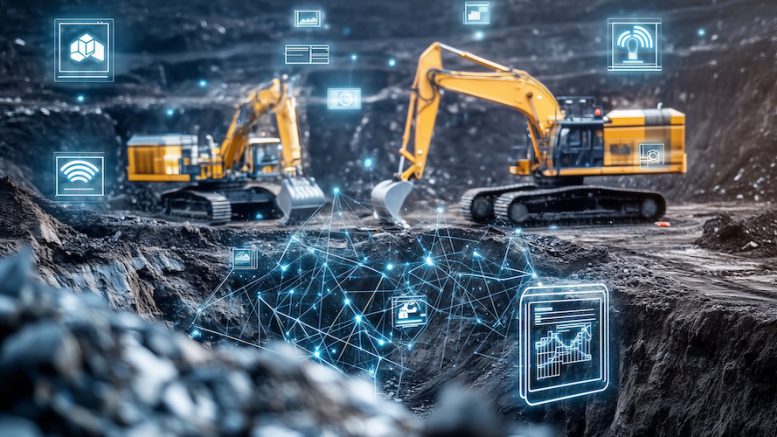
Artificial intelligence is increasingly being promoted across the mining sector as a way to sharpen exploration and improve targeting, but industry executives say most tools deliver modest efficiency gains rather than transformative results.
EY’s 2026 outlook found that 21% of miners plan to increase AI spending by more than 20% over the next year, even as returns remain limited by siloed data and misalignment with business needs. Currently, AI is delivering its most consistent value in data management, quality control and workflow automation, while its impact on mineral prospectivity remains difficult to measure.
Northisle Copper and Gold (TSXV: NCX; US-OTC: NTCPF) is working with Stanford University’s Mineral-X initiative to evaluate AI-based exploration targeting at its North Island copper-gold project on Vancouver Island.
“We are at the very early stages of using AI,” vice-president of exploration Pablo Mejía Herrera said.
The company is drawing on decades of geophysical, geochemical and mapping data – including airborne magnetic and electromagnetic surveys, soil sampling and surface mapping – to assess how these datasets could be integrated for targeting.
“The challenge for any geologist is our understanding is more blurred as we go deeper,” Mejía Herrera told The Northern Miner. “This is where we use AI to establish different risk scenarios and help define good targets.”
Deeper data
Mejía Herrera, who previously worked with Stanford University and Ero Copper (TSX, NYSE: ERO) on AI applications, said the technology performs best when supported by high-quality datasets.
“If you don’t have a good understanding of the chemistry or the rock properties, it’s very hard to use AI,” he said.
Northisle is among a growing number of miners evaluating artificial intelligence in exploration workflows. Nevada Sunrise Metals (TSXV: NEV) is using VRIFY’s AI-assisted mineral discovery platform to help identify new targets at its Griffon Gold Mine in Nevada, while Canterra Minerals (TSXV: CTM) has reported initial AI-driven results from targeting work at its Buchans Project in Newfoundland.
In February, Equinox Gold (TSX, NYSE: EQX) said drilling at its Valentine Gold Mine in Newfoundland confirmed a new AI-supported gold discovery at the Minotaur Zone.
Junior buy-in
Mejía Herrera said AI tools can help exploration teams filter large datasets and focus on the most relevant variables for targeting, making it a key tool for junior companies operating with more limited budgets.
Juniors face stronger pressure to improve targeting efficiency, making AI-based decision-support tools more attractive, Mejía Herrera said. “Bad results are really hard to digest for a junior company.”
AI can function as a sign-off on a target. “In terms of risk, AI is a decision-making tool,” he said.
One barrier to wider adoption is the limited availability of quantitative expertise within exploration teams. Machine-learning systems require statistical and probabilistic modelling skills that are not traditionally embedded in geology-focused organizations, increasing reliance on external partners.
“That’s one of the weaknesses and maybe one of the opportunities – identifying how we start this dialogue with other people in other fields that manage [AI] very well,” he said.
Operational focus
Sebastian Goodfellow, senior director of product and AI at KORE Geosystems, helped develop an AI-powered digital core logging platform for geologists. He said KORE’s strongest demand remains in production and brownfield operations, particularly at mines drilling hundreds of thousands of metres annually, where staffing and consistency issues are common.
In these settings, the company’s Spectre GEO platform uses high-resolution core photography and embedded AI tools to support visual logging and help standardize descriptions and reduce errors across multiple shifts. Companies can spend months reconciling inconsistent datasets. Early error detection can generate measurable savings even without leading directly to new discoveries.
“It’s not an automated system – it’s your name on the data,” Goodfellow said. “But you can significantly speed up what you’re doing.”
KORE launched in 2016 amid rising hype in AI. “A lot of mining companies got burned in that early period and paid a lot of money for some kind of consultant or some product that didn’t deliver,” Goodfellow said. “Now when we engage with these companies, they kind of know what it can and can’t do.”
Variable advantage
Antoine Caté, a structural geologist at SRK Consulting in Toronto who specializes in data science and machine learning, said AI’s value as a tool for core logging, satellite imagery recognition and searching large amounts of data for patterns is well-documented.
“But when you talk about target generation, the value of AI is highly variable,” Caté said. “People are sometimes dubious about it.”
He points to Equinox’s new AI-supported gold discovery. In this case, it’s helping with the discovery process, not making the discovery, he said. “The word ‘help’ or ‘augmenting the human’ is very important there – AI is just a tool that helps with the success, it’s not the entire recipe.”
While Caté said he’s optimistic about AI’s potential in exploration, it needs to be used selectively. “When you have a really good shiny hammer, everything becomes a nail,” he said. “But not everything is a nail.”
Be the first to comment on "AI’s application still clouded by hype"