
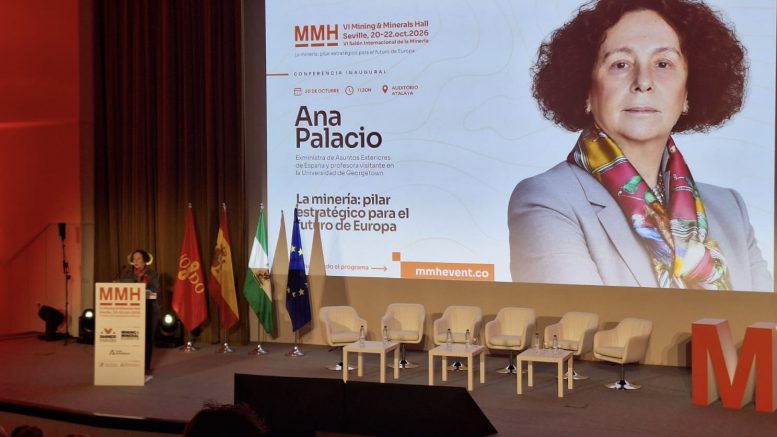
Europe needs to match its critical minerals ambitions with purchase guarantees, public investment and stable policies if it wants companies to build mines and processing plants, speakers told the sixth Mining and Minerals Hall conference in Seville on Tuesday.
The European Union has set 2030 benchmarks for domestic capacity to extract the equivalent of at least 10% of its annual strategic raw materials consumption, process 40% and recycle 25%. Delivering that capacity will require governments to share investment risks and strengthen the industrial chain beyond extraction, panellists said.
“Mining needs stability, and the problem that we have in Europe is that we don’t guarantee stability,” former Spanish foreign minister Ana Palacio said. “We need big pacts, big agreements where everybody commits.”
The challenge extends beyond shortening permit timelines. Europe must make projects commercially attractive while overcoming weak exploration spending, processing limitations and shortages of skilled workers. Otherwise, greater mineral production could leave its dependence on foreign processors largely intact.
The three-day conference, organized by Spanish metallic mining association Aminer and promoted by Andalusia’s regional government, brings together 332 exhibitors and about 100 speakers. It runs through Thursday at Seville’s Fibes conference centre.
Palacio urged Europe to learn from the U.S.’s use of tax credits and purchase guarantees to support strategically important production. European governments also need to strengthen their internal market and make their capital markets more attractive to domestic savers, she said.
“We don’t have easy tools, but the U.S. have all the easiness that Europe doesn’t have,” Palacio said. “Let’s learn from them, truly.”
Washington’s approach includes direct support for prices and customers. MP Materials (NYSE: MP) announced a 10-year price-floor agreement with the U.S. Department of Defense in July 2025 for its neodymium-praseodymium products, alongside an agreement covering magnet purchases from a planned factory.
Europe is developing its own measures. The European Commission’s RESourceEU plan, announced in December, proposed a critical raw materials centre to help coordinate investment and secure supplies, alongside joint purchasing and offtake agreements.
Andalusian President Juan Manuel Moreno Bonilla highlighted two projects designated strategic by the European Commission during the opening ceremony: Atlantic Copper’s newly launched CirCular electronics-recycling plant and Cobre Las Cruces’ planned polymetallic development. Both form part of the region’s effort to capture more value through processing and recycling alongside extraction.
Public authorities must change the investment equation where markets won’t shoulder the risks, Mark Rachovides, president emeritus of European mining industry association Euromines, said.
“Sometimes we need to use that dirty word subsidies. That’s what the Americans are doing,” he said. “They are subsidizing their producers for long-term gain.”
Beyond permits
Spain’s deputy director general for mines, Daniel Torrejón Braojos, cautioned that legislation cannot quickly deliver projects that require years of exploration, engineering and investment.
“Mining projects need time because they have long periods of maturing,” he said. “There’s no magical solution from one day to the other. You cannot open a mine.”
Torrejón challenged the idea that permitting alone explains Europe’s limited mining development. Governments also need exploration programs that improve knowledge of their resources and encourage companies to pursue discoveries.
The European Commission’s 2023 impact assessment found that the EU accounted for only about 2% to 3% of worldwide exploration expenditure between 2010 and 2022. It also identified energy costs as a key factor determining where processing and refining take place.
Torrejón pointed to another weakness: producing copper concentrate in Spain does not ensure the country captures the subsequent processing business. Technologies that allow complex concentrates to be treated domestically are also needed, he said.
Andalusia’s mining director general, Jesús Portillo García-Pintos, said regional authorities could contribute through geological research, data sharing and better coordination with national governments. But regional efforts to accelerate approvals remain constrained by national and European legislation.
Europe also needs to recognize the limits of its mineral endowment and maintain strong trading relationships, he said.
“Europe has what it has. We don’t have more than what we have,” Portillo said. “That’s important to be aware of.”
Chile’s Mining Chamber President Manuel Viera offered a similar warning from an established producing country.
“Having a resource doesn’t guarantee that we have the value chain,” he said.
Declining copper grades require more material to be processed, increasing costs and the need for technology, Viera said. He encouraged partnerships between Chilean resource owners and European processing and technology companies.
Old waste, new metals
Europe could also recover more materials from historical mining and industrial sites, Rachovides said. Modern processes can extract metals that earlier operators did not value or could not recover economically.
“You can also use technology today, which wasn’t available in the past, to get better extraction from materials,” he said. “So that means, for example, remining an old copper site, remining an old polymetallic site to extract things that weren’t valued at the time.”
Such projects could combine production with rehabilitation and employment, but still need a viable investment case, he said.
Public acceptance also requires more than explaining the demand for metals. Communities need confidence in how projects operate, Portillo said.
“Trust can only be based on transparency,” he said. “Society will trust us if we are sufficiently transparent to show what we do, why we do it, and how we do it.”
Be the first to comment on "Seville panel: Europe must match US mining support"