
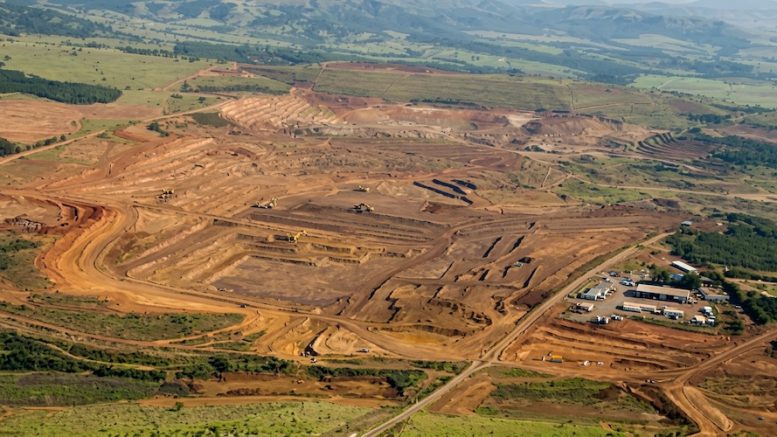
Gold Mountain (ASX: GMN) is weighing the revival of a Brazilian tungsten mine that began during the Second World War after securing a 12-month exclusive right to acquire the property as Western governments scramble to diversify supplies of the strategic metal.
The Australian explorer has paid 1 million reais (C$284,000) for the right to acquire the 858-hectare Malhada do Angico property in northeastern Brazil’s Seridó Tungsten Province, according to an Oct. 5 announcement. A further 2 million reais would be payable if the transaction proceeds and receives regulatory approvals.
“GMN is excited by this tungsten opportunity, which I recently visited,” executive director David Evans said in the release. “We are fast tracking the exploration program and will commence drilling as soon as the necessary permits are obtained.”
The potential acquisition would expand Gold Mountain’s position in one of South America’s established tungsten-producing districts as China tightens control over exports and Western governments seek alternative sources for defence and industrial applications.
Gold Mountain shares closed 3.6% stronger at A5.7¢ in Sydney on Thursday. The stock has traded between A4.5¢ and A18.5¢ over the past year. Its market capitalization is A$16.7 million (C$16.5 million).
Historical workings
Malhada do Angico, about 10 km from Parelhas in Rio Grande do Norte state, began producing tungsten in 1942 and operated until 1982, according to a 1995 Brazilian mining engineering dissertation. The operation was sold to Companhia Industrial Fluminense in 1977, five years before its closure.
The operation extracted scheelite-bearing rock, a source of tungsten, from deposits formed where mineral-rich fluids altered surrounding rocks. The project lies within the Jucurutu Formation, which hosts several tungsten deposits, including the producing Brejuí mine, about 47 km north of Gold Mountain’s adjoining Logradouro tenements.
Gold Mountain has identified about 2 km of tungsten-bearing geological formations associated with the main historical workings, with another 2 km identified farther east. The company plans to test whether mineralization continues beneath the old workings.
Three rock-chip samples collected from Gold Mountain’s adjoining ground, mainly 300 to 600 metres along strike from Malhada do Angico, returned tungsten values exceeding the laboratory’s upper analytical limit of 10,000 parts per million, equivalent to more than 1.26% tungsten trioxide. The grab samples indicate mineralization but aren’t representative of the deposit’s overall grade.
The company has begun auger drilling of historical tailings to determine their grade and thickness and obtain samples for metallurgical testing. A separate diamond drilling program, awaiting permits, will test about 2 km of strike to depths of approximately 120 metres.
Gold Mountain is conducting technical, legal and regulatory due diligence before deciding whether to complete the acquisition. The mining application remains subject to a decision by Brazil’s National Mining Agency on an exploration report submitted in 2016.
Supply concerns
Tungsten is used in armour-piercing ammunition, cutting tools and high-temperature industrial components. Its strategic importance has grown as China, the dominant producer, has imposed export restrictions and Western governments have sought to reduce their dependence on Chinese supplies.
Tungsten prices have risen sharply amid constrained supplies and years of underinvestment, with BMO Capital Markets warning in February of a potential global shortage.
The European Union has also considered stockpiling tungsten, while the U.S. Department of Defense has committed $150 million to support the restart of Blue Moon Metals’ (TSXV: MOON; Nasdaq: BMM) Springer tungsten complex in Nevada.
For Gold Mountain, the immediate task is to establish whether the historical workings and tailings contain sufficient recoverable tungsten to justify further development. The company has yet to establish a mineral resource at Malhada do Angico or demonstrate the economic viability of restarting production.
Be the first to comment on "Gold Mountain targets WWII tungsten mine in Brazil"