
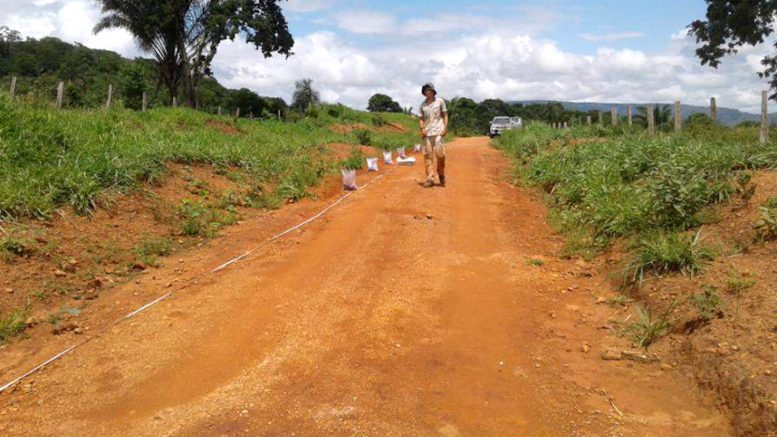
BOCA RATON, Fla. – Lara Exploration (TSXV: LRA; US-OTC: LRAXF) has seven rigs turning at its Planalto copper-gold project in Brazil, a 14,000-metre test of whether the Carajás discovery can support a mine value far above the company’s market worth.
The Vancouver-based explorer says the Pará state project, about 680 km southeast of Belém, the state capital, could produce 36,000 tonnes copper a year in its first six years under an 8-million-tonne-a-year open-pit plan. A November preliminary economic assessment (PEA) gave Planalto a net present value of $378 million (C$536.8 million) after tax, while Lara’s January spot-price case study raised that figure to $1.2 billion.
“Simple projects move faster. Simple projects get built because they’re not complicated,” CEO Simon Ingram told investors during a lunch presentation at the Rule Symposium. “This project has the opportunity to be built and I think it has even more value because of that.”
Major copper producers need projects that can reach the development queue before aging mines lose grade, but many new deposits sit far from roads, power and workers or face long permitting fights. Planalto gives Lara a better offering: a moderate-grade deposit in a working mining belt, on cleared ranch land, with a mine plan that could draw a builder before the company has to finance construction itself.
Lara’s Toronto-listed shares more than doubled over the past 12 months, adding 3% Wednesday to C$4.06. That gives it a market capitalization of C$251.7 million.
Carajás edge
Planalto lies in one of Brazil’s main mining districts, about 30 km from the mining town of Canaã dos Carajás and 45 km from Parauapebas, a regional mining centre. Vale (NYSE: VALE) runs the Sossego copper mine about 32 km away and owns the Cristalino deposit about 10 km from Lara’s ground. BHP (NYSE, LSE, ASX: BHP) previously owned the Pedra Branca and Antas North copper assets nearby before selling them to privately held conglomerate CoreX Holding.
Existing infrastructure is central to Lara’s development proposal. The PA-160 state highway and high-tension power lines run within 4 km of the proposed mine site. The land is private farmland, not rainforest, and the surrounding towns already supply miners, mechanics, contractors and other workers to Vale, BHP and other operators.
The PEA outlined an 18-year mine producing 560,000 tonnes copper and 111,000 oz. gold over its life. Initial capital spending stands at $546 million, with a 3.5-year payback from the start of production.
Planalto is to produce about 120,000 tonnes of clean chalcopyrite concentrate a year grading 28% copper. Lara says the concentrate carries no arsenic, an advantage in a district where some copper deposits contain impurities that can draw smelter penalties.
Resource work
Planalto holds 47.7 million indicated tonnes grading 0.53% copper and 0.06 gram gold per tonne for 253,000 tonnes copper and 92,000 oz. gold. Inferred resources add 154 million tonnes at 0.36% copper and 0.04 gram gold for 549,000 tonnes copper and 224,000 oz. gold.
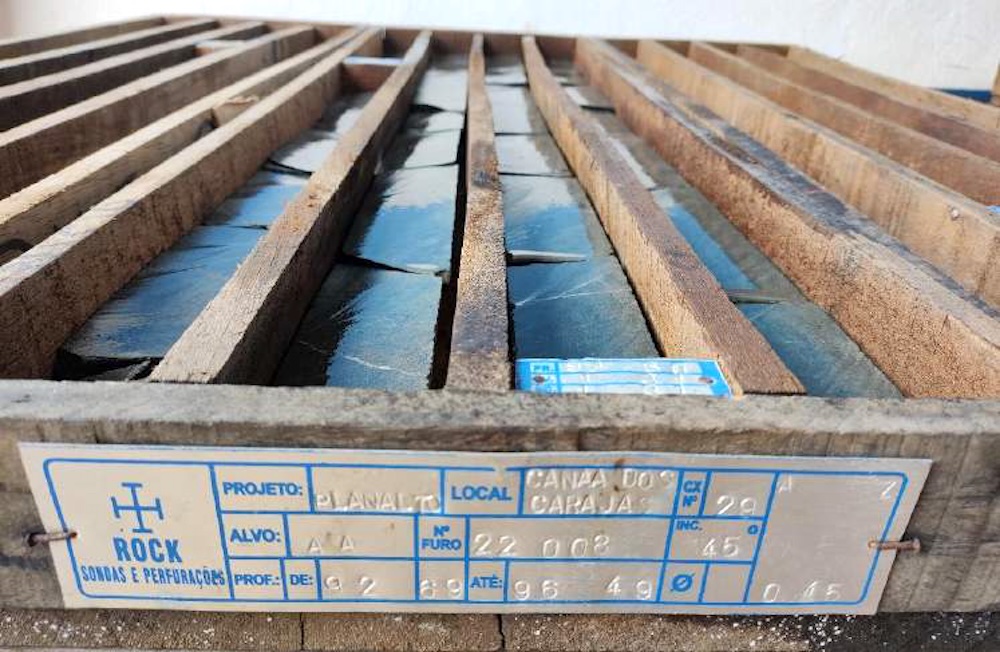
A Planalto drill core box with aluminum plate identification and run markers. Credit: GE21
Lara’s current 14,000-metre drill program aims to move more material in the planned pit into the measured and indicated categories. The company is also testing a higher-grade core at Cupuzeiro and targets along the Silica Cap trend, where Ingram says higher-grade feed could improve early cash flow.
Lara has said it sees strong chalcopyrite mineralization in new drill core, but the assays feeding into the next resource update must show whether the higher-grade zones are broad and continuous enough to change the mine plan.
Buyer question
Atalaya Mining Copper (LSE: ATYM) gave Lara a strategic endorsement in April when it bought 4.5 million shares for $13.5 million. The Spanish copper producer runs the Riotinto complex in southwest Spain, an open-pit operation with a 15-million-tonne-a-year plant and a grade profile close enough to Planalto to make its investment appear more than a passive bet.
Lara does not present itself as the likely builder. Its management team made its name through Reservoir Minerals, which discovered the Čukaru Peki copper-gold deposit in Serbia with Freeport-McMoRan (NYSE: FCX), then sold the company to Nevsun Resources for $512 million in 2016. China’s Zijin Mining Group later bought Nevsun and put Čukaru Peki into production.
Early stage
Planalto still has no reserves. The study remains preliminary and includes inferred resources that require more drilling before they can support a reserve. Lara must complete higher-level engineering, convert resources, file environmental applications and secure licences before any builder can make a construction decision.
Ingram expects permitting to set the pace. It is gathering wet- and dry-season baseline data, including studies on water, wildlife, dust, noise and local health conditions, before filing an environmental impact study. Ingram said Pará’s state-level process gives Lara a clear path, helped by recent mine approvals in the district.
The next test is whether Lara can close the gap between Planalto’s study value and its own market value without losing the leverage that makes the story compelling, Ingram said. The drill core, permit filing and Atalaya’s next move will show whether Planalto becomes a mine a buyer can price, or another junior copper study waiting for capital.
“If you drill, it’s a truth machine,” Ingram said. “You find out what’s really there.”
Be the first to comment on "Rule Summit: Lara drills Planalto toward $1B Brazil copper test"